Question
Calculate weighted index number for 2018 by Weighted Aggregative Method and Weighted Average of Relative Method for the following data:
Item Weight Prices in 2017 Prices in 2018
A 10 100 161
B 7 200 210
C 15 50 60
D 9 20 30
E 10 10 14

Answer

Item Weight $p_0$ $p_1$ $p_0W$ $p_1W$ $\text{R}=\frac{\text{p}_1}{\text{p}_0}\times100$ WR
A 10 100 161 1000 1610 161 1610
B 7 200 210 1400 1470 105 735
C 15 50 60 750 900 120 1800
D 9 20 30 180 270 150 1350
E 10 10 14 100 140 140 1400
  $\Sigma\text{W}=51$     $\Sigma\text{p}_0\text{W}=3430$ $\Sigma\text{p}_1\text{W}=4390$   $\Sigma\text{WR}=6895$
Weighted Aggregative Methode:
$\text{P}_{01}=\frac{\Sigma\text{p}_1\text{W}}{\Sigma\text{p}_0\text{W}}\times100=\frac{4390}{3430}\times100=127.98$
Weighted Average of Price Method:
$\text{p}_{01}=\frac{\Sigma\text{WR}}{\Sigma\text{W}}=\frac{6895}{51}=135.19$

Need a full question paper?

Generate a complete, print-ready paper with questions like this in minutes — across 16+ boards, with answer keys.

Start Generating Free

Similar questions

Which measure of dispersion is the best and how?
In the previous question, calculate the relative measures of variation and indicate the value which, in your opinion, is more reliable.
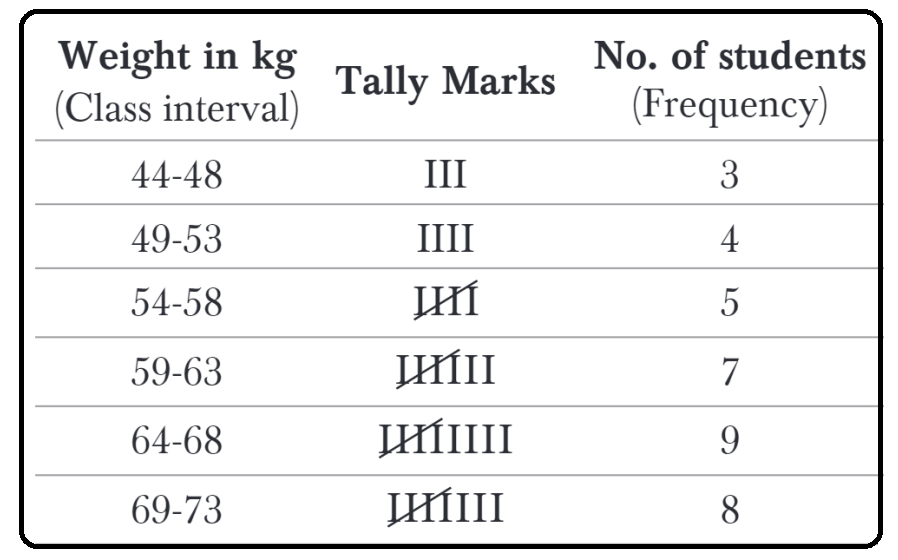
Direction Read the following case study table carefully and answer questions 1 to 5 on the basis of the same.
  1. The above series is an example of ..... series.
  1. Inclusive
  2. Exclusive
  3. Both (a) and (b)
  4. Neither (a) nor (b)
  1. The above situation shows which of the following types of presentation of data?
  1. Chronological classification
  2. Spatial classification
  3. Qualitative classification
  4. Quantitative classification
  1. What is the percentage of students having weight more than 63 kgs?
  1. 43.25%
  2. 47.22%
  3. 51.63%
  4. 62.32%
  1. How many students have weight less then 58 kgs?
  1. 12
  2. 15
  3. 7
  4. 10
  1. Variable which doesn't take integral values is known as .....
  1. Individual series
  2. Discrete series
  3. Continuous series
  4. None of the above
Explain different types of frequency curves with an example.
Compute Mean Deviation from the following data:
X 0-20 20-40 40-60 60-80 80-100 100-120
f 5 50 84 32 10 6
Construct index number of 2015 from the given data by the simple aggregative method and the simple average of relative method.
Commodity
A
B
C
D
E
F
Price In 2015 (₹)
10
18
16
14
12
17
Price in 2010 (₹)
8
15
12
10
8
12.5
Calculate Karl Pearson's coefficient of correlation by actual mean method:
Find out the arithmetic mean using the step deviation method.
Item
Frequency
More than 0
28
More than 10
24
More than 20
14
More than 30
4
Hint: In the above problem, cumulative frequencies are given. Firstly, it will be changed into exclusive class interval and thereafter we will calculate arithmetic mean using the step deviation method.
Explain the factors that shift the demand curve to the right.
Explain important terms related to a frequency distribution.