Question
Can a process on an ideal gas be both adiabatic and isothermal?

Answer

No,
In a system either temperature varies or it heat varies.
In case of ideal gas Internal energy is function of temperature only thus for isothermal process change in internal energy is zero.
Now, since process is adiabatic thus heat exchange is zero.
therefore, work done is also zero.

Need a full question paper?

Generate a complete, print-ready paper with questions like this in minutes — across 16+ boards, with answer keys.
Start Generating Free

Similar questions

A book is lifted from the floor and is kept in an almirah. One person says that the potential energy of the book is increased by 20J and the other says it is increased by 30J. Is one of them necessarily wrong?
A convex lens of focal length 25 cm is placed coaxially in contact with a concave lens of focal length 20 cm. Determine the power of the combination. Will the system be converging or diverging in nature?
The electric current existing in a discharge tube is $2.0\mu\text{A}.$ How much charge is transferred across a cross-section of the tube in 5 minutes?
The frequency ν of incident radiation is greater than threshold frequency (ν0) in a photocell. How will the stopping potential vary if frequency (ν) is increased, keeping other factors constant?
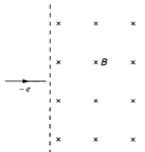
a. An electron moving horizontally with a velocity of $4 \times 10^4 m / s$ enters a region of uniform magnetic field of $10^{-5} T$ acting vertically upward as shown in the figure. Draw its trajectory and find out the time it takes to

Image

b. A straight wire of mass 200 g and length 1.5 m carries a current of 2 A. It is suspended in mid air by a uniform magnetic field B. What is the magnitude of the magnetic field?
You are facing a circular wire carrying an electric current. The current is clockwise as seen by you. Is the field at the centre coming towards you or going away from you?
A small metal sphere with $+Q$ charge is placed in the cavity of a larger uncharged metal sphere. As shown in the Fig. Find the value of electric field intensity at point $P_1$ and $P_2$ from Gauss's law.
Find the angular separation between the consecutive bright fringes in a Young's double slit experiment with blue-green light of wavelength 500nm. The separation between the slits is 2.0 × 10⁻³m.
A 12 pF capacitor is connected to a 50V battery. How much electrostatic energy is lost in the capacitor?
Unpolarised light is passed through a polaroid P1. When this polarised beam passes through another polaroid P2 and if the pass axis of P2 makes angle $\theta$ with the pass axis of P1, then write the expression for the polarised beam passing through P2. Draw a plot showing the variation of intensity when $\theta$ varies from 0 to $2\pi$.