Question
Find the angular separation between the consecutive bright fringes in a Young's double slit experiment with blue-green light of wavelength 500nm. The separation between the slits is 2.0 × 10⁻³m.
Answer

Given that, $\lambda=500\text{nm}=500\times10^{-9}\text{m}$ and d = 2 × 10⁻³m

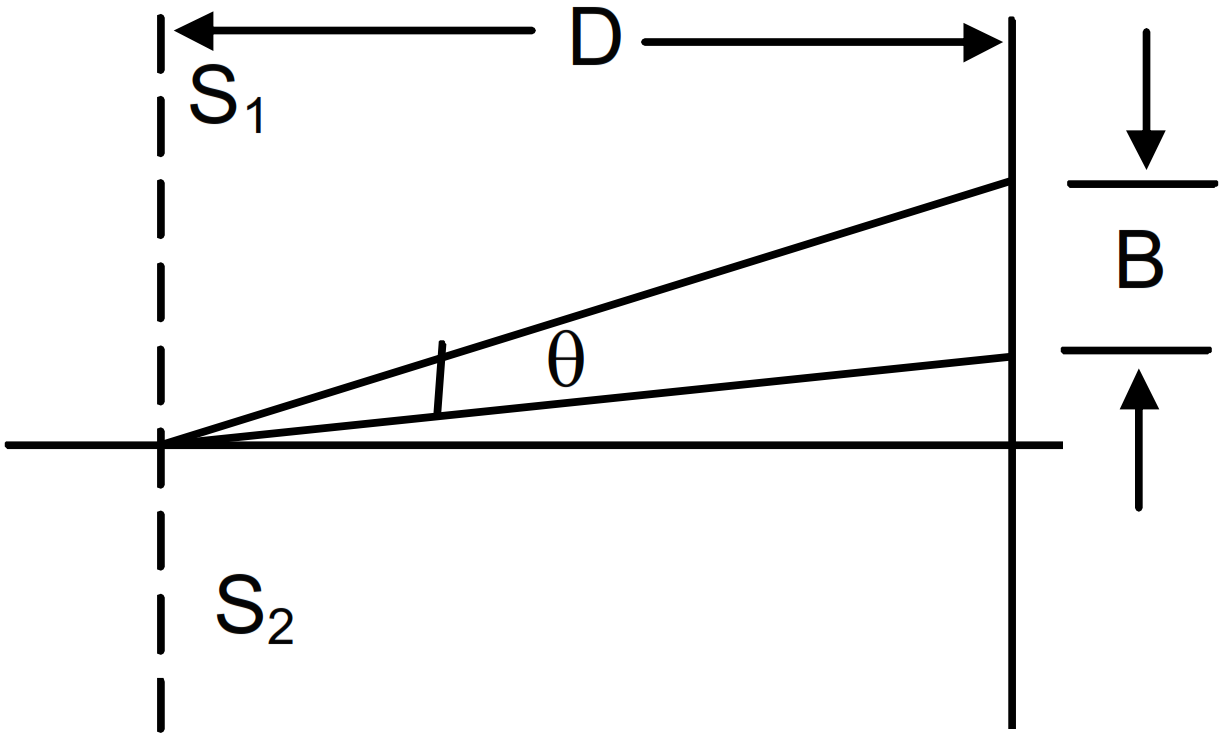
As shown in the figure, angular separation $\theta=\frac{\beta}{\text{D}}=\frac{\lambda\text{D}}{\text{dD}}=\frac{\lambda}{\text{d}}$
So, $\theta=\frac{\beta}{\text{D}}=\frac{\lambda}{\text{d}}=\frac{500\times10^{-9}}{2\times10^{-3}}=250\times10^{-6}$
= 25 × 10-5 radian = 0.014 degree.

Need a full question paper?

Generate a complete, print-ready paper with questions like this in minutes — across 16+ boards, with answer keys.

Start Generating Free

Similar questions

The coil of a moving-coil galvanometer keeps on oscillating for a long time if it is deflected and released. If the ends of the coil are connected together, the oscillation stops at once. Explain
An optical fibre $(\mu=1.72)$ is surrounded by a glass coating $(\mu=1.50).$ Find the critical angle for total internal/ reflection at the fibre-glass interface.
In how many ways the continuous charges are distributed?
Give a physical explanation of the fact that the potential energy of a positive charge coupled is positive.
A radioactive nucleus ‘A’ undergoes a series of decays according to the following scheme:

$\text{A} - \xrightarrow{a}\text{A}_{1} \xrightarrow{\beta}\text{A}_{2}\xrightarrow{\alpha}\text{A}_{3}\xrightarrow{\gamma}\text{A}_{4}$

The mass number and atomic number of A are 180 and 72 respectively. What are these numbers for A4?

Answer the following question:
The refractive index of diamond is much greater than that of ordinary glass. Is this fact of some use to a diamond cutter?
A particle executes simple harmonic motion with an amplitude of 10cm. At what distance from the mean position are the kinetic and potential energies equal?
Write the shortcomings of Rutherford atomic model. Explain how these were overcome by the postulates of Bohr's atomic model.
Derive $D_m=A\left(n_{21}-1\right)$ for thin lens.
The masses of 11C and 11B are respectively 11.0114u and 11.0093u. Find the maximum energy a positron can have in the $\beta^+$-decay of 11C to 11B.