Question
Can static friction do nonzero work on an object? If yes, give an example. If no, give reason.

Answer

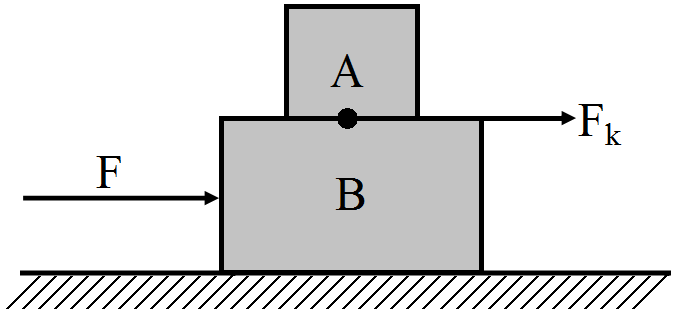
Yes. Let us consider a block A which is resting on another block B. Block B is resting on a smooth horizontal surface. Let the coefficient of kinetic friction between the blocks be $\mu\text{k}.$

When a force is applied on block B in the forward direction as shown in the above figure, block A moves with block B in the direction of the applied force. The friction force on block A and the displacement will be in the forward direction. Therefore, work done by the friction force is positive. In this case, block A will remain in contact with block B. This shows that static friction is doing a nonzero work on an object.

Need a full question paper?

Generate a complete, print-ready paper with questions like this in minutes — across 16+ boards, with answer keys.
Start Generating Free

Similar questions

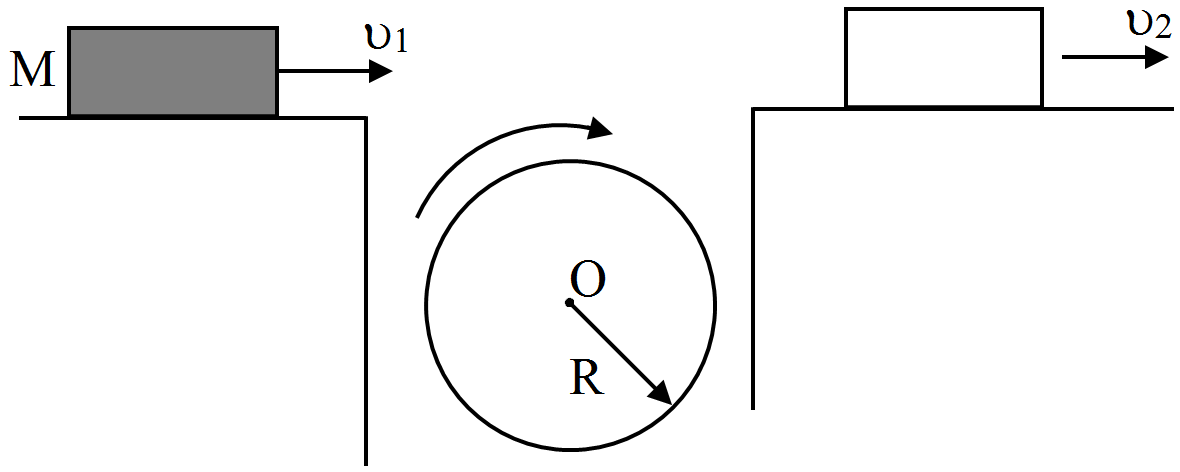
A block of mass M is moving with a velocity v1 on a frictionless surface as shown in fig. It passes over to a cylinder of radius R and moment of inertia I which has fixed axis and is initially at rest. When it first makes contact with the cylinder, it slips on the cylinder, but the friction is large enough so that slipping ceases before it losses contact with the cylinder. Finally it goes to the dotted position with velocity v2 compute v2 in terms of v1, M, I and R.

Find the expression for time period of motion of a body suspended by two springs connected in parallel and series.
The electric field in a region is given by $\overrightarrow{\text{E}}=\frac{\text{E}_0\text{x}}{\text{l}}\vec{\text{i}}.$ Find the charge contained inside a cubical volume bounded by the surfaces x = 0, x = a, y = 0, y = a, z = 0 and z = a. Take E0 = 5 × 10³Nc-1, l = 2cm and a = 1cm.
Estimate the average thermal energy of a helium atom at:
  1. Room temperature (27°C)
  2. The temperature on the surface of the Sun(6000K)
  3. The temperature of 10 million kelvin (the typical core temperature in the case of a star).
A metal ball of mass 1kg is heated by means of a 20W heater in a room at 20°C. The temperature of the ball becomes steady at 50°C.
  1. Find the rate of loss of heat to the surrounding when the ball is at 50°C.
  2. Assuming Newton's law of cooling, calculate the rate of loss of heat to the surrounding when the ball is at 30°C.
  3. Assume that the temperature of the ball rises uniformly from 20°c to 30°C in 5 minutes. Find the total loss of heat to the surrounding during this period.
  4. Calculate the specific heat capacity of the metal.
What is a conservative force? Prove that gravitational force is conservative, while frictional force is non-conservative.
Taking an example of angular simple harmonic motion, establish an expression for the time period of the oscillator.
Two identical steel cubes (masses 50g, side 1cm) collide head-on face to face with a speed of 10cm/ s each. Find the maximum compression of each. Young’s modulus for steel = Y = 2 × 10¹¹ N/ m2.
Io, one of the satellites of Jupiter, has an orbital period of 1.769 days and the radius of the orbit is 4.22 × 10⁸m. Show that the mass of Jupiter is about one-thousandth that of the sun.
Suppose the smaller pulley of the previous problem has its radius 5.0cm and moment of inertia 0.10kg-m2. Find the tension in the part of the string joining the pulleys.