Question
What is a conservative force? Prove that gravitational force is conservative, while frictional force is non-conservative.

Answer

Conservative force : The work done against or by the force in moving a body depends only on initial and final positions of body and not on nature of path followed. For example, gravitational force is a conservative force.


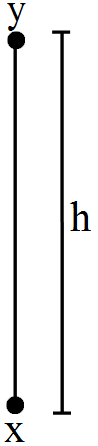
Consider a body of mass 'm' to be moved to height ‘h’ over different paths from x to y.
In Mass is being raised vertically upwards along direction of force applied.
Work done = Force x distance
W1 = mg x h
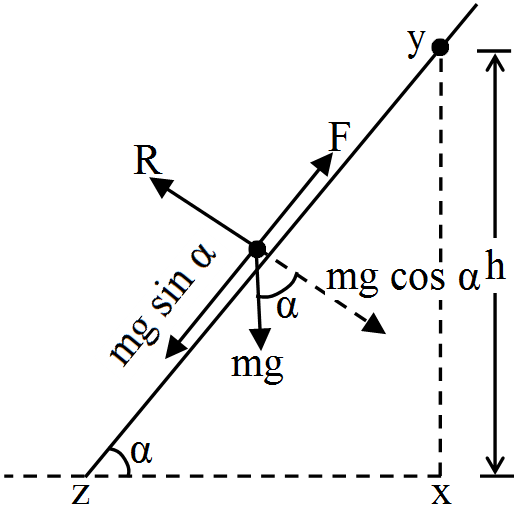
In Mass 'm' is taken along a smooth inclined plane yz of height 'h' and inclination a.
Work done = F × yz
W2 = mg sin a × yz
$=\text{mg}\Big(\frac{\text{xy}}{\text{yz}}\Big)\times\text{yz}$
(F = mg sina as sine component contributes to applied force)
W2 = mgh
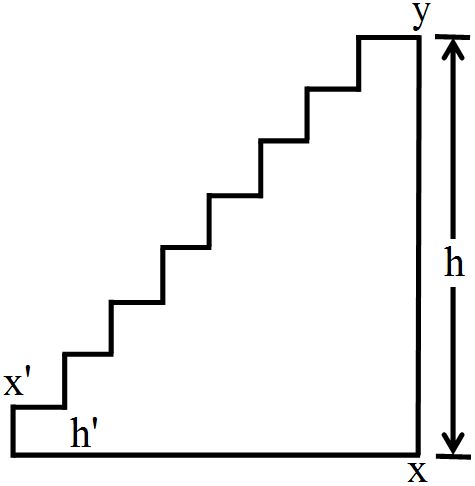
In Mass ‘m' is taken to height 'h' through a staircase having ‘n’ number of steps. Each step has height h' and width x' so work done in carrying the mass through horizontal distance $\text{x}'=\text{mg}\cos90^\circ=0$ and through vertical distance h' = mgh'.
Hence total work done in n steps is W3 = mgh' × n = mgh
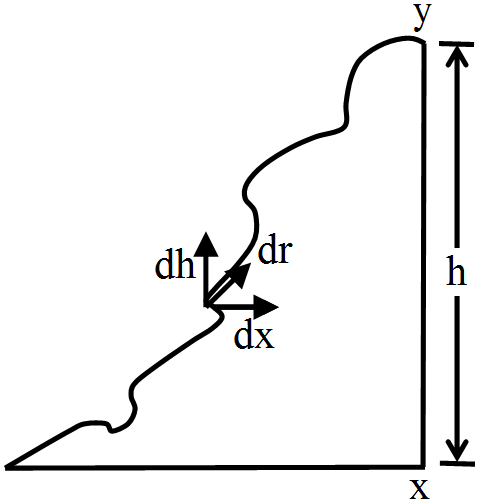
In Mass ‘m’is carried to height-h’ in a zig-zag path. Zig-zag path can be divided into infinitesimally small steps of horizontal displacement dx and vertical displacement dh. As the work done along any horizontal displacement is zero. Total work done along all vertical paths will add up $\text{W}_4=\Sigma(\text{dh)}=\text{mgh}$
Thus $\text{W}_1=\text{W}_2=\text{W}_3=\text{W}_4=\text{mgh}$
$\therefore$ Whatever is the path followed to go from X to Y work done is the same. This shows that gravitational force is a conservative force.

Need a full question paper?

Generate a complete, print-ready paper with questions like this in minutes — across 16+ boards, with answer keys.
Start Generating Free

Similar questions

Consider the situation of the previous problem.
  1. Calculate the force needed to keep the sliding wire moving with a constant velocity v.
  2. If the force needed just after t = 0 is F0, find the time at which the force needed will be $\frac{\text{F}_0}{2}.$
The coefficient of volume expansion of glycerine is $49 \times 10^{-5} K^{-1}$. What is the fractional change in its density for a $30^{\circ} C$ rise in temperature?
A simple pendulum with a brass bob has a time period T. The bob is now immersed in a non-viscous liquid and oscillated. If the density of the liquid is $\frac{1}{9}$ that of brass, find the time of the same pendulum.
An air chamber of volume $V$ has a neck of the area of cross-section $A$ into which a ball of mass $m$ can move without friction. Show that when the ball is pressed down through some distance and released, the ball executes SHM. Obtain the formula for the time period of this SHM, assuming pressure-volume variations of the air to be
i. isothermal and
ii. adiabatic.
Define impulse and establish its relation with momentum change. Explain the importance of impulse. Or Define impulse of a force and prove that the impulse of a force on a body is equal to change in momentum. Or State the momentum impulse theorem. Explain its physical importance with examples.
  1. What are beats? Name the basic phenomenon due to which beats are produced.
  2. Two sources of sound are producing waves of frequency n1 and n2, where (n1 - n2) is small, show mathematically that the beat frequency is (n1 - n2).
What is the principle of superposition? On what factors frequency and amplitude of the resultant wave depend? What effect can be produced by the superposi- tion of two sound waves? Exaplain interference of sound wave and analyze it mathematically.
Figure shows a smooth track which consists of a straight inclined part of length 1 joining smoothly with the circular part. A particle of mass m is projected up the incline from its bottom.
  1. Find the minimum projection-speed v0, for which the particle reaches the top of the track.
  2. Assuming that the projection-speed is 2v0 and that the block does not lose contact with the track before reaching its top, find the force acting on it when it reaches the top.
  3. Assuming that the projection-speed is only slightly greater than v0, where will the block lose contact with the track?
Describe the working of Carnot engine. Obtain an expression for its efficiency.
Electrons emitted with negligible speed from an electron gun are accelerated through a potential difference V along the x-axis. These electrons emerge from a narrow hole into a uniform magnetic field B directed along this axis. However, some of the electrons emerging from the hole make slightly divergent angles, as shown in the figure. Show that these paraxial electrons are refocussed on the x-axis at a distance $\sqrt{\frac{8\pi^2\text{mV}}{\text{eB}^2}}.$