Question
Can the potential difference across a battery be greater than its emf?

Answer

In general potential difference can be equal or less than the emf.
E.m.f can never exceed the potential difference.
If the emf of a battery is E Volt, the potential difference across a battery is given by,
V = E - I r where I is the current in the circuit and r is the internal resistance.

Need a full question paper?

Generate a complete, print-ready paper with questions like this in minutes — across 16+ boards, with answer keys.
Start Generating Free

Similar questions

A 1cm object is placed perpendicular to the principal axis of a convex mirror of focal length 7.5cm. Find its distance from the mirror if the image formed is 0.6cm in size.
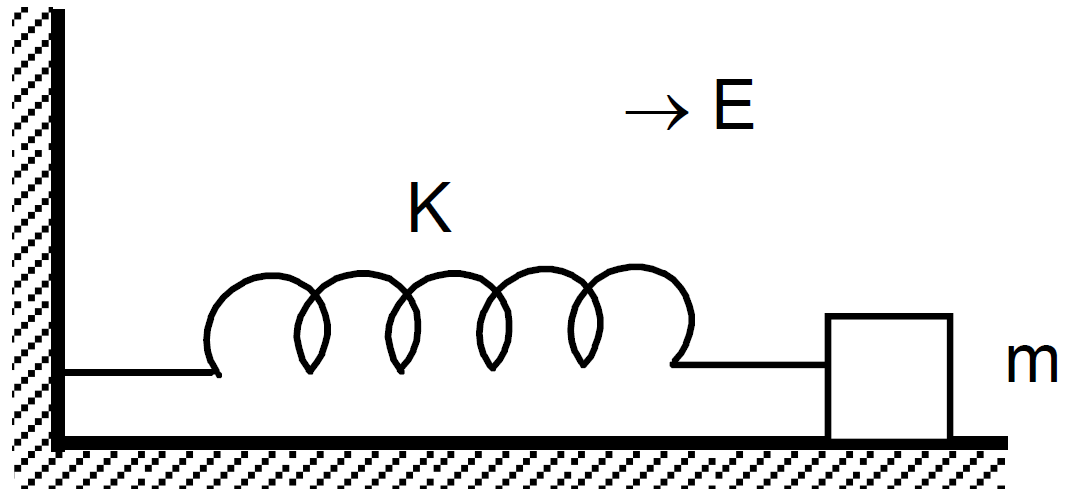
A block of mass m having a charge q is placed on a smooth horizontal table and is connected to a wall through an unstressed spring of spring constant k as shown in figure. A horizontal electric field E parallel to the spring is switched on. Find the amplitude of the resulting SHM of the block.
The radii of curvature of the faces of a double convex lens are 10 cm and 15 cm. If focal length of the lens is 12 cm, find the refractive index of the material of the lens.
Why do stable nuclei never have more protons than neutrons?
Suppose $\vec{\text{a}}$ is a vector of magnitude 4.5 unit due north. What is the vector:
  1. $3\vec{\text{a}}$
  2. $-4 \ \vec{\text{a}}?$
Explain in short about electric dipole.
A plate of thickness t made of a material of refractive index $\mu$ is placed in front of one of the slits in a double slit experiment.
  1. Find the change in the optical path due to introduction of the plate.
  2. What should be the minimum thickness t which will make the intensity at the centre of the fringe pattern zero? Wavelength of the light used is $\lambda$. Neglect any absorption of light in the plate.
Calculate the de-Broglie wavelength associated with an electron accelerated by a potential difference of 400 volt.
Write down the expression (equation) to find the distance of $n^{\text {th }}$ bright fringe and $n^{\text {th }}$ dark fringe from the central maximum.
Give brief explanation of modern solid state semi-conductor electronics.