MCQ
Can the resultant of $2$ vectors be zero
  • A
    Yes, when the $2$ vectors are same in magnitude and direction
  • B
    No
  • Yes, when the $2$ vectors are same in magnitude but opposite in sense
  • D
    Yes, when the $2$ vectors are same in magnitude making an angle of $\frac{{2\pi }}{3}$ with each other
Answer

Correct option: C.
Yes, when the $2$ vectors are same in magnitude but opposite in sense
c
Yes, when the $2$ vectors are same in magnitude but opposite in sense

Need a full question paper?

Generate a complete, print-ready paper with questions like this in minutes — across 16+ boards, with answer keys.

Start Generating Free

Similar questions

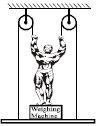
A man uses two pulleys to raise himself with an acceleration $2\,m/s^2$, as in figure. Man stands on a light weighing machine fitted on horizontal platform. Determine the  reading of weighing machine. Mass of man $= 75\, kg,$ mass of platform $= 25\, kg.$  ............ $N$
A uniform ring of radius $R$ is moving on a horizontal surface with speed $v$, then climbs up a ramp of inclination $30^{\circ}$ to a height $h$. There is no slipping in the entire motion. Then, $h$ is
A body of mass $5\ kg$ undergoes a change in speed from $30$ to $40\ m/ s.$ Its momentum would increase by:
The sum of the numbers $436.32, 227.2$ and $0.301$ in appropriate significant figures is:
A stone ties to the end of a string $1\,m$ long is whirled in a horizontal circle with a constant speed. If the stone makes $22$ revolution in $44$ seconds, what is the magnitude and direction of acceleration of the stone
Which statement is incorrect?
If opened door of a refrigerator in working condition kept in an insulated room:
Moment of inertia of uniform rod of mass $M$ and length $L$ about an axis through its centre and perpendicular to its length is given by $\frac{{M{L^2}}}{{12}}$. Now consider one such rod pivoted at its centre, free to rotate in a vertical plane. The rod is at rest in the vertical position. A bullet of mass $M$ moving horizontally at a speed $v$ strikes and embedded in one end of the rod. The angular velocity of the rod just after the collision will be
The direction of the angular velocity vector along
The distance between the vertex and the centre of mass of a uniform solid planar circular segment of angular size $\theta$ and radius $R$ is given by