MCQ 11 Mark
If $\overrightarrow{ F }=2 \hat{ i }+\hat{ j }-\hat{ k }$ and $\overrightarrow{ r }=3 \hat{ i }+2 \hat{ j }-2 \hat{ k }$, then the scalar and vector products of $\overrightarrow{ F }$ and $\overrightarrow{ r }$ have the magnitudes respectively as
- A
$5, \sqrt{3}$
- B
$4, \sqrt{5}$
- ✓
$10, \sqrt{2}$
- D
$10,2$
AnswerCorrect option: C. $10, \sqrt{2}$
c
$\overrightarrow{ F }=2 \hat{ i }+\hat{ j }-\hat{ k }$ $\quad \overrightarrow{ r }=3 \hat{ i }+2 \hat{ j }-2 \hat{ k }$
$\overrightarrow{ F } \cdot \overrightarrow{ r }=6+2+2=10$
$\overrightarrow{ F } \times \overrightarrow{ r }=\left|\begin{array}{ccc}\hat{ i } & \hat{ j } & \hat{ k } \\ 2 & 1 & -1 \\ 3 & 2 & -2\end{array}\right|$
$=\hat{ i }(0)-\hat{ j }(-1)+\hat{ k }(1)$
$=\hat{ j }+\hat{ k }$
$|\overrightarrow{ F } \times \overrightarrow{ r }|=\sqrt{2}$
View full question & answer→MCQ 21 Mark
The angle between $(\overrightarrow A - \overrightarrow B )$ and $(\overrightarrow A \times \overrightarrow B )$ is $(\overrightarrow{ A } \neq \overrightarrow{ B })$
Answerc
$\overrightarrow{ A }, \overrightarrow{ B }, \overrightarrow{ A }-\overrightarrow{ B }$ are in same plane. $\overrightarrow{ A } \times \overrightarrow{ B }$ is perpendicular to the plane of $\vec{A}, \vec{B}$ and $\vec{A}-\vec{B}$ then angle between $\vec{A}-\vec{B}$ and $\overrightarrow{ A } \times \overrightarrow{ B }$ is $90^{\circ}$.
View full question & answer→MCQ 31 Mark
If the magnitude of sum of two vectors is equal to the magnitude of difference of the two vectors, the angle between these vectors is ........ $^o$
Answera
$\begin{array}{l}
Let\,the\,two\,vectors\,be\,\vec A\,and\,\vec B\,.\\
Then,\,magnitude\,of\,sum\,of\,\vec A\,and\,\vec B\,,\\
\,\,\,\,\,\,\,\,\left| {\vec A + \vec B} \right| = \sqrt {{A^2} + {B^2} + 2AB\cos \theta } \\
and\,magnitude\,od\,difference\,of\,\vec A\,and\,\vec B\,,\\
\,\,\,\,\,\,\,\left| {\vec A - \vec B} \right| = \sqrt {{A^2} + {B^2} - 2AB\cos \theta } \,,\\
\,\,\,\,\,\,\,\left| {\vec A + \vec B} \right|\, = \,\,\left| {\vec A - \vec B} \right|\,\,\left( {given} \right)
\end{array}$
$\begin{array}{l}
or\,\,\sqrt {{A^2} + {B^2} + 2AB\cos \theta } \\
\,\,\,\, = \sqrt {{A^2} + {B^2} - 2AB\cos \theta } \\
\Rightarrow \,\,4\,AB\cos \theta = 0\\
\,\,\,\,4\,AB \ne 0,\,\,\therefore \cos \theta = 0\,or\,\theta = {90^ \circ }
\end{array}$
View full question & answer→MCQ 41 Mark
If $A = 3\hat i + 4\hat j$ and $B = 7\hat i + 24\hat j,$the vector having the same magnitude as $B$ and parallel to $A$ is
- A
$5\hat i + 20\hat j$
- B
$15\hat i + 10\hat j$
- C
$20\hat i + 15\hat j$
- ✓
$15\hat i + 20\hat j$
AnswerCorrect option: D. $15\hat i + 20\hat j$
d
(d)$|B|\, = \sqrt {{7^2} + {{(24)}^2}} $ $ = \sqrt {625} $ $ = 25$
Unit vector in the direction of $A$ will be $\hat A = \frac{{3\hat i + 4\hat j}}{5}$
So required vector =$25\left( {\frac{{3\hat i + 4\hat j}}{5}} \right)\,$ $ = 15\hat i + 20\hat j$
View full question & answer→MCQ 51 Mark
If $\overrightarrow A = 2\hat i + 4\hat j - 5\hat k$ the direction of cosines of the vector $\overrightarrow A $ are
- ✓
$\frac{2}{{\sqrt {45} }},\frac{4}{{\sqrt {45} }}\,{\rm{and}}\,\frac{{ - \,{\rm{5}}}}{{\sqrt {{\rm{45}}} }}$
- B
$\frac{1}{{\sqrt {45} }},\frac{2}{{\sqrt {45} }}\,{\rm{and}}\,\frac{{\rm{3}}}{{\sqrt {{\rm{45}}} }}$
- C
$\frac{4}{{\sqrt {45} }},\,0\,{\rm{and}}\,\frac{{\rm{4}}}{{\sqrt {45} }}$
- D
$\frac{3}{{\sqrt {45} }},\frac{2}{{\sqrt {45} }}\,{\rm{and}}\,\frac{{\rm{5}}}{{\sqrt {{\rm{45}}} }}$
AnswerCorrect option: A. $\frac{2}{{\sqrt {45} }},\frac{4}{{\sqrt {45} }}\,{\rm{and}}\,\frac{{ - \,{\rm{5}}}}{{\sqrt {{\rm{45}}} }}$
a
(a)$\vec A = 2\hat i + 4\hat j - 5\hat k$
$|\overrightarrow A |\, = \sqrt {{{(2)}^2} + {{(4)}^2} + {{( - 5)}^2}} \, = \,\sqrt {45} $
$\cos \alpha = \frac{2}{{\sqrt {45} }},\,\,\,\,\,\cos \beta = \frac{4}{{\sqrt {45} }},\,\,\,\,\cos \gamma = \frac{{ - 5}}{{\sqrt {45} }}$
View full question & answer→MCQ 61 Mark
$100$ coplanar forces each equal to $10 \,N$ act on a body. Each force makes angle $\pi /50$ with the preceding force. What is the resultant of the forces.......... $N$
Answerd
(d)Total angle = $100 \times \frac{\pi }{{50}} = 2\pi $
So all the force will pass through one point and all forces will be balanced. i.e. their resultant will be zero.
View full question & answer→MCQ 71 Mark
Given vector $\overrightarrow A = 2\hat i + 3\hat j, $ the angle between $\overrightarrow A $and $y-$axis is
- A
${\tan ^{ - 1}}3/2$
- ✓
${\tan ^{ - 1}}2/3$
- C
${\sin ^{ - 1}}2/3$
- D
${\cos ^{ - 1}}2/3$
AnswerCorrect option: B. ${\tan ^{ - 1}}2/3$
b
(b) $\vec{A}=2 \hat{i}+3 \hat{j}$
$A=|\vec{A}|=\sqrt{4+9}=\sqrt{13}$
$\cos \beta=\frac{y}{A}=\frac{3}{\sqrt{13}}$
$\cos \beta=\frac{3}{\sqrt{13}}$
$\sin \beta=\frac{x}{A}=\frac{2}{\sqrt{13}}$
$\operatorname{Tan} \beta =\frac{x}{y}=\frac{2}{3}$
$=\tan ^{-1}\left(\frac{2}{3}\right)$
View full question & answer→MCQ 81 Mark
The angle made by the vector $A = \hat i + \hat j$ with $x-$ axis is ....... $^o$
Answerb
(b) $\vec A = \hat i + \hat j$
$⇒$ $|A| = \sqrt {{1^2} + {1^2}} = \sqrt 2 $
$\cos \alpha = \frac{{{A_x}}}{{|A|}} = \frac{1}{{\sqrt 2 }} = \cos 45^\circ $
$⇒$ $\alpha = 45^\circ $
View full question & answer→MCQ 91 Mark
Any vector in an arbitrary direction can always be replaced by two (or three)
- A
Parallel vectors which have the original vector as their resultant
- B
Mutually perpendicular vectors which have the original vector as their resultant
- ✓
Arbitrary vectors which have the original vector as their resultant
- D
It is not possible to resolve a vector
AnswerCorrect option: C. Arbitrary vectors which have the original vector as their resultant
c
(c) Any vector in an arbitrary direction can always be replaced by two (or three) arbitrary vectors which have the original vector as their resultant.
View full question & answer→MCQ 101 Mark
A boy walks uniformally along the sides of a rectangular park of size $400\, m × 300\, m$, starting from one corner to the other corner diagonally opposite. Which of the following statement is incorrect
- A
He has travelled a distance of $700\, m$
- ✓
His displacement is $700 \,m$
- C
His displacement is $500\, m$
- D
His velocity is not uniform throughout the walk
AnswerCorrect option: B. His displacement is $700 \,m$
b
(b) Displacement $\overrightarrow {AC} = \overrightarrow {AB} + \overrightarrow {BC} $
$AC = \sqrt {{{(AB)}^2} + {{(BC)}^2}} = \sqrt {{{(400)}^2} + {{(300)}^2}} = 500m$
Distance $ = AB + BC = 400 + 300 = 700\,m$
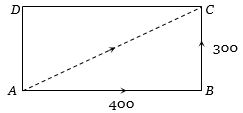
View full question & answer→MCQ 111 Mark
The unit vector parallel to the resultant of the vectors $\vec A = 4\hat i + 3\hat j + 6\hat k$ and $\vec B = - \hat i + 3\hat j - 8\hat k$ is
- ✓
$\frac{1}{7}(3\hat i + 6\hat j - 2\hat k)$
- B
$\frac{1}{7}(3\hat i + 6\hat j + 2\hat k)$
- C
$\frac{1}{{49}}(3\hat i + 6\hat j - 2\hat k)$
- D
$\frac{1}{{49}}(3\hat i - 6\hat j + 2\hat k)$
AnswerCorrect option: A. $\frac{1}{7}(3\hat i + 6\hat j - 2\hat k)$
a
(a) Resultant of vectors $\overrightarrow A $ and $\overrightarrow B $
$\overrightarrow R = \overrightarrow A + \overrightarrow B = 4\hat i + 3\hat j + 6\hat k - \hat i + 3\hat j - 8\hat k$
$\overrightarrow R = 3\hat i + 6\hat j - 2\hat k$
$\hat R = \frac{{\overrightarrow R }}{{|\vec R|}} = \frac{{3\hat i + 6\hat j - 2\hat k}}{{\sqrt {{3^2} + {6^2} + {{( - 2)}^2}} }} = \frac{{3\hat i + 6\hat j - 2\hat k}}{7}$
View full question & answer→MCQ 121 Mark
With respect to a rectangular cartesian coordinate system, three vectors are expressed as
$\vec a = 4\hat i - \hat j$, $\vec b = - 3\hat i + 2\hat j$ and $\vec c = - \hat k$
where $\hat i,\,\hat j,\,\hat k$ are unit vectors, along the $X, Y $ and $Z-$axis respectively. The unit vectors $\hat r$ along the direction of sum of these vector is
- ✓
$\hat r = \frac{1}{{\sqrt 3 }}(\hat i + \hat j - \hat k)$
- B
$\hat r = \frac{1}{{\sqrt 2 }}(\hat i + \hat j - \hat k)$
- C
$\hat r = \frac{1}{3}(\hat i - \hat j + \hat k)$
- D
$\hat r = \frac{1}{{\sqrt 2 }}(\hat i + \hat j + \hat k)$
AnswerCorrect option: A. $\hat r = \frac{1}{{\sqrt 3 }}(\hat i + \hat j - \hat k)$
a
(a) $\vec r = \vec a + \vec b + \vec c$
$ = 4\hat i - \hat j - 3\hat i + 2\hat j - \hat k$
$ = \hat i + \hat j - \hat k$
$\hat r = \frac{{\vec r}}{{|r|}} = \frac{{\hat i + \hat j - \hat k}}{{\sqrt {{1^2} + {1^2} + {{( - 1)}^2}} }} = \frac{{\hat i + \hat j - \hat k}}{{\sqrt 3 }}$
View full question & answer→MCQ 131 Mark
A force vector applied on a mass is represented as $\vec F = 6\hat i - 8\hat j + 10\hat k$ and accelerates with $1\;m/{s^2}$. What will be the mass of the body in $kg$.
- ✓
$10\sqrt 2 $
- B
$20$
- C
$2\sqrt {10} $
- D
$10$
AnswerCorrect option: A. $10\sqrt 2 $
a
(a) ${\rm{Mass}} = \frac{{{\rm{Force}}}}{{{\rm{Acceleration}}}} = \frac{{|\vec F|}}{a}$
= $\frac{{\sqrt {36 + 64 + 100} }}{1}$$ = 10\sqrt 2 \;kg$
View full question & answer→MCQ 141 Mark
A physical quantity which has a direction
- A
- B
- ✓
may be both scalar and vector
- D
AnswerCorrect option: C. may be both scalar and vector
c
Time, pressure, surface tension, current, etc, are some such physical quantities which have direction but are not vectors. Hence, a physical quantity having a direction may or may not be a vector.
View full question & answer→MCQ 151 Mark
A particle is moving with speed $6\,m/s$ along the direction of $\vec A = 2\hat i + 2\hat j - \hat k,$ then its velocity is
- A
$(4\hat i + 2\hat j - 4\hat k)\,\,units$
- ✓
$(4\hat i + 4\hat j - 2\hat k)\,\,units$
- C
$(4\hat i + 4\hat j - 4\hat k)\,\,units$
- D
$(2\hat i + 4\hat j - 2\hat k)\,\,units$
AnswerCorrect option: B. $(4\hat i + 4\hat j - 2\hat k)\,\,units$
b
$\overrightarrow{\mathrm{v}} =|\overrightarrow{\mathrm{v}}| \hat{\mathrm{v}} $
$=6\left(\frac{2 \hat{\mathrm{i}}+2 \hat{\mathrm{j}}-\hat{\mathrm{k}}}{3}\right) $
$=4 \hat{\mathrm{i}}+4 \hat{\mathrm{j}}-2 \hat{\mathrm{k}}$
View full question & answer→MCQ 161 Mark
The vector that must be added to the vector $\hat i - 3\hat j + 2\hat k$ and $3\hat i + 6\hat j - 7\hat k$ so that the resultant vector is a unit vector along the $y-$axis is
- A
$4\hat i + 2\hat j + 5\hat k$
- ✓
$ - 4\hat i - 2\hat j + 5\hat k$
- C
$3\hat i + 4\hat j + 5\hat k$
- D
AnswerCorrect option: B. $ - 4\hat i - 2\hat j + 5\hat k$
b
(b) Unit vector along y axis $ = \hat j$ so the required vector
$ = \hat j - [(\hat i - 3\hat j + 2\hat k) + (3\hat i + 6\hat j - 7\hat k)]$
$ = - \,4\hat i - \,2\hat j + 5\hat k$
View full question & answer→MCQ 171 Mark
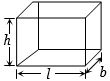
A hall has the dimensions $10\,m \times 12\,m \times 14\,m.$A fly starting at one corner ends up at a diametrically opposite corner. What is the magnitude of its displacement...........$m$
Answerd
(d)Diagonal of the hall = $\sqrt {{l^2} + {b^2} + {h^2}} $
$ = \sqrt {{{10}^2} + {{12}^2} + {{14}^2}} $
$ = \sqrt {100 + 144 + 196} $
$ = \sqrt {440} = 20.97\approx 21 \,m$
View full question & answer→MCQ 181 Mark
The position vector of a particle is determined by the expression $\vec r = 3{t^2}\hat i + 4{t^2}\hat j + 7\hat k$ The distance traversed in first $10 \,sec$ is........ $m$
Answera
(a) $\vec r = 3{t^2}\hat i + 4{t^2}\hat j + 7\hat k$
at $t = 0$, ${\vec r_1} = 7\hat k$
at $t = 10\sec $, ${\vec r_2} = 300\hat i + 400\hat j + 7\hat k$,
$\overrightarrow {\Delta r} = {\vec r_2} - {\vec r_1} = 300\hat i + 400\hat j$
$|\overrightarrow {\Delta r} |\, = \,|{\vec r_2} - {\vec r_1}|\, = \sqrt {{{(300)}^2} + {{(400)}^2}} = 500m$
View full question & answer→MCQ 191 Mark
Unit vector parallel to the resultant of vectors $\vec A = 4\hat i - 3\hat j$and $\vec B = 8\hat i + 8\hat j$ will be
- A
$\frac{{24\hat i + 5\hat j}}{{13}}$
- ✓
$\frac{{12\hat i + 5\hat j}}{{13}}$
- C
$\frac{{6\hat i + 5\hat j}}{{13}}$
- D
AnswerCorrect option: B. $\frac{{12\hat i + 5\hat j}}{{13}}$
b
(b) Resultant of vectors $\overrightarrow A $ and $\overrightarrow B $
$\overrightarrow R = \overrightarrow A + \overrightarrow B = 4\hat i - 3\hat j + 8\hat i + 8\hat j$$ = 12\hat i + 5\hat j$
$\hat R = \frac{{\overrightarrow R }}{{|R|}} = \frac{{12\hat i + 5\hat j}}{{\sqrt {{{(12)}^2} + {{(5)}^2}} }}$$ = \frac{{12\hat i + 5\hat j}}{{13}}$
View full question & answer→MCQ 201 Mark
There are two force vectors, one of $5\, N$ and other of $12\, N $ at what angle the two vectors be added to get resultant vector of $17\, N, 7\, N $ and $13 \,N$ respectively
- ✓
$0^o, 180^o$ and $90^o$
- B
$0^o, 90^o$ and $180^o$
- C
$0^o, 90^o $ and $90^o$
- D
$180^o, 0^o$ and $90^o$
AnswerCorrect option: A. $0^o, 180^o$ and $90^o$
a
(a) For $17 \,N$ both the vector should be parallel i.e. angle between them should be zero.
For $7\, N$ both the vectors should be antiparallel i.e. angle between them should be $180^o$
For $13\, N$ both the vectors should be perpendicular to each other i.e. angle between them should be $90^o$
View full question & answer→MCQ 211 Mark
If $\overrightarrow A = 4\hat i - 3\hat j$ and $\overrightarrow B = 6\hat i + 8\hat j$ then magnitude and direction of $\overrightarrow A \, + \overrightarrow B $ will be
- A
$5,\,{\tan ^{ - 1}}(3/4)$
- ✓
$5\sqrt 5 ,{\tan ^{ - 1}}(1/2)$
- C
$10,\,{\tan ^{ - 1}}(5)$
- D
$25,\,{\tan ^{ - 1}}(3/4)$
AnswerCorrect option: B. $5\sqrt 5 ,{\tan ^{ - 1}}(1/2)$
b
(b) $\overrightarrow A + \overrightarrow B = 4\hat i - 3\hat j + 6\hat i + 8\hat j\,\, = 10\hat i + 5\hat j$
$|\overrightarrow A + \overrightarrow B |\, = \,\sqrt {{{(10)}^2} + {{(5)}^2}} $ $ = \,5\sqrt 5 $
$\tan \theta = \frac{5}{{10}} = \frac{1}{2}$ $ \Rightarrow $$\theta = {\tan ^{ - 1}}\left( {\frac{1}{2}} \right)$
View full question & answer→MCQ 221 Mark
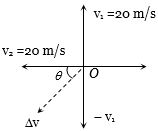
A truck travelling due north at $20 \,m/s $ turns west and travels at the same speed. The change in its velocity be
- A
$40\, m/s \,N-W$
- B
$20\sqrt 2 \, m/s\, N-W$
- C
$40\, m/s\, S-W$
- ✓
$20\sqrt 2 \,m/s \,S-W$
AnswerCorrect option: D. $20\sqrt 2 \,m/s \,S-W$
d
(d) From figure
$\vec v _1 = 20\hat j$ and $\vec v _2 = - 20\hat i$
$\Delta \vec v = \vec v _2 - \vec v _1 = - 20(\hat i + \hat j)$
$|\Delta \vec v |\, = \,20\sqrt 2 $ and direction
$\theta = {\tan ^{ - 1}}(1) = 45^\circ $ i.e. $S - W$
View full question & answer→MCQ 231 Mark
$\overrightarrow A = 2\hat i + \hat j,\,B = 3\hat j - \hat k$ and $\overrightarrow C = 6\hat i - 2\hat k$.Value of $\overrightarrow A - 2\overrightarrow B + 3\overrightarrow C $ would be
- A
$20\hat i + 5\hat j + 4\hat k$
- ✓
$20\hat i - 5\hat j - 4\hat k$
- C
$4\hat i + 5\hat j + 20\hat k$
- D
$5\hat i + 4\hat j + 10\hat k$
AnswerCorrect option: B. $20\hat i - 5\hat j - 4\hat k$
b
(b) $\overrightarrow A - 2\overrightarrow B + 3\overrightarrow C = (2\hat i + \hat j) - 2(3\hat j - \hat k) + 3(6\hat i - 2\hat k)$
$ = 2\hat i + \hat j - 6\hat j + 2\hat k + 18\hat i - 6\hat k$
=$20\hat i - 5\hat j - 4\hat k$
View full question & answer→MCQ 241 Mark
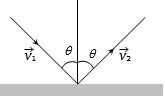
An object of $m\, kg$ with speed of $v\, m/s$ strikes a wall at an angle $\theta$ and rebounds at the same speed and same angle. The magnitude of the change in momentum of the object will be
- ✓
$2m\,v\,\cos \theta $
- B
$2\,m\,v\,\sin \theta $
- C
$0$
- D
$2\,m\,v$
AnswerCorrect option: A. $2m\,v\,\cos \theta $
a
(a) ${\overrightarrow P _1} = m\,v\,\sin \theta \,\hat i - m\,v\,\cos \theta \,\hat j$
and ${\overrightarrow P _2} = m\,v\,\sin \theta \,\hat i + \,m\,v\,\cos \theta \,\hat j$
So change in momentum
$\overrightarrow {\Delta P} = {\overrightarrow P _2} - {\overrightarrow P _1} = 2\,m\,v\,\cos \theta \,\hat j,$$|\Delta \overrightarrow P |\, = 2\,m\,v\,\cos \theta $
View full question & answer→MCQ 251 Mark
Two forces, each of magnitude $F$ have a resultant of the same magnitude $F$. The angle between the two forces is....... $^o$
Answerb
(b) $R = \sqrt {{A^2} + {B^2} + 2AB\cos \theta } $
By substituting, $A = F,\;B = F$ and $R = F$ we get
$\cos \theta = -\frac{1}{2}\therefore \theta = 120^\circ $
View full question & answer→MCQ 261 Mark
If $| A + B |=| A |+| B |$ the angle between $\overrightarrow A $and $\overrightarrow B $ is ....... $^o$
Answera
For two vectors $A \square A \rightarrow$ and $B \square B \rightarrow$, the angle between them being $\theta \theta$, the magnitude of the resultant vector $A + B \rightarrow A + B \rightarrow$ is given by,
$| A + B |=\sqrt{| A |^2+| B |^2+2 AB \cos \theta}$
Now in the problem we've,
$| A + B |=| A |+| B |$
Squaring on both sides,
$\begin{array}{l}| A + B |^2=(| A |+| B |)^2 \\| A |^2+| B |^2+2| A || B | \cos \theta=| A |^2+| B |^2+2| A || B | \\\Rightarrow \cos \theta=1\end{array}$
assuming neither of the vectors are $zero$ vectors.
View full question & answer→MCQ 271 Mark
Let the angle between two nonzero vectors $\overrightarrow A $ and $\overrightarrow B $ be $120^°$ and resultant be $\overrightarrow C $
- A
$\overrightarrow C $ must be equal to $|\overrightarrow A - \overrightarrow B |$
- B
$\overrightarrow C $ must be greater than $|\overrightarrow A - \overrightarrow B |$
- ✓
$\overrightarrow C $ must be less than $|\overrightarrow A - \overrightarrow B |$
- D
$\overrightarrow C $ may be equal to $|\overrightarrow A - \overrightarrow B |$
AnswerCorrect option: C. $\overrightarrow C $ must be less than $|\overrightarrow A - \overrightarrow B |$
c
(c) If $\overrightarrow{\mathrm{C}}$ is resultant of $\overrightarrow{\mathrm{A}}$ and $\overrightarrow{\mathrm{B}}$, then
$|\overrightarrow{\mathrm{C}}|=\sqrt{\mathrm{A}^{2}+\mathrm{B}^{2}+2 \mathrm{AB} \cos 120^{\circ}}$
$|\overrightarrow{\mathrm{C}}|=\sqrt{\mathrm{A}^{2}+\mathrm{B}^{2}-\mathrm{AB}} \quad\left[\text { Ascos } 120^{\circ}=-\frac{1}{2}\right]$
similarly, $|\overrightarrow{\mathrm{A}}-\overrightarrow{\mathrm{B}}|=\sqrt{\mathrm{A}^{2}+\mathrm{B}^{2}-2 \mathrm{AB} \cos 120^{\circ}}$
$=\sqrt{A^{2}+B^{2}+A B}$
$|\overrightarrow{\mathrm{A}}-\overrightarrow{\mathrm{B}}|>\mathrm{C}$
View full question & answer→MCQ 281 Mark
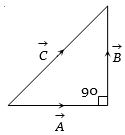
The magnitude of vector $\overrightarrow A ,\,\overrightarrow B $ and $\overrightarrow C $ are respectively $12, 5$ and $13$ units and $\overrightarrow A + \overrightarrow B = \overrightarrow C $ then the angle between $\overrightarrow A $ and $\overrightarrow B $ is
- A
$0$
- B
$\pi $
- ✓
$\pi /2$
- D
$\pi /4$
AnswerCorrect option: C. $\pi /2$
c
(c) $C = \sqrt {{A^2} + {B^2}} $
The angle between $A$ and $B$ is $\frac{\pi }{2}$
View full question & answer→MCQ 291 Mark
The three vectors $\overrightarrow A = 3\hat i - 2\hat j + \hat k,\,\,\overrightarrow B = \hat i - 3\hat j + 5\hat k$ and $\overrightarrow C = 2\hat i + \hat j - 4\hat k$ form
Answerc
(c) $\vec A = 3\hat i - 2\hat j + \hat k$, $\vec B = \hat i - 3\hat j + 5\hat k$, $\vec C = 2\hat i - \hat j + 4\hat k$
$|\vec A| = \sqrt {{3^2} + {{( - 2)}^2} + {1^2}} = \sqrt {9 + 4 + 1} = \sqrt {14} $
$|\vec B| = \sqrt {{1^2} + {{( - 3)}^2} + {5^2}} = \sqrt {1 + 9 + 25} = \sqrt {35} $
$|\vec A| = \sqrt {{2^2} + {1^2} + {{( - 4)}^2}} = \sqrt {4 + 1 + 16} = \sqrt {21} $
As $B = \sqrt {{A^2} + {C^2}} $ therefore $ABC$ will be right angled triangle.
View full question & answer→MCQ 301 Mark
Let $\overrightarrow C = \overrightarrow A + \overrightarrow B $ then
- A
$|\overrightarrow {C|} $ is always greater then $|\overrightarrow A |$
- ✓
It is possible to have $|\overrightarrow C |\, < \,|\overrightarrow A |$ and $|\overrightarrow C |\, < \,|\overrightarrow B |$
- C
$C$ is always equal to $A + B$
- D
$C$ is never equal to $A + B$
AnswerCorrect option: B. It is possible to have $|\overrightarrow C |\, < \,|\overrightarrow A |$ and $|\overrightarrow C |\, < \,|\overrightarrow B |$
b
(b) $\vec C + \vec A = \vec B$.
The value of $C$ lies between $A - B$ and $A + B$
$|\vec C|\; < \;|\vec A|\;\;{\rm{or}}\;\;|\vec C|\; < \;|\vec B|$
View full question & answer→MCQ 311 Mark
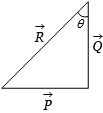
If vectors $P, Q$ and $R$ have magnitude $5, 12$ and $13 $ units and $\overrightarrow P + \overrightarrow Q = \overrightarrow R ,$ the angle between $Q$ and $R$ is
- A
${\cos ^{ - 1}}\frac{5}{{12}}$
- B
${\cos ^{ - 1}}\frac{5}{{13}}$
- ✓
${\cos ^{ - 1}}\frac{{12}}{{13}}$
- D
${\cos ^{ - 1}}\frac{7}{{13}}$
AnswerCorrect option: C. ${\cos ^{ - 1}}\frac{{12}}{{13}}$
c
(c) $|\vec P|\; = \;5$, $|\vec Q|\; = 12$ and $|\vec R|\; = 13$
$\cos \theta = \frac{Q}{R} = \frac{{12}}{{13}}$
$\theta = {\cos ^{ - 1}}\left( {\frac{{12}}{{13}}} \right)$
View full question & answer→MCQ 321 Mark
The resultant of two vectors $A$ and $B$ is perpendicular to the vector $A$ and its magnitude is equal to half the magnitude of vector $B$. The angle between $A$ and $B$ is ....... $^o$
Answerb
(b) $\frac{B}{2} = \sqrt {{A^2} + {B^2} + 2AB\;\cos \theta } $…$(i)$
$\tan 90^\circ = \frac{{B\sin \theta }}{{A + B\cos \theta }} \Rightarrow A + B\cos \theta = 0$
$\cos \theta = - \frac{A}{B}$
Hence, from $(i)$ $\frac{{{B^2}}}{4} = {A^2} + {B^2} - 2{A^2} \Rightarrow A = \sqrt 3 \frac{B}{2}$
$⇒ \cos \theta = - \frac{A}{B} = - \frac{{\sqrt 3 }}{2}$
$⇒ \theta = 150^\circ $
View full question & answer→MCQ 331 Mark
What vector must be added to the two vectors $\hat i - 2\hat j + 2\hat k$ and $2\hat i + \hat j - \hat k,$ so that the resultant may be a unit vector along $X-$axis
- A
$2\hat i + \hat j - \hat k$
- ✓
$ - 2\hat i + \hat j - \hat k$
- C
$2\hat i - \hat j + \hat k$
- D
$ - 2\hat i - \hat j - \hat k$
AnswerCorrect option: B. $ - 2\hat i + \hat j - \hat k$
b
(b) $(\hat i - 2\hat j + 2\hat k) + (2\hat i + \hat j - \hat k) + \vec R = i$
Required vector $\vec R$ = $ - 2\hat i + \hat j - \hat k$
View full question & answer→MCQ 341 Mark
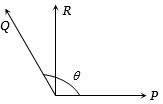
The resultant of $\overrightarrow P $ and $\overrightarrow Q $ is perpendicular to $\overrightarrow P $. What is the angle between $\overrightarrow P $ and $\overrightarrow Q $
AnswerCorrect option: B. ${\cos ^{ - 1}}( - P/Q)$
b
(b) $\tan 90^\circ = \frac{{Q\sin \theta }}{{P + Q\cos \theta }}$
$⇒$ $P + Q\cos \theta = 0$
$\cos \theta = \frac{{ - P}}{Q}$
$⇒$ $\theta = {\cos ^{ - 1}}\left( {\frac{{ - P}}{Q}} \right)$
View full question & answer→MCQ 351 Mark
Maximum and minimum magnitudes of the resultant of two vectors of magnitudes $P$ and $Q$ are in the ratio $3:1.$ Which of the following relations is true
- ✓
$P = 2Q$
- B
$P = Q$
- C
$PQ = 1$
- D
AnswerCorrect option: A. $P = 2Q$
a
(a) According to problem $P + Q = 3\;{\rm{and }}P - Q = 1$
By solving we get $P = 2\;{\rm{and }}Q = 1$
$\therefore \frac{P}{Q} = 2$
$⇒$ $P = 2Q$
View full question & answer→MCQ 361 Mark
Two forces, ${F_1}$ and ${F_2}$ are acting on a body. One force is double that of the other force and the resultant is equal to the greater force. Then the angle between the two forces is
- A
${\cos ^{ - 1}}(1/2)$
- B
${\cos ^{ - 1}}( - 1/2)$
- ✓
${\cos ^{ - 1}}( - 1/4)$
- D
${\cos ^{ - 1}}(1/4)$
AnswerCorrect option: C. ${\cos ^{ - 1}}( - 1/4)$
c
(c)Let $F 1=F$
and $\quad F 2=2 F$
Resultant force $=F_{\text {net }}=2 F$
$F_{net}$ $=\sqrt{F_{1}^{2}+F_{2}^{2}+2 F_{1} F_{2}} \cos \theta$
$2 F=\sqrt{F^{2}+2 F^{2}+2 \times F \times(2 F) \cos \theta}$
$4 F^{2}=5 F^{2}+4 F^{2} \cos \theta$
$4 \cos \theta=-1$
$\therefore \cos \theta=\frac{-1}{4}$
View full question & answer→MCQ 371 Mark
Given that $\overrightarrow A + \overrightarrow B = \overrightarrow C $and that $\overrightarrow C $ is $ \bot $ to $\overrightarrow A $. Further if $|\overrightarrow A |\, = \,|\overrightarrow C |,$then what is the angle between $\overrightarrow A $ and $\overrightarrow B $
AnswerCorrect option: C. $\frac{{3\pi }}{4}radian$
c
Given, $A+B=C$
and $B=C-A$
Since, $C \perp A$, therefore
$B^{2}=C^{2}+A^{2}$
Also, $|C|=|A|,$ therefore
$B^{2}=2 A^{2} \Rightarrow B=\sqrt{2} A$
$\mathrm{Now}, A^{2}+B^{2}+2 A B \cos \theta=C^{2}=A^{2}$
$\therefore \cos \theta=\frac{1}{\sqrt{2}}$
This gives $\theta=\frac{3 \pi}{4}$ rad
View full question & answer→MCQ 381 Mark
A plane is revolving around the earth with a speed of $100\, km/hr $ at a constant height from the surface of earth. The change in the velocity as it travels half circle is.........$km/hr$
- ✓
$200$
- B
$150$
- C
$100 \sqrt 2$
- D
$0$
Answera
(a) $\Delta v = 2v\sin \left( {\frac{\theta }{2}} \right) $
$= 2 \times v \times \sin 90^\circ $
$ = 2 \times 100 = 200\;km/hr$
View full question & answer→MCQ 391 Mark
What displacement must be added to the displacement $25\hat i - 6\hat j\,\,m$ to give a displacement of $7.0\, m$ pointing in the $X- $direction
- A
$18\hat i - 6\hat j$
- B
$32\hat i - 13\hat j$
- ✓
$ - 18\hat i + 6\hat j$
- D
$ - 25\hat i + 13\hat j$
AnswerCorrect option: C. $ - 18\hat i + 6\hat j$
c
(c) Previous position $=25 \hat i - 6 \hat j $
New position $=7 \hat i+0 \hat k $
Displacement $=$ (New position) $-$ (old position) $=(7 \hat i+0 \hat j)-(25 \hat i-6 \hat j)=-18 \hat i+6 \hat j $
Required displacement $=-18 \hat i + 6 hat j $
View full question & answer→MCQ 401 Mark
While travelling from one station to another, a car travels $75 \,km$ North, $60\, km$ North-east and $20 \,km $ East. The minimum distance between the two stations is.......$km$
Answerc
(c) $x=60 \cos 45^{\circ}+20$
$=\frac{60}{\sqrt{2}}+20=(30 \sqrt{2}+20) k m$
$y=\sqrt{2}$
$y=75+60 \sin 45^{\circ}$
$=75+\frac{60}{\sqrt{2}}=(75+30 \sqrt{2}) k m$
$S=\sqrt{X^{2}+Y^{2}}=\sqrt{(20+30 \sqrt{2})^{2}+(75+30 \sqrt{2})^{2}}$
$S=\sqrt{(62.4)^{2}+(117.4)^{2}}$
$=132 \mathrm{km}$
View full question & answer→MCQ 411 Mark
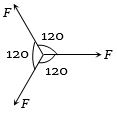
Three concurrent forces of the same magnitude are in equilibrium. What is the angle between the forces Also name the triangle formed by the forces as sides
- ✓
$120^°$ equilateral triangle
- B
$60^°$ equilateral triangle
- C
$120^°, 30^°, 30^° $ an isosceles triangle
- D
$120^°$ an obtuse angled triangle
AnswerCorrect option: A. $120^°$ equilateral triangle
a
(a) In $N$ forces of equal magnitude works on a single point and their resultant is zero then angle between any two forces is given
$\theta = \frac{{360}}{N}$$ = \frac{{360}}{3} = 120^\circ $
If these three vectors are represented by three sides of triangle then they form equilateral triangle
View full question & answer→MCQ 421 Mark
Two equal forces ($P$ each) act at a point inclined to each other at an angle of $120^°$. The magnitude of their resultant is
Answerc
(c) $R = \sqrt {{A^2} + {B^2} + 2AB\cos \theta } $
If $A = B = P$ and $\theta = 120^\circ $ then $R = P$
View full question & answer→MCQ 431 Mark
The vectors $5i + 8j$ and $2i + 7j$ are added. The magnitude of the sum of these vector is
- ✓
$\sqrt {274} $
- B
$38$
- C
$238$
- D
$560$
AnswerCorrect option: A. $\sqrt {274} $
a
(a) Sum of the vectors $\overrightarrow R = 5\hat i + 8\hat j + 2\hat i + 7\hat j$$ = 7\hat i + 15\hat j$
magnitude of $\overrightarrow R = \,|\overrightarrow R |\, = \sqrt {49 + 225} $$ = \sqrt {274} $
View full question & answer→MCQ 441 Mark
If two vectors $2\hat i + 3\hat j - \hat k$ and $ - 4\hat i - 6\hat j + \lambda \hat k$ are parallel to each other then value of $\lambda$ be
Answerb
(b) Let $\overrightarrow A = 2\hat i + 3\hat j - \hat k$ and $\overrightarrow B = - 4\hat i - 6\hat j + \lambda \hat k$
$\overrightarrow A $ and $\overrightarrow B $ are parallel to each other
$\frac{{{a_1}}}{{{b_1}}} = \frac{{{a_2}}}{{{b_2}}} = \frac{{{a_3}}}{{{b_3}}}$ i.e. $\frac{2}{{ - 4}} = \frac{3}{{ - 6}} = \frac{{ - 1}}{\lambda }$$ \Rightarrow \,\,\lambda = 2$.
View full question & answer→MCQ 451 Mark
If $|{\overrightarrow V _1} + {\overrightarrow V _2}|\, = \,|{\overrightarrow V _1} - {\overrightarrow V _2}|$ and ${V_2}$ is finite, then
- A
${V_1}$ is parallel to ${V_2}$
- B
${\overrightarrow V _1} = {\overrightarrow V _2}$
- ✓
${V_1}$ and ${V_2}$ are mutually perpendicular
- D
$|{\overrightarrow V _1}|\, = \,|{\overrightarrow V _2}|$
AnswerCorrect option: C. ${V_1}$ and ${V_2}$ are mutually perpendicular
c
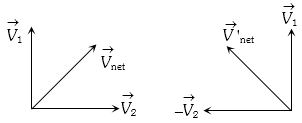
(c) According to problem $|{\vec V_1} + {\vec V_2}|\; = \;|{\vec V_1} - {\vec V_2}|$
$⇒$ $|{\vec V_{{\rm{net}}}}|\; = \;|{\vec V'_{{\rm{net}}}}|$
So ${V_1}$ and ${V_2}$ will be mutually perpendicular.
View full question & answer→MCQ 461 Mark
If the resultant of $n$ forces of different magnitudes acting at a point is zero, then the minimum value of $n$ is
Answerc
(c) If vectors are of equal magnitude then two vectors can give zero resultant, if they works in opposite direction.
But if the vectors are of different magnitudes then minimum three vectors are required to give zero resultant.
View full question & answer→MCQ 471 Mark
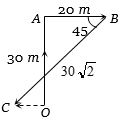
A person moves $30\, m$ north and then $20\, m$ towards east and finally $30\sqrt 2 \,m$ in south-west direction. The displacement of the person from the origin will be
- A
$10\, m$ along north
- B
$10 \,m $ along south
- ✓
$10\, m$ along west
- D
$Zero$
AnswerCorrect option: C. $10\, m$ along west
c
(c) From figure, $\overrightarrow {OA} = 0\;\overrightarrow i + 30\;\overrightarrow j $, $\overrightarrow {AB} = 20\;\overrightarrow i + 0\;\overrightarrow j $
$\overrightarrow {BC} = - 30\sqrt 2 \;cos{45^o}\overrightarrow i $$ - 30\sqrt 2 \;\sin {\rm{4}}{{\rm{5}}^{\rm{o}}}\overrightarrow j $ $ = - 30\;\overrightarrow i - 30\;\overrightarrow j $
Net displacement, $\overrightarrow {OC} = \overrightarrow {OA} + \overrightarrow {AB} + \overrightarrow {BC} $$ = - 10\;\overrightarrow i + 0\;\overrightarrow j $
$|\overrightarrow {OC} |\; = 10\;m.$
View full question & answer→MCQ 481 Mark
Two forces of magnitude $F$ have a resultant of the same magnitude $F$. The angle between the two forces is ........ $^o$
Answerb
(b) $F = \sqrt {{{(F)}^2} + {{(F)}^2} + 2F.F\cos \theta } $
$⇒$ $\theta = 120^\circ $
View full question & answer→MCQ 491 Mark
Two forces with equal magnitudes $F$ act on a body and the magnitude of the resultant force is $F/3$. The angle between the two forces is
- ✓
${\cos ^{ - 1}}\left( { - \frac{{17}}{{18}}} \right)$
- B
${\cos ^{ - 1}}\left( { - \frac{1}{3}} \right)$
- C
${\cos ^{ - 1}}\left( {\frac{2}{3}} \right)$
- D
${\cos ^{ - 1}}\left( {\frac{8}{9}} \right)$
AnswerCorrect option: A. ${\cos ^{ - 1}}\left( { - \frac{{17}}{{18}}} \right)$
a
(a) $F_{_{net}}^2 = F_1^2 + F_2^2 + 2{F_1}{F_2}\cos \theta $
$⇒$ ${\left( {\frac{F}{3}} \right)^2}$$ = {F^2} + {F^2} + 2{F^2}\cos \theta $
$⇒$ $\cos \theta = \left( { - \frac{{17}}{{18}}} \right)$
View full question & answer→MCQ 501 Mark
The resultant of two forces $3P$ and $2P$ is $R$. If the first force is doubled then the resultant is also doubled. The angle between the two forces is ........... $^o$
- A
${60}$
- ✓
$120$
- C
${70}$
- D
${180}$
Answerb
(b) ${R^2} = {(3P)^2} + {(2P)^2} + 2 \times 3P \times 2P \times \cos \theta $…(i)
${(2R)^2} = {(6P)^2} + {(2P)^2} + 2 \times 6P \times 2P \times \cos \theta $…(ii)
by solving (i) and (ii), $\cos \theta = - 1/2$
$⇒$ $\theta = 120^\circ $
View full question & answer→