Question
Can the work by kinetic friction on an object be positive? Zero?

Answer

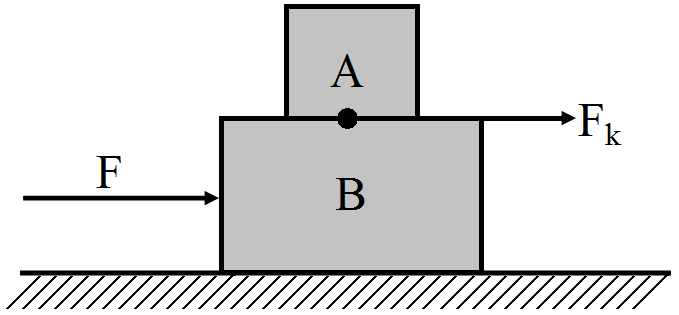
Yes. Let us consider a block A which is resting on another block B. Block B is resting on a smooth horizontal surface. Let the coefficient of friction between the blocks be $\mu.$
When a force F is applied on block B in the forward direction as shown in the above figure, block A moves with block B in the direction of the applied force. The frictional force on block A and the displacement will be in the forward direction. Therefore, work done by the frictional force is positive. If we consider the reference frame of block B, then displacement of block A will be zero. Therefore, work done by the frictional force is zero.

Need a full question paper?

Generate a complete, print-ready paper with questions like this in minutes — across 16+ boards, with answer keys.
Start Generating Free

Similar questions

A disc of mass $5kg$ and radius $50cm$ rolls on the ground at the rate of $10ms^{-1}$. Calculate the K.E. of the disc. $\Big(\text{Given}:\text{I}=\frac{1}{2}\text{MR}^2\Big)$
A body weighs 90kgf on the surface of earth. How much will it weigh on the surface of a planet whose mass is $\frac{1}{9}$ and radius $\frac{1}{2}$ that of earth?
A hollow metallic sphere of radius 20cm surrounds a concentric metallic sphere of radius 5cm. The space between the two spheres is filled with a nonmetallic material. The inner and outer spheres are maintained at 50°C and 10°C respectively and it is found that 100J of heat passes from the inner sphere to the outer sphere per second. Find the thermal conductivity of the material between the spheres.
What is the ideal gas equation? Derive the equation of state for an ideal gas from the molecular kinetic theory of gases.
A star like the sun has several bodies moving around it at different distances. Consider that all of them are moving in circular orbits. Let r be the distance of the body from the centre of the star and let its linear velocity be v, angular velocity $\omega$, kinetic energy K, gravitational potential energy U, total energy E and angular momentum l. As the radius r of the orbit increases, determine which of the above quantities increase and which ones decrease.
Three masses, each equal to M, are placed at the three corners of a square of side 'a'. Calculate the force of attraction on unit mass at the fourth corner.
A biconvex thick lens is constructed with glass $(\mu=1.50)$ Each of the surfaces has a radius of $10cm$ and the thickness at the middle is $5cm$. Locate the image of an object placed far away from the lens.
From a uniform disk of radius R , a circular hole of radius $\frac{R}{2}$ is cut out. The centre of the hole is at $\frac{R}{2}$ from the centre of the original disc. Locate the centre of gravity of the resulting flat body.
A $100kg$ gun fires a ball of $1kg$ horizontally from a cliff of height $500m$. It falls on the ground at a distance of $400m$ from the bottom of the cliff. Find the recoil velocity of the gun. (acceleration due to gravity = $10m s^{–2}$)
An electron of mass $9 \times 10^{-31}kg$ revolves in a circle of radius $0.53\mathring{\text{A}}$ around the nucleus of hydrogen with a velocity of $2.2 \times 10^6ms$. Show that angular momentum of elect ron is $\frac{\text{h}}{2\pi}$ where h is Planck's constant.