Question
Can the work by kinetic friction on an object be positive? Zero?
Answer

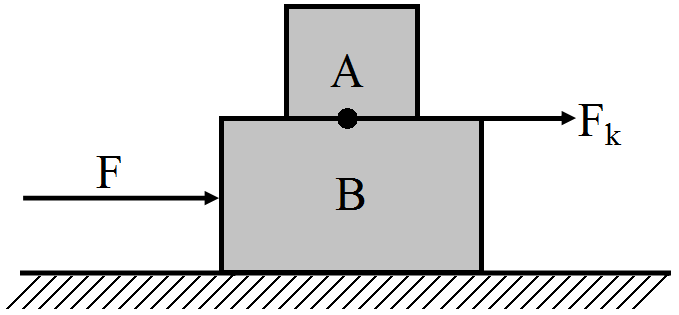
Yes. Let us consider a block A which is resting on another block B. Block B is resting on a smooth horizontal surface. Let the coefficient of friction between the blocks be $\mu.$

When a force is applied on block B in the forward direction as shown in the above figure, block A moves with block B in the direction of the applied force. The frictional force on block A and the displacement will be in the forward direction. Therefore, work done by the frictional force is positive.

If we consider the reference frame of block B, then displacement of block A will be zero. Therefore, work done by the frictional force is zero.

Need a full question paper?

Generate a complete, print-ready paper with questions like this in minutes — across 16+ boards, with answer keys.
Start Generating Free

Similar questions

If the linear momentum is increased by 50%, what is the change in its kinetic energy?
A capacitor of capacitance $12.0\mu\text{F}$ is connected to a battery of emf 6.00V and internal resistance $1.00\Omega$ through resistanceless leads. $12.0\mu\text{s}$ after the connections are made, what will be (a) the current in the circuit (b) the power delivered by the battery (c) the power dissipated in heat and (d) the rate at which the energy stored in the capacitor is increasing.
What is gravitational potential? Derive the formula for gravitational potential due to a ponit mass and also draw the graph.
Two narrow bores of diameters 3.0mm and 6.0mm are joined together to form a U-tube open at both ends. If the U-tube contains water, what is the difference in its levels in the two limbs of the tube ? Surface tension of water at the temperature of the experiment is 7.3 × 10⁻²N m–1. Take the angle of contact to be zero and density of water to be 1.0 × 10³kg/ m–3 (g = 9.8m/ s–2) .
Find the acceleration of the blocks A and B in the three situations shown in figure.


  1. A steel wire of mass μ per unit length with a circular cross section has a radius of 0.1cm. The wire is of length 10m when measured lying horizontal, and hangs from a hook on the wall. A mass of 25kg is hung from the free end of the wire. Assuming the wire to be uniform and lateral strains << longitudinal strains, find the extension in the length of the wire. The density of steel is 7860kg m–3 (Young’s modules Y = 2 × 10¹¹ Nm–2).

  2. If the yield strength of steel is 2.5 × 10⁸ Nm–2, what is the maximum weight that can be hung at the lower end of the wire?
What do you understand by beat? Explain beats analytically.
A capacitor of capacitance $10\mu\text{F}$ is connected to a battery of emf 2V. It is found that it takes 50ms for the charge of the capacitor to become $12.6\mu\text{C}.$ Find the resistance of the circuit.
A cricketer can throw a ball to a maximum horizontal distance of 100m. How much high above the ground can the cricketer throw the same ball.
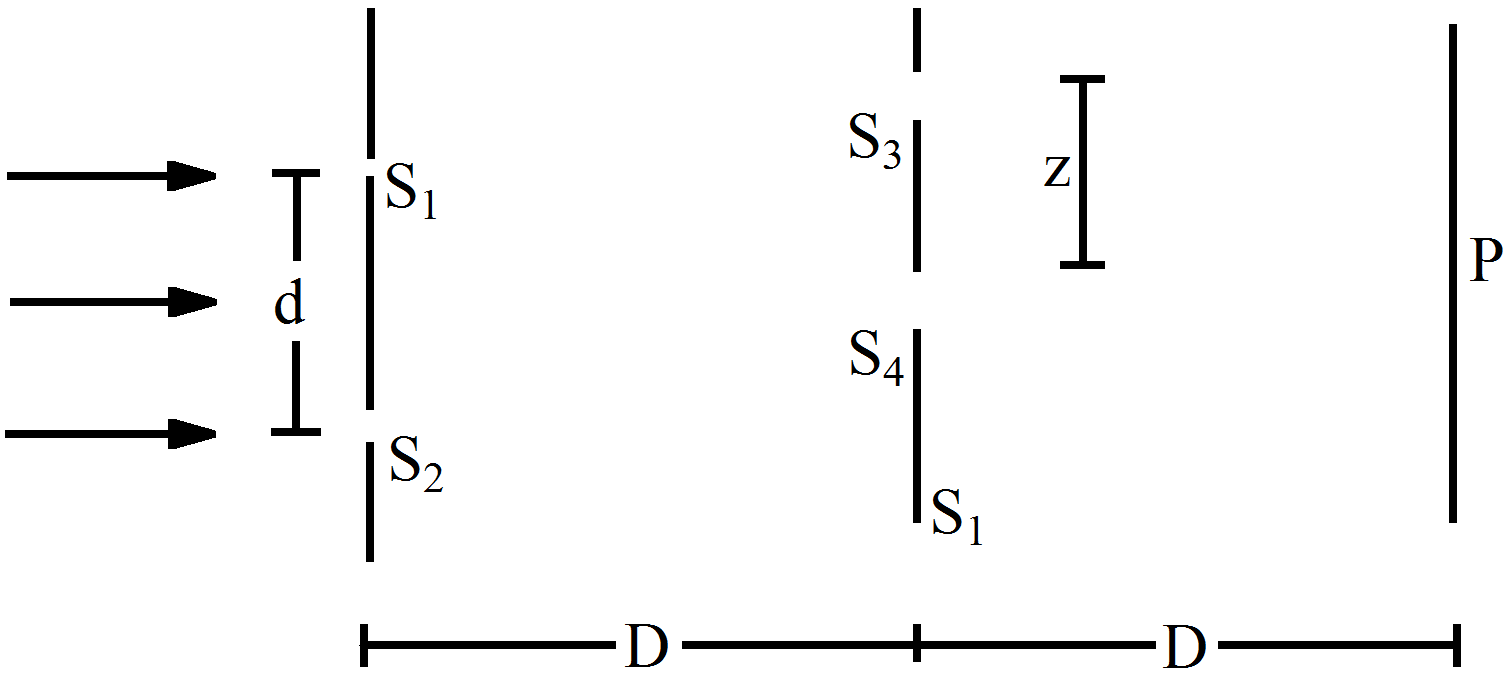
Consider the arrangement shown in figure. By some mechanism, the separation between the slits S3 and S4 can be changed. The intensity is measured at the point P which is at the common perpendicular bisector

of S1S2 and S3S4. When $\text{z}=\frac{\text{D}\lambda}{2\text{d}},$ intensity measured at P is I. Find this intensity when z is equal to:

  1. $\frac{\text{D}\lambda}{\text{d}}$

  2. $\frac{3\text{D}\lambda}{2\text{d}}$

  3. $\frac{2\text{D}\lambda}{\text{d}}$