Question
Can two equipotential surfaces cut each other?

Answer

At the point of intersection, two normals can be drawn. Also, we know that electric field lines are perpendicular to the equipotential surface. This implies that at that point two different directions of the electric field are possible, which is not possible physically.
Hence, two equipotential surfaces cannot cut each other.

Need a full question paper?

Generate a complete, print-ready paper with questions like this in minutes — across 16+ boards, with answer keys.

Start Generating Free

Similar questions

Is the colour of 620nm light and 780nm light same? Is the colour of 620nm light and 621nm light same? How many colours are there in white light?
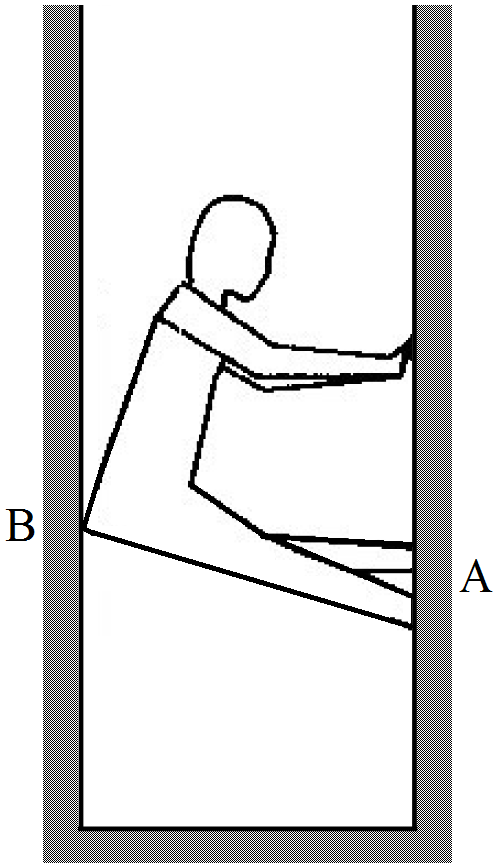
A person $(40\ kg)$ is managing to be at rest between two vertical walls by pressing one wall A by his hands and feet and the other wall B by his back. Assume that the friction coefficient between his body and the walls is $0.8$ and that limiting friction acts at all the contacts.
  1. Show that the person pushes the two walls with equal force.
  2. Find the normal force exerted by either wall on the person. Take $g = 10m/s^2.$
Explain Lorentz force and state its characteristics.
Light of frequency $7.21 \times 10^{14} Hz$ is incident on a metal surface. Electrons with a maximum speed of $6.0 \times 10^5\ m/s$ are ejected from the surface. What is the threshold frequency for photoemission of electrons?
Define half-life of a radioactive sample. Which of the following radiations: $\alpha-$rays, $\beta-$rays and $\gamma-$rays.
  1. Are similar to X-rays.
  2. Are easily absorbed by matter.
  3. Travel with the greatest speed.
  4. Are similar in nature to cathode rays?
Explain the principle and working of a cyclotron with the help of a schematic diagram. Write the expression for cyclotron frequency.
A proton is projected with a velocity of $3 \times 10^6 ms^{-1}$ perpendicular to a uniform magnetic field of $0.6T.$ Find the acceleration of the proton.
An infinite line charge produces a field of 9 x10⁴ N C-1at a distance of 2 cm. Calculate the linear charge density.
Figure, shows an aluminium rod joined to a copper rod. Each of the rods has a length of $20\ cm$ and area of cross section $0.20\ cm^2.$ The junction is maintained at a constant temperature $40^\circ C$ and the two ends are maintained at $80^\circ C.$ Calculate the amount of heat taken out from the cold junction in one minute after the steady state is reached. The conductivities are $\text{KAI} = 200\ wm^{-1^\circ }C^{-1}$ and $K_{cu} = 400\ wm^{-1^\circ }C^{-1}.$
A thin prism of crown glass $(\mu_\text{r}=1.515,\mu_\text{v}=1.525)$ and a thin prism of flint glass $(\mu_\text{r}=1.612,\mu_\text{v}=1.632)$ are placed in contact with each other. Their refracting angles are 5.0° each and are similarly directed. Calculate the angular dispersion produced by the combination.