Question
Explain Lorentz force and state its characteristics.

Answer

Suppose a point charge $q$ moving with a velocity $\vec{v}$ in presence of the electric field $\overrightarrow{ E }(\vec{r})$ and the magnetic field $\overrightarrow{ B }(\vec{r})$.
Force on charge $q$ due to the electric and magnetic field.
$\begin{aligned}
\overrightarrow{ F } & =q[\overrightarrow{ E }(r)+(\vec{v} \times \overrightarrow{ B }(\vec{r}))] \\
\therefore \quad \overrightarrow{ F } & =q \overrightarrow{ E }(\vec{r})+q \times \times \overrightarrow{ B })
\end{aligned}$
[Here $\overrightarrow{ B }(r)=\overrightarrow{ B }$ ]
Electric force $\overrightarrow{ F }_{\text {electric }}=q \cdot \overrightarrow{ E }(\vec{r})$
Magnetic force $\overrightarrow{ F }$. magnetic $=q(\overrightarrow{ v } \times \overrightarrow{ B })$
$\therefore \overrightarrow{ F }=\overrightarrow{ F }_{\text {electric }}+\overrightarrow{ F }_{\text {magnetic }}$
The combination of electric and magnetic force here is known as Lorentz force.
• Characteristics :
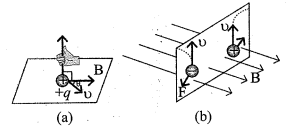
(1) The Lorentz force depends on charge ( $q$ ), velocity ( $\vec{v}$ ) and the magnetic field $(\vec{B})$. Force on negative charge is opposite to that on a positive charge.
(2) The direction of magnetic force $\vec{F}_m=q(\vec{v} \times$ $\vec{B}$ ) can be found using right hand screw rule.
Image
(3) If velocity $\vec{v}$ and the magnetic field $\vec{B}$ are parallel $(\theta=0)$ anti parallel $\left(\theta=180^{\circ}, \pi\right)$ to each other, the force becomes zero.
The magnetic force is maximum when the velocity $\vec{v}$ and the magnetic field $\vec{B}$ are perpendicular to each other.
(4) If charge is not moving i.e. the charge is stationary. then $\vec{v}=0$ hence the magnetic force is zero.

Need a full question paper?

Generate a complete, print-ready paper with questions like this in minutes — across 16+ boards, with answer keys.
Start Generating Free

Similar questions

Accepting the relation $\frac{v_s}{v_p}=\frac{ N _s}{N_s}$ for ideal transformer, and using thé formula of power; derive $\frac{I_p}{I_s}=\frac{v_s}{v_p}=\frac{N_s}{ N _p}$ and from that explain the types of the transformers.
Light in certain cases may be considered as a stream of particles called photons. Each photon has a linear momentum $\frac{\text{h}}{\lambda}$ where h is the Planck's constant and $\lambda$ is the wavelength of the light. A beam of light of wavelength $\lambda$ is incident on a plane mirror at an angle of incidence $\theta.$ Calculate the change in the linear momentum of a photon as the beam is reflected by the mirror.
In a children's park a heavy rod is pivoted at the centre and is made to rotate about the pivot so that the rod always remains horizontal. Two kids hold the rod near the ends and thus rotate with the rod (fig). Let the mass of each kid be 15 kg, the distance between the points of the rod where the two kids hold it be 3.0 m and suppose that the rod rotates at the rate of 20 revolutions per minute. Find the force of friction exerted by the rod on one of the kids.
A (i) series (ii) parallel combination of two given resistors is connected, one by one, across a cell. In which case will the terminal potential difference, across the cell have a higher value?
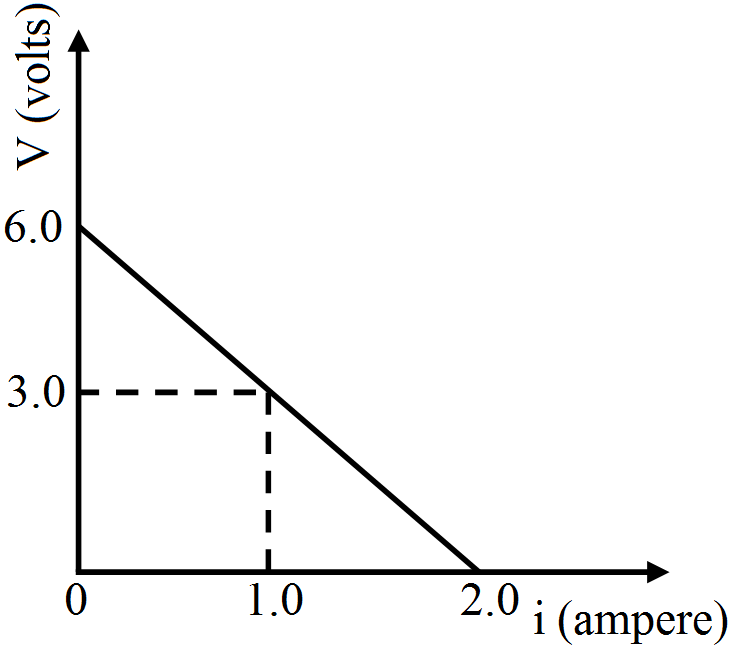
The graph shown here shows the variation of terminal potential difference V, across a combination of three cells in series to a resistor, versus current i:
  1. Calculate the emf of each cell.
  2. For what current i, will the power dissipation of the circuit be maximum?
$a$. Draw the energy level diagram for the line spectra representing Lyman series and Balmer series in the spectrum of hydrogen atom.
$b$. Using the Rydberg formula for the spectrum of hydrogen atom, calculate the largest and shortest wavelengths of the emission lines of the Balmer series in the spectrum of hydrogen atom. $($Use the value of Rydberg constant $\left.R =1.1 \times 10^7 m^{-1}\right)$
The index of refraction of fused quartz is 1.472 for light of wavelength 400nm and is 1.452 for light of wavelength 760nm. Find the speeds of light of these wavelengths in fused quartz.
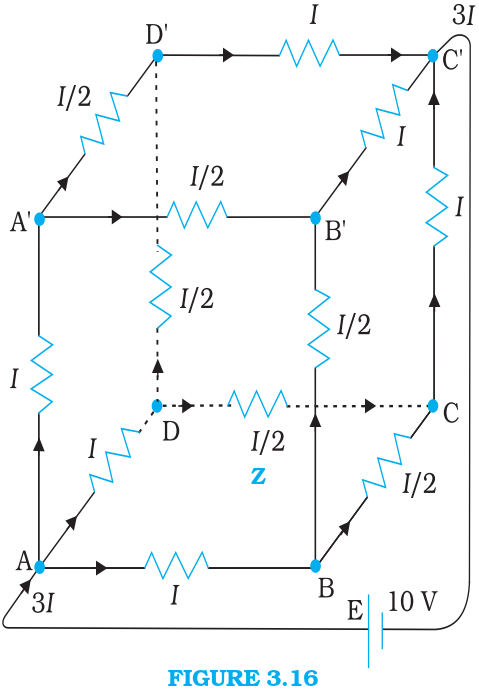
A battery of $10 V$ and negligible internal resistance is connected across the diagonally opposite corners of a cubical network consisting of 12 resistors each of resistance $1 \Omega$ (Fig. 3.16). Determine the equivalent resistance of the network and the current along each edge of the cube.
Image
A charge $Q$ is uniformly distributed over a rod of length l. Consider a hypothetical cube of edge l with the centre of the cube at one end of the rod. Find the minimum possible flux of the electric field through the entire surface of the cube.
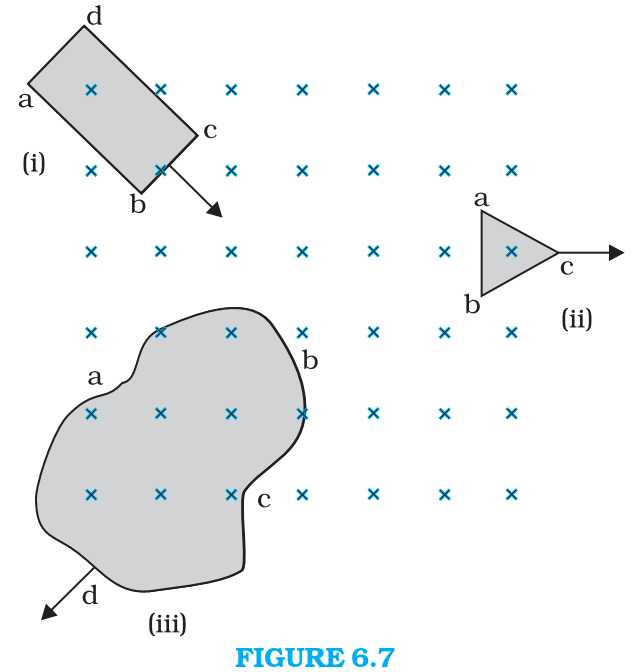
shows planar loops of different shapes moving out of or into a region of a magnetic field which is directed normal to the plane of the loop away from the reader. Determine the direction of induced current in each loop using Lenz's law.
Image