Question
Can we conclude from the interference phenomenon whether light is a transverse wave or a longitudinal wave?

Answer

The interference pattern can be produced by any two coherent waves moving in the same direction. It cannot be concluded from the interference phenomenon that light is a transverse wave, as sound waves that are longitudinal in nature also interfere.

Need a full question paper?

Generate a complete, print-ready paper with questions like this in minutes — across 16+ boards, with answer keys.
Start Generating Free

Similar questions

When a capacitor is charged by a battery; is the energy stored in the capacitor same as energy supplied by the battery?
The fundamental frequency of a closed pipe is 293Hz when the air in it is at a temperature of 20°C. What will be its fundamental frequency when the temperature changes to 22°C?
If a particle is accelerating, it is either speeding up or speeding down. Do you agree with this statement?
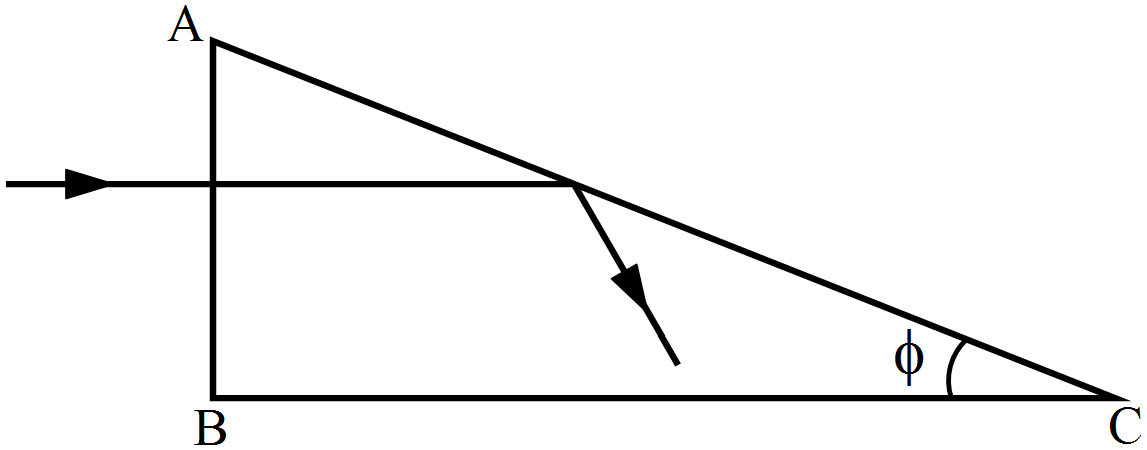
 A light ray is incident normally on the face AB of a right-angled prism ABC $(\mu=1.50)$ as shown in figure. What is the largest angle $\phi$ for which the light ray is totally reflected at the surface AC? 

A sample of paramagnetic salt contains $2.0 \times 10^{24}$ atomic dipoles each of dipole moment $1.5 \times 10^{-23} JT ^{-1}$. The sample is placed under homogeneous magnetic field of 0.84 T and cooled to the temperature of 4.2 K . The degree of magnetic saturation achieved is equal to $15 \%$. What is the total dipole moment of the sample for a magnetic field of 0.98 T and a temperature of 2.8 K (assume Curie's law)?
Write the definition of electrostatic potential. Tell whether it is a vector or a scalar quantity ? Also write its SI unit and dimensional formula.
Write down the conditions for constructive and destructive interference in terms of path difference.
The velocities of two $\alpha-$particles A and B entering a uniform magnetic field are in the ratio 4 : 1. On entering the field they move in different circular paths. Give the ratio of the radii of curvature of the paths of the particles.
Define Electric flux and write its S.I. unit.
An electric dipole of dipole moment $2\times10^{-6}cm$ is kept inside a closed surface. What will be the net flux coming out from the surface ?