Question
Can you add three unit vectors to get a unit vector? Does your answer change if two unit vectors are along the coordinate axes?

Answer

Of course we can add three unit vectors to give a unit vector. An example of this is i, i, -i even If any two unit vectors are along the axes the third vector can so be aligned so that they give a vector of unit magnitude. I will give you an example: i, j, –i.

Need a full question paper?

Generate a complete, print-ready paper with questions like this in minutes — across 16+ boards, with answer keys.
Start Generating Free

Similar questions

What is the specific heat capacity of:
  1. Melting ice
  2. Boiling water?
The masses of 11C and 11B are respectively 11.0114u and 11.0093u. Find the maximum energy a positron can have in the $\beta^+$-decay of 11C to 11B.
Define the ionisation energy. What is the value of it for hydrogen atom?
Explain the physical effect of displacement current.
A concave mirror and a converging lens have the same focal length in air. Which one of the two will have greater focal length when both are immersed in water?
A closely wound solenoid of 800 turns and area of cross section 2.5 × 10–4 m2 carries a current of 3.0 A. Explain the sense in which the solenoid acts like a bar magnet. What is its associated magnetic moment?
Four $ 12~\Omega $ resistances are connected in parallel. There such combinations are connected in series. What will be the total resistance ?
A point charge is taken from a point A to a point B in an electric field. Does the work done by the electric field depend on the path of the charge?
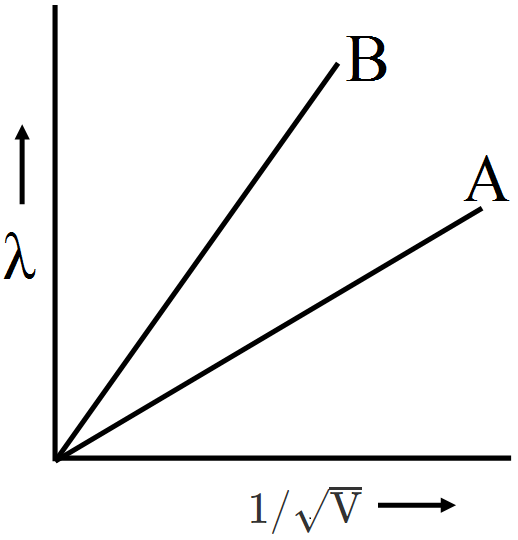
Two lines A and B shown in the graph represent the de Broglie wavelength $(\lambda)$ as a function of $\frac{1}{\sqrt{\text{V}}}$ (V is the accelerating potential) for two particles having the same charge. Which of the two represents the particle of smaller mass?

An electric current of 5 A is flowing through a wire of area of cross-section $4 \times 10^{-6} m^2$. If the number density of charge carriers (free electrons) is $5 \times 10^{26}$ $m ^{-3}$. Find the drift velocity of the electrons.