Question
Four $ 12~\Omega $ resistances are connected in parallel. There such combinations are connected in series. What will be the total resistance ?

Answer

Four $ 12~\Omega $ resistances are connected (i) Parallel.
$ \Rightarrow \frac{1}{R_P} = \frac{1}{12} + \frac{1}{12} + \frac{1}{12} + \frac{1}{12} = \frac{4}{12} = \frac{1}{3} $
$ R_P = 3~\Omega $
Now, $ 3~\Omega $ resistances (3 in number) are connected in series.
$ \Rightarrow R_S = 3 + 3 + 3 = 9~\Omega $.

Need a full question paper?

Generate a complete, print-ready paper with questions like this in minutes — across 16+ boards, with answer keys.
Start Generating Free

Similar questions

You are facing a circular wire carrying an electric current. The current is clockwise as seen by you. Is the field at the centre coming towards you or going away from you?
Explain Rutherford's argument for scattered $\alpha$-particles.
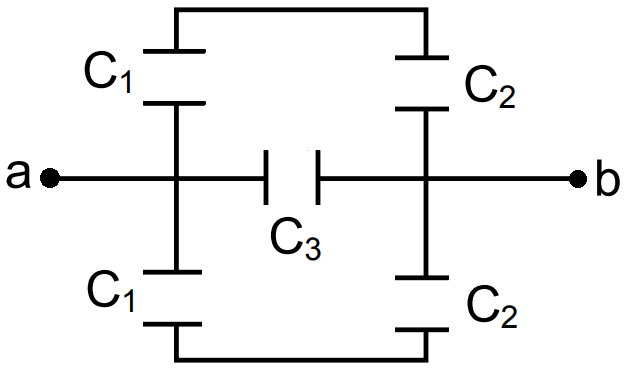
Find the equivalent capacitance of the syatem shown in figure between the points a and b.

An atom absorbs a photon of wavelength 500nm and emits another photon of wavelength 700nm. Find the net energy absorbed by the atom in the process.
Which one of the two, an ammeter or a milliammeter, has a higher resistance and why?
An electric dipole of dipole moment $2\times10^{-6}cm$ is kept inside a closed surface. What will be the net flux coming out from the surface ?
Two bar magnets are placed close to each other with their opposite poles facing each other. In absence of other force the magnets are pulled towards each other and their kinetic energy increases. Does it contradict our earher knowledge that magnetic forces cannot do any work and hence cannot increase kinetic energy of a system?
If two quantities have same dimensions, do they represent same physical content?
Write the equation of P.E. of electric dipole in external electric field and discuss its special cases.
A tightly-wound, long solenoid has n turns per unit length, a radius r and carries a current i. A particle having charge q and mass m is projected from a point on the axis in a direction perpendicular to the axis. What can be the maximum speed for which the particle does not strike the solenoid ?