Question
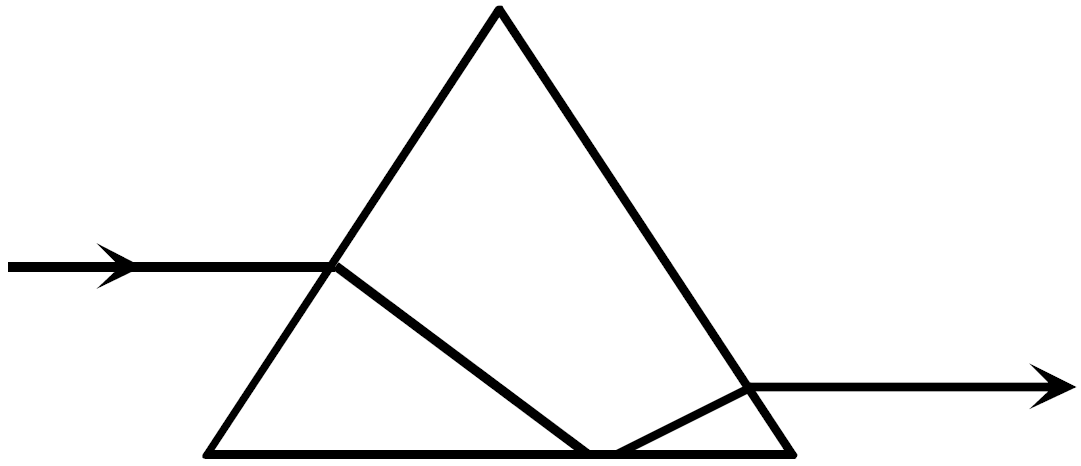
Can you ever have a situation in which a light ray goes undeviated through a prism?

Answer

Yes.

Need a full question paper?

Generate a complete, print-ready paper with questions like this in minutes — across 16+ boards, with answer keys.
Start Generating Free

Similar questions

What is electrostatics?
Calculate the amount of heat radiated per second by a body of surface area $12cm^2$ kept in thermal equilibrium in a room at temperature $20^\circ C.$ The emissivity of the surface = 0.80 and $\sigma=6.0\times10^{-8}\text{Wm}^{-2}\text{K}^{-4}.$
An electric dipole is placed inside a closed surface, whose dipole moment is $20 \times 10^{-6}$ coulomb$-$meter. What will be the electric flux emerging out of this surface?
In how many ways the continuous charges are distributed?
Two identical coils, radius of each is 8 cm and number of turns is 100 are coaxial and their centers are 12 cm apart. If current of 1 A flows in each coil in the same direction, then calculate the magnetic field at the midpoint on the axial line.
Find the intensity at a point on a screen in Young’s double slit experiment where the interfering waves have a path difference of (i) $\lambda/6$, and (ii) $\lambda/2.$
An unruly demonstrator lifts a stone of mass 200g from the ground and throws it at his opponent. At the time of projection, the stone is 150cm above the ground and has a speed of 3.00m/s. Calculate the work done by the demonstrator during the process. If it takes one second for the demonstrator to lift the stone and throw, what horsepower does he use?
Obtain the de Broglie wavelength of a neutron of kinetic energy 150 eV . As you have seen in Exercise 11.31, an electron beam of this energy is suitable for crystal diffraction experiments. Would a neutron beam of the same energy be equally suitable? Explain. $( \left.\mathrm{m}_{\mathrm{n}}=1.675 \times 10^{-27} \mathrm{~kg}\right)$.
An electric field $\vec{\text{E}}=(\vec{\text{i}}20+\vec{\text{j}}30)\text{N}\text{C}^{-1}$ exists in the space. If the potential at the origin is taken to be zero, find the potential at (2m, 2m).
The plates of a parallel-plate capacitor are made of circular discs of radii 5.0cm each. If the separation between the plates is 1.0mm, what is the capacitance?