Question
CellsFunctions
(1) T-lymphocytes(a) Phagocytic in function
(2) Neutrophils(b) Responsible for Humoral immunity
(3) Eosinophils/Acidophils(c) Responsible for cell-medicated immunity
(4) B-lymphocytes(d) Anti-allergic [Antihistamine] in function

Answer

CellsFunctions
(1) T-lymphocytes(c) Responsible for cell-medicated immunity
(2) Neutrophils(a) Phagocytic in function
(3) Eosinophils/Acidophils(d) Anti-allergic [Antihistamine] in function
(4) B-lymphocytes(d) Anti-allergic [Antihistamine] in function

Need a full question paper?

Generate a complete, print-ready paper with questions like this in minutes — across 16+ boards, with answer keys.

Start Generating Free

Similar questions

Diffusion and Osmosis.
Image
Read the following and answer any four questions from (i) to (v) given below:
Enzymes are best known for their ability to catalise biochemical reactions without undergoing any change. A large number of enzymes are being used in biotechnological industry. Most of them are obtained from microbes. Proteases degrade proteins and polypeptides. Most of the commercially applicable proteases are alkaline and are biosynthesised mainly by bacteria such as Pseudomonas, Bacillus and some fungi like, Aspergillus. These enzymes are used in clearing beer, softening of bread and meat, degumming of silk, etc. Alkaline serine proteases have the largest applications in bio-industry. Alkaline proteases have shown their capability to work under high pH, temperature and in presence of inhibitory compounds. Another important group of enzymes is amylases. Amylolytic enzymes act on starch. These are obtained from Aspergillus, Rhizopus and Bacillus sp. These are used in softening and sweetening of bread, production of alcoholic beverages from starchy materials, clearing of turbidity in juices caused by starch, etc.
  1. Polypeptides are degraded by:
  1. Amylases.
  2. Proteases.
  3. Pectinases.
  4. Lipases.
  1. Amylolytic enzymes are not obtained from:
  1. Aspergillus.
  2. Aspergillus.
  3. Mucor.
  4. Bacillus.
  1. Clearing of turbidity in juices caused by starch is achieved by:
  1. Amylases.
  2. Proteases.
  3. Rennet.
  4. Both (a) and (b).
  1. Select the incorrect option from the following.
  1. Enzymes are proteinaceous substances.
  2. Enzymes are substrate specific.
  3. Enzymes are large sized molecules.
  4. Microbial enzymes can work only in normal temperature and pH.
  1. A farmer harvests corns and prepares corn starch. He wants to prepare some corn syrup from this. for the conversion he needs to use enzyme ______.
  1. Amylase.
  2. Glucoamylases.
  3. Glucoisomerases.
  4. All of these.
Read the following and answer any four questions from (i) to (v) given below:
Priya was 4 years old when she contracted chicken pox. It took her around 15 days to recover completely. Now Priya is 5 years old, so her mother got her vaccinated few days back for DPT ($5^{th}$​​​​​​​ dose) as per immunisation program. Recently she was playing with her friend in the park when her friend accidently fell on iron pipe and badly bruised her knee. She was taken to the hospital where doctor gave her ATS injection and painkillers. Based on the above information, answer the following questions.
  1. Select the correct statement.
  1. Priya has developed natural active immunity against chicken pox.
  2. Priya has developed artificial active immunity against DPT.
  3. Priya's friend has developed artificial passive immunity against tetanus.
  4. All of these
  1. Which of the following do you think is an example of natural passive immunity?
  1. Administration of AGS (anti gas gangrene serum) in a person.
  2. Transfer of IgA antibodies from mother to baby through mother's milk.
  3. A person recovered from viral infection.
  4. A child vaccinated for polio.
  1. Which of the following is true for active immunity?
  1. It provides immediate relief.
  2. It is temporary, not long lasting
  3. It has no side effects.
  4. None of these
  1. Select the incorrect match.
  1. Passive immunity-IgG antibodies crossing placental barrier to reach fetus.
  2. Active immunity-Vaccination against corona virus.
  3. Active immunity-Administration of antidiphtheria serum in patient.
  4. Passive immunity-Fetus having mother's milk.
  1. Assertion: A person recovered from measles develops an active immunity against this infection.
Reason: In active immunity, person's own cells develop antibodies in response to infection.
  1. Both assertion and reason are true and reason is the correct explanation of assertion.
  2. Both assertion and reason are true, but reason is not the correct explanation of assertion.
  3. Assertion is true, but reason is false.
  4. Both assertion and reason are false.
The bacterium Bacillus thuringiensis is widely used in contemporary biology as:
  1. Agent for production of dairy products.
  2. Source of industrial enzyme.
  3. Indicator of water pollution.
  4. Insecticide.
Read the following and answer any four questions from (i) to (v) given below:
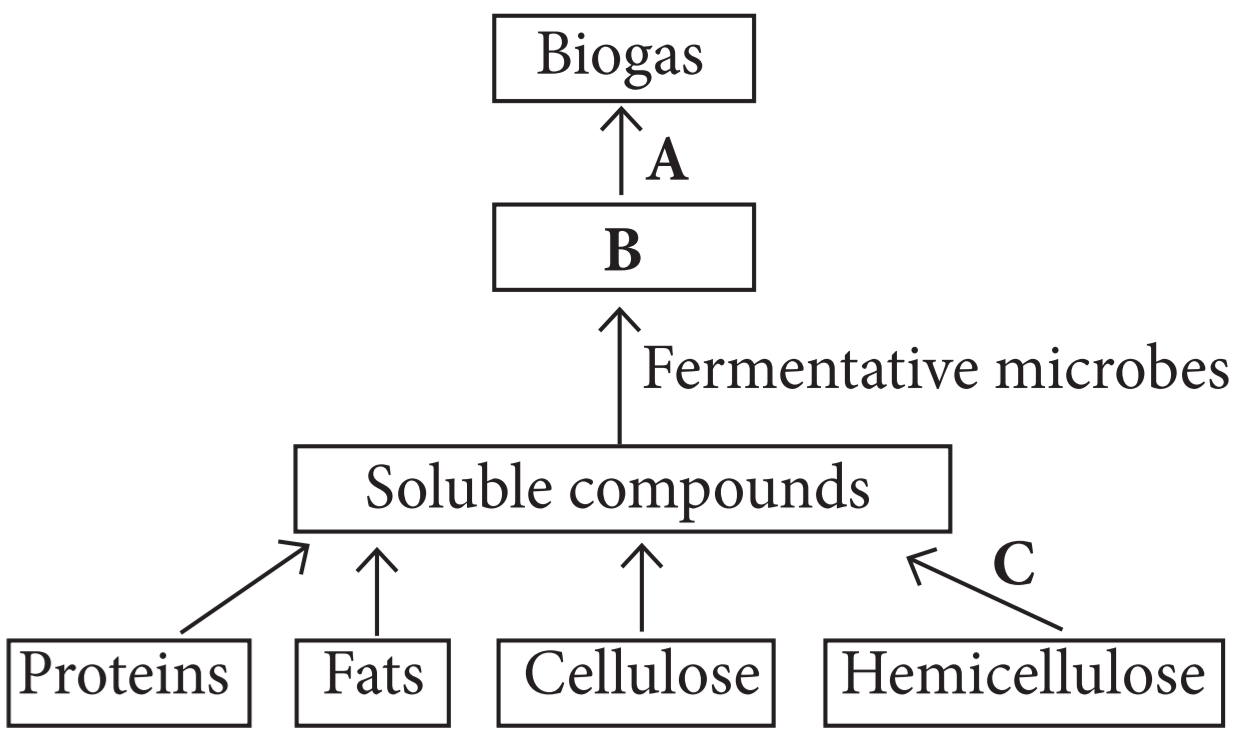
Villagers in a place near Chambur started planning to make power supply for agricultural purposes from cow dung. 'Tiley have started a biogas plant for the purpose. Study the flow chart for biogas production given below and answer the following questions.
  1. Biagas is composed of majorly:
  1. Methane, $CO_2$ and $O_2$​​​​​​​
  2. $CO_2, H_2S$ and H
  3. Methane, $CO_2​​​​​​​$
  4. $H_2S, H$ and $O_2​​​​​​​$
  1. In the given flow chart, 'A' denotes:
  1. Aerobic bacteria.
  2. Methanogenic bacteria.
  3. Cellulose degrading bacteria.
  4. Yeast and protozoa.
  1. What is represented by 'B' in the flow chart?
  1. Carbohydrates.
  2. Protein polymers.
  3. Organic acids.
  4. Fat globules.
  1. 'C' in the given flow chart causes:
  1. Aerobic breakdown of complex organic compounds.
  2. Anaerobic digestion of complex organic compounds.
  3. Fermentation of organic compounds.
  4. Fermentation of monomers.
  1. If 'A' is not added in the procedure.
  1. Methane will not be formed.
  2. $CO_2​​​​​​​$​​​​​​​ will not be formed.
  3. Organic compounds will not be converted to $H_2S$
  4. $O_2​​​​​​​$ will not be formed.
Column I [Contraceptive method]Column II [Mode of action]
(1) Pill(a) Prevents sperms reaching cervix
(2) Condom(b) Prevents implantation
(3) Vasectomy(c) Prevents ovulation
(4) Copper T(d) Semen contains no sperms
Valves in heartLocation
(1) Bicuspid/Mitral valve(a) Opening of inferior vena cava
(2) Tricuspid valve(b) Opening of coronary sinus
(3) Eustachian valve(c) Left atrioventricular aperture
(4) Thebesian valve(d) Right atrioventricular aperture
Read the following and answer any four questions from (i) to (v) given below:
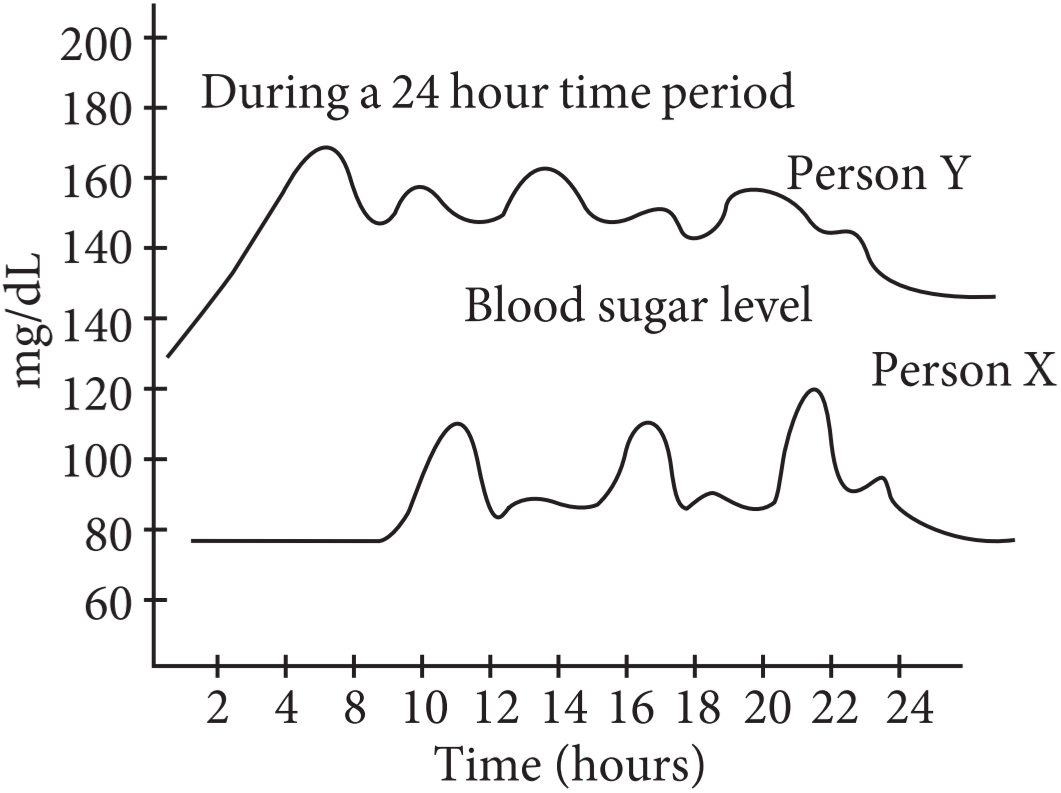
The given graphs show fluctuations in blood sugar of person X and Y during a 24 hour time period.

Based on the above information, answer the following questions.
  1. Which of the following holds true for person X?
  1. Person X is suffering from type I diabetes.
  2. Person X shows severe insulin deficiency and beta cell depletion.
  3. Person X is normal and shows good control of blood sugar level.
  4. Person X is subjected to excessive urination and abnormal thrust.
  1. The given graph indicates that person Y is suffering from.
  1. Diabetes
  2. Hypertension
  3. Atherosclerosis
  4. Rheumatic heart disease.
  1. Which of the following conditions are common in person Y?
  1. Excretion of glucose in urine and excessive urination.
  2. Polydipsia and mild beta cell depletion.
  3. Progressive erosion of articular cartilage at synovial joint.
  4. Both (a) and (b).
  1. A person suffering from diabetes mellitus becomes weak because.
  1. The cells are unable to utilise glucose and other carbohydrates for energy production.
  2. Degradation of fat increases production of toxic ketone bodies.
  3. Cells utilise proteins for obtaining energy
  4. All of these.
  1. Assertion: Type I diabetes involves failure of insulin to facilitate the movement of glucose into cells.
Reason: Type II diabetes is caused by failure of beta cells to produce adequate amount of insulin due to beta cell depletion.
  1. Both assertion and reason are true, and reason is the correct explanation of assertion.
  2. Both assertion and reason are true, but reason is not the correct explanation of assertion.
  3. Assertion is true, but reason is false.
  4. Both assertion and reason are false.
Distinguish between : T. S. of artery and T.S. of vein.