Question
Image

Answer

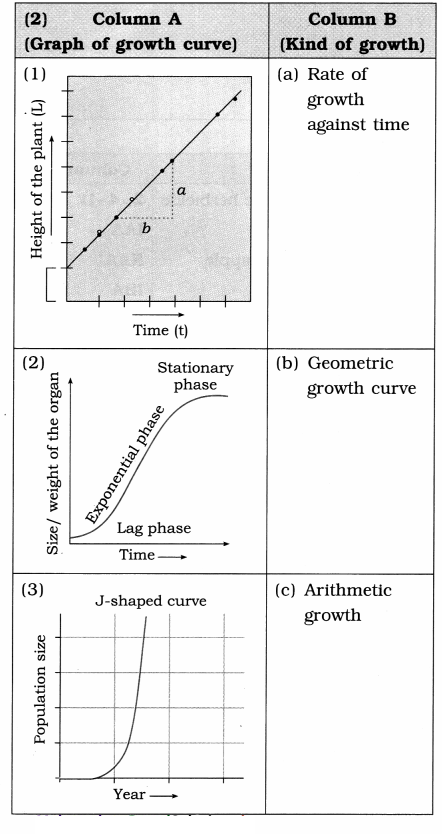
(1) -(c) Arithmetic growth
(2) –(a) Rate of growth against time
(3) -(b) Geometric growth curve

Need a full question paper?

Generate a complete, print-ready paper with questions like this in minutes — across 16+ boards, with answer keys.

Start Generating Free

Similar questions

Read the following and answer any four questions from (i) to (v) given below:
Organism P has thick lips and tongue so that it can easily feed on the commonly available spiny plants. Organism Q has thick layer of insulating fat under the skin. It was strong hooves to walk steadily on steep surfaces and lives in burrows during winters. Organism R has bright colours and sticky pads on its fingers and toes. It lives on trees.
  1. Which of the following is correct habitat for organisms P regarding its adaptation?
  1. Grassland biome.
  2. Desert biome.
  3. Tropical rainforest.
  4. Tropical deciduous forest.
  1. Which of the following is correct match regarding organism Q and its habitat?
  1. Tundra - Polar bear.
  2. Tropical rain forest - Deer.
  3. Grassland - Bighorn sheep.
  4. Desert - Camel.
  1. Which of the following is incorrect regarding organisms R's habitat?
  1. The vegetation shows stratification.
  2. Epiphytic growth is rich.
  3. Standing crop is highest.
  4. Deep rooted shrubs are common due to abundant sunlight.
  1. The dominant plants in habitat where P lives could be:
  1. Opuntia
  2. Nymphaea
  3. Deodar
  4. both (a) and (c).
  1. Organisms P, Q and R respectively most likely occur in:
  1. F, B and A.
  2. C, A, E.
  3. A, F and C.
  4. B, D and A.
Respiratory surfaceOrganism
(1) Plasma membrane(a) Insect
(2) Lungs(b) Salamander
(3) External gills(c) Bird
(4) Internal gills(d) Amoeba
(e) Fish
Waves recorded in ECGHeart activity
(1) P wave(a) Ventricular repolarization
(2) QRS complex(b) Atrial depolarization
(3) T wave(c) Isoelectric segment
(4) ST segment(d) Ventricular depolarization
Distinguish between : Inborn immunity and acquired immunity.
Column A (Artificial Vegetative Propagation)Column B (Examples)
(1) Leaf cutting(a) Blackberry
(2) Stem cutting(b) Apple
(3) Grafting(c) Bougainvillea
(4) Root cutting(d) Sansevieria
  1. What are the three options that can be thought of, to increase food production?
  2. Mention the reasons for the success of Green Revolution in increasing food production.
  3. Why do we still search for other alternatives to increase food production?
Read the following and answer any four questions from (i) to (v) given below.
Prashant wanted to find the genotype of a pea plant bearing purple coloured flowers in his kitchen garden. For this, he crossed purple flowered plant with white flowered plant. As a result, all plants which were produced had purple flower only. Upon selfing these plants, 75 purple flower plants and 25 white flower plants were produced. Now, he can determine the genotype of a purple flowered plant by crossing it with a white flowered plant.
  1. Which of the following cannot be derived from the crosses done by Prashant?
  1. Mendel's law of segregation.
  2. Mendel's law of dominance.
  3. Mendel's law of independent assortment.
  4. Both (a) and (c).
  1. To determine the genotype of a purple flowered plant, Prashant crossed this plant with a white flowered plant. This cross represents a?
  1. Test cross.
  2. Dihybrid cross.
  3. Reciprocal cross.
  4. Trihybrid cross.
  1. In white flowered plant, allele is expressed in?
  1. Heterozygous condition only.
  2. Homozygous condition only.
  3. F3 generation.
  4. Both homozygous and heterozygous condition.
  1. The character, i.e., purple colour of the flowers that appeared in the first filial generation is called?
  1. Recessive character.
  2. Dominant character.
  3. Dominant character.
  4. Lethal character.
  1. Assertion: A geneticist crossed two plants and he obtained 50% purple flowered plants and 50% white flowered plants.
Reasons: Purple coloured flower plant might be heterozygous.
  1. Both assertion and reason are true and reason is the correct explanation of assertion.
  2. Both assertion and reason are true but reason is not the correct explanation of assertion.
  3. Assertion is true but reason is false.
  4. Both assertion and reason are false.
Read the following and answer any four questions from (i) to (v) given below:
Study the given table and answer the questions based on it.
 
Hormone
Source
Function
(A)
Oxytocin
W
Ejection of milk
(B)
X
Anterior lobe of pituitary gland
Stimulates secretion of ABP from Sertoli cells
(C)
Y
Placenta
Maintains corpus luteum to secrete progesterone
(D)
Relaxin
Ovary
Z
  1. Identify the hormones X and Y, respectively.
  1. Testosterone, FSH.
  2. LH, hPL.
  3. FSH, hCG.
  4. ICSH, hCG.
  1. W in the given table is:
  1. Hypothalamus.
  2. Posterior lobe of pituitary.
  3. Placenta.
  4. Ovary.
  1. Which of the following is correct for Z?
  1. Dilation of uterine cervix during labour pains.
  2. Stimulates the growth of the mammary glands during pregnancy.
  3. Supports the fetal growth and prevents desiccation.
  4. Forms protective plug in cervix of uterus during pregnancy.
  1. Which set of hormones is secreted only during pregnancy?
  1. Human chorionic gonadotropin, relax in and human placental lactogen.
  2. Human placental lactogen, estrogen and chorionic thyrotropin.
  3. Human chorionic gonadotropin, human placental lactogen and progesterone.
  4. Chorionic thyrotropin, chorionic gonadotropin and estrogen.
  1. Assertion: Follicle stimulating hormone controls the maintenance and functions of male reproductive organs.
Reason: FSH acts directly on spermatogonia to stimulate sperm production.
  1. Both assertion and reason are true, and reason is the correct explanation of assertion.
  2. Both assertion and reason are true, but reason is not the correct explanation of assertion.
  3. Assertion is true, but reason is false.
  4. Both assertion and reason are false.
Distinguish between: Zona pellucida and Corona radiata.
Genomic library and c-DNA library.