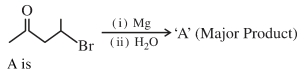
MCQ
$CH_3-NH_2$ $\xrightarrow{{HN{O_2}}}$
- A$CH_3-OH$
- B$CH_3-N = N-OH$
- ✓$CH_3-O-CH_3$
- D$CH_3-N=O$
Generate a complete, print-ready paper with questions like this in minutes — across 16+ boards, with answer keys.
$(i)$ ter. butyl chloride easily hydrolysed to gives alcohol
$(ii$) sec. alcohol gives blue colour in victer-meyer test
$(iii)$ $IUPAC$ name of (figure) is $3-$ methylpentan $-2-$ ol
$(iv)$ alcohol release $H_2$ gas with Grignard reagent
$Sn ^{2+}+2 e ^{-} \rightarrow Sn$
$Sn ^{4+}+4 e ^{-} \rightarrow Sn$
The electrode potentials are; $E _{ Sn ^{2+} / Sn }^{\circ}=-0.140\, V$ and $E _{ Sn ^{4+} / Sn }^{\circ}=0.010\, V$. The magnitude of standard electrode potential for $Sn ^{4+} / Sn ^{2+}$ i.e. $E _{ Sn ^{4+} / Sn ^{2+}}^{\circ}$ is $.....\times 10^{-2}\, V$. (Nearest integer)
$Zn\,(s)\,\, + \,\,C{u^{2 + }}\,(aq)\, \rightleftharpoons \,Z{n^{2 + \,}}\,(aq)\, + Cu\,(s)$
At $300\,K$ is approximately $(R = 8 \,JK^{-1}\,mol^{-1},\, F = 96000\,C\,mol^{-1})$