Question
"Change in path of a light ray as it passes from one medium to another medium is called refraction of light."
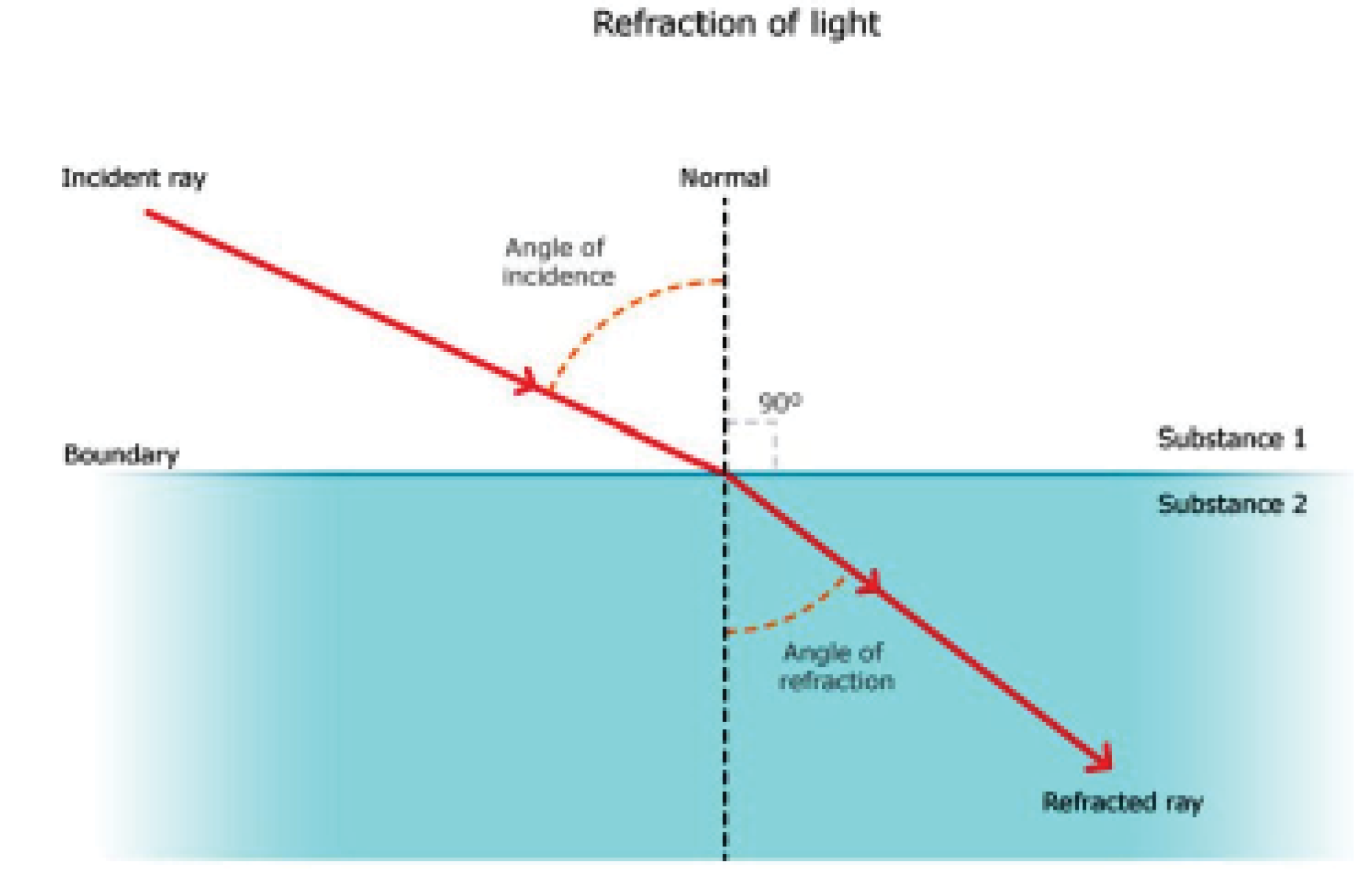
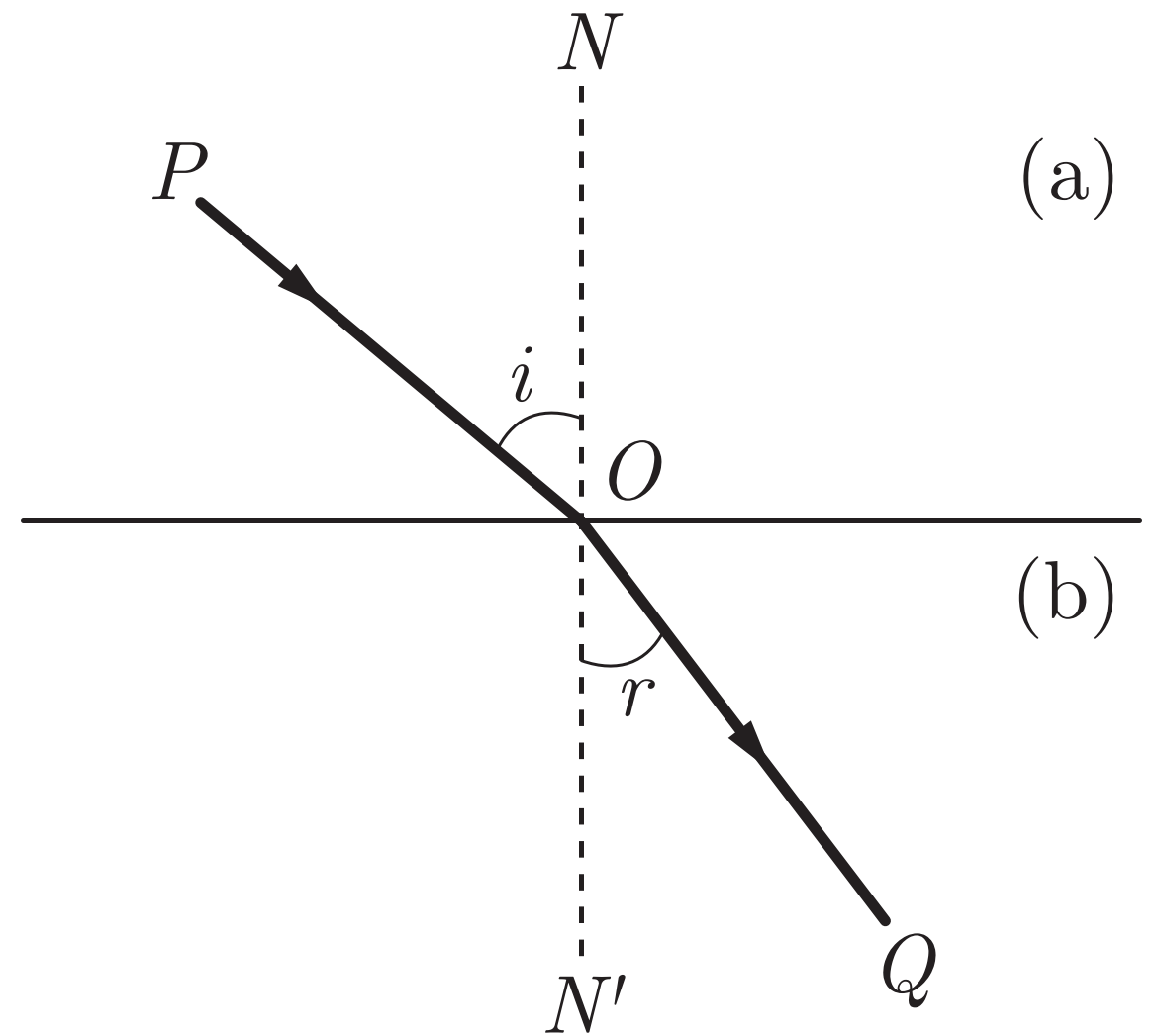
When light travels from a rarer medium to a denser one, it bends towards the normal $(i>r)$ and when travels from a denser medium to a rarer one. it bends away from the normal $(iWhere, $\quad i=$ Angle of incidence
and $\quad r=$ Angle of refraction
We can see refraction in our daily life, some of the examples are given below :
The bottom of a tank or pond containing water appears to be raised due to refraction of light which takes place when light rays pass from the pool of water into the air. The letters appear to be raised when viewed through a glass slab placed over the document because of refraction of light.
When a light ray enters in a glass slab, then the emergent ray is parallel to the incident ray but it is shifted sideward slightly.
In this case, refraction takes place twice, first when ray enters glass slab from air and second when exits from glass slab to air.
(i) What do you mean by optically rarer and denser medium ?
(ii) What is the cause of refraction?
(iii) Draw a ray diagram shotving refraction through a glass slab.
or
(iv) Give one example of refraction from our daily life experience other than the two examples given above.
Answer

(i) $\quad \Lambda$ medium in which the speed of light is more, is known as optically rarer medium and the medium in which speed of light is lesser is known as optically denser medium.
(ii) Speed of light is different in different media. It is lesser in denser medium and higher in rarer medium. So, when light enters a denser medium, its speed reduces and it bends towards the normal and when it enters rarer medium, its speed increases and it bends away from the normal
(iv) A lemon kept in water in a glass tumbler appears to be bigger than its actual size, when viewed from the sides.

Need a full question paper?

Generate a complete, print-ready paper with questions like this in minutes — across 16+ boards, with answer keys.

Start Generating Free

Similar questions

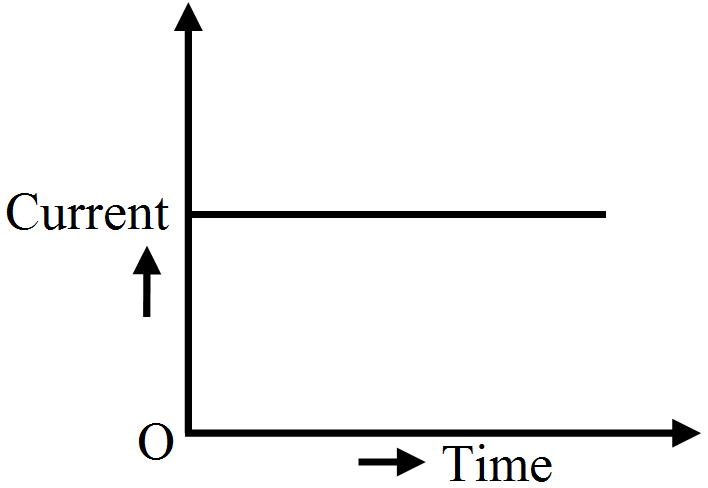
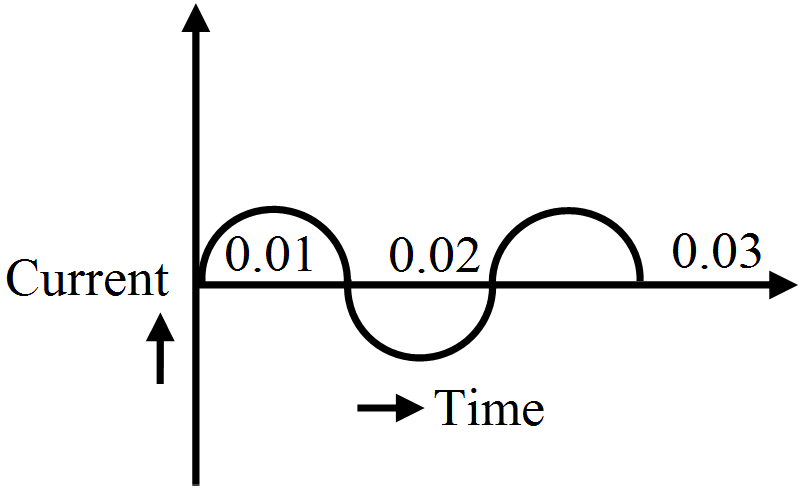
You are given the following current- time graphs from two different sources:


Now, answer the following questions:
  1. Name the type of current in two cases. 
  2. Identify any one source for each type of these currents. 
  3. What is the frequency of current in case (b) in India?
Use above graphs to write two differences between the current in two cases.
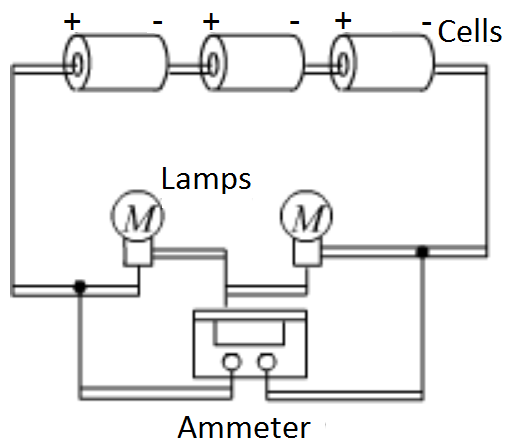
A student made an electric circuit shown here to measure the current through two lamps.
  1. Are the lamps in series or parallel?
  2. The student has made a mistake in this circuit. What is the mistake?
  3. Draw a circuit diagram to show the correct way to connect the circuit. Use the proper circuit symbols in your diagram.

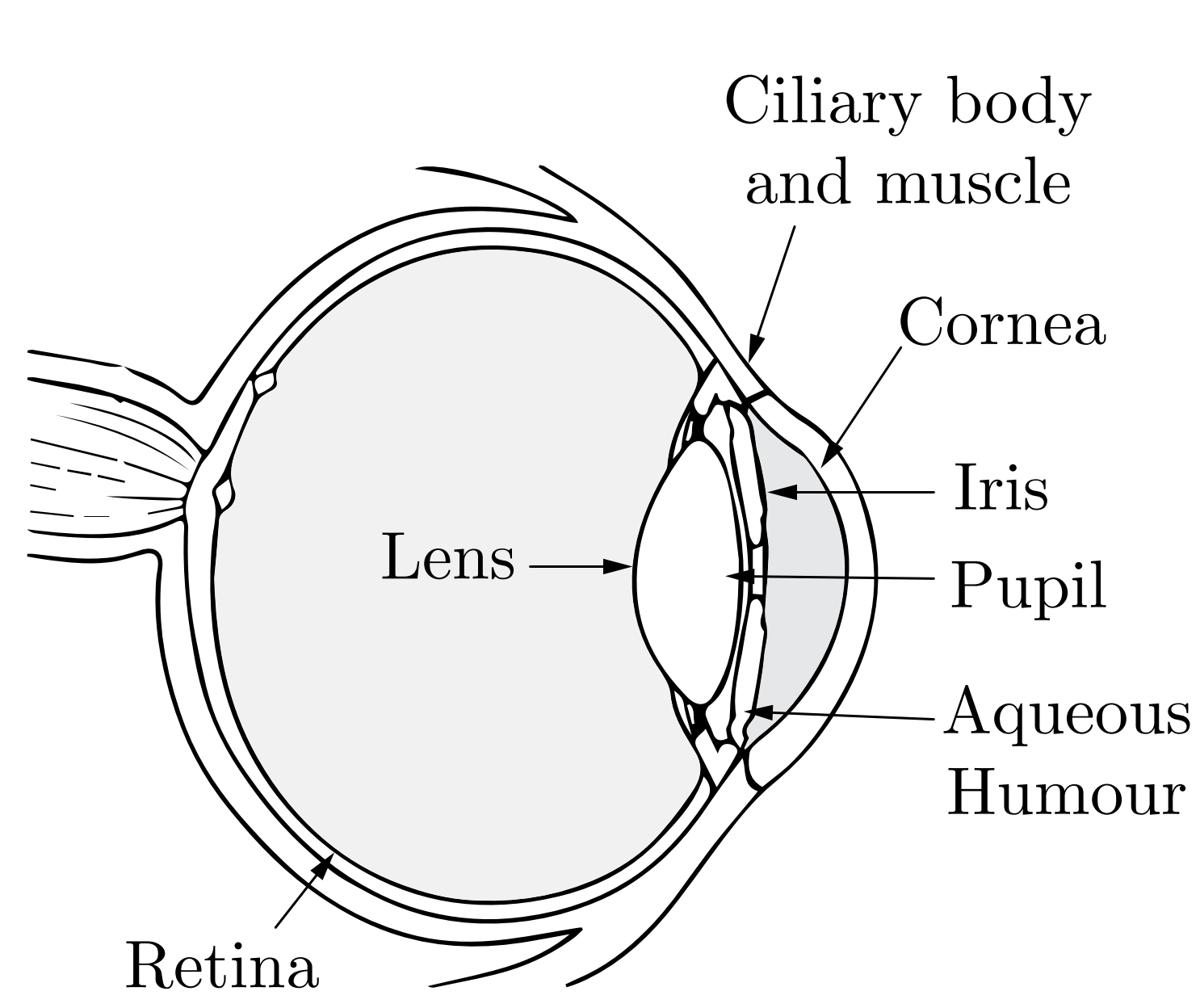
The lens of the eye does little of the bending of the light rays. Most of the refraction is done at the front surface of the cornea which also acts as a protective covering. The lens acts as a fine adjustment for focussing at different distances. This is accomplished by the ciliary muscle, which change the curvature of the lens so that its focal length is changed. To focus on a distant object, the muscles are relaxed and the lens is thin and parallel rays focus at the focal point (on the retina). To focus on a nearby object, the muscles contract, causing the centre of the lens to be thicker, thus shortening the focal length so that images of nearby objects can be focused on the retina, behind the focal point. This focusing adjustment is called accommodation.
The closest distance at which the eye can focus clearly is called the near point of the eye. A given person's far point is the farthest distance at which an object can be seen clearly. To check your own near point, place this book close to your eye and slowly move it away until the type is sharp.
A large part of the population have eyes that do not accommodate within the normal range of $25 cm$ to infinity, or have some other defect. Two common defects are near-sightedness and far-sightedness. Both can be corrected to a large extent with lenses-either eyeglasses or contact lenses.
(i) The ciliary muscle muscles of a normal eye are in their (i). most relaxed (ii). most contracted state. In which of the two cases is the focal length of the eye-lens more?
(ii) What is the least distinct of vision of young man?
(iii) What is persistence of vision?
or
(iv) What is meant by power of accommodation of the eye?
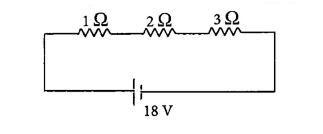
Two or more resistances are connected in series or in parallel or both, depending upon whether we want to increase or decrease the circuit resistance.
Image
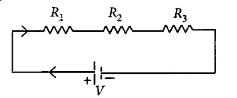
The two or more resistances are said to be connected in series if the current flowing through each resistor is the same.
i. When the three resistors each of resistance R ohm are connected in series then what will be the equivalent resistance?
ii. There is a wire of length 20 cm and having resistance $20 \Omega$ cut into 4 equal pieces and then joined in series. What is equivalent resistance?
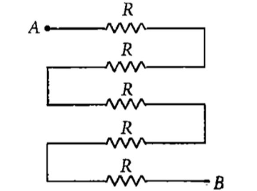
iii. In the following circuit, find the equivalent resistance between A and $\mathrm{B}(\mathrm{R}=2 \Omega)$
Image
OR
In the given circuit, what is the current in each resistor?
Image
Leena creates an electric circuit with three resistors R1, R2 and R3.
Image
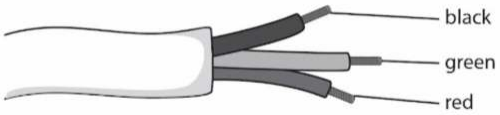
9. Which wire should be connected to the negative terminal of a socket?
Read the following and answer any three questions from (i) to (iv).

The heating effect of current is obtained by transformation of electrical energy in heat energy. Just as mechanical energy used to overcome friction is covered into heat, in the same way, electrical energy is converted into heat energy when an electric current flows through a resistance wire. The heat produced in a conductor, when a current flows through it is found to depend directly on (a) strength of current (b) resistance of the conductor (c) time for which the current flows. The mathematical expression is given by $\text{H} = \text{I}^2\text{Rt}.$

The electrical fuse, electrical heater, electric iron, electric geyser etc. all are based on the heating effect of current.

  1. What are the properties of heating element?

  2. What are the properties of electric fuse?

  3. When the current is doubled in a heating device and time is halved, the heat energy produced will be?
                                             OR
  4. A) A fuse wire melts at 5 A. It is is desired that the fuse wire of same material melt at 10 A. The new radius of the wire will be.

    B) When a current of 0.5A passes through a conductor for 5 min and the resistance of conductor is $10\Omega$ the amount of heat produced will be.
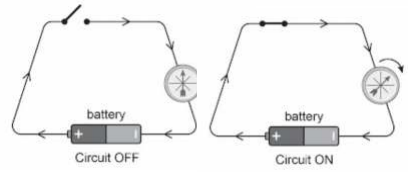
Reema placed a magnetic needle in an electric circuit.
She noticed a delection of the needle when the circuit is turned ON.
Image
3. Reema placed a second battery in the circuit and turned the circuit ON.
What change in the needle will she observe now?
  A. The needle will keep spinning.
  B. The delection of the needle will increase.
  C. The delection of the needle will decrease.
  D. There will be no change in the delection of the needle.
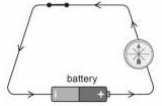
4. Reema reverses the direction of the battery in the circuit.
She turns the circuit ON.
Draw an arrow on the magnetic needle to show the correct delection.
Image
When light ray goes from one transparent medium to another transparent medium, it suffers a change in direction, into second medium. The extent of the change in direction suffered by the phenomenon of change in the path of light rays when going from one medium to another medium is known as refraction. Ray is a given pair of media can be expressed in terms of refractive index. The refractive index is related to an important physical quantity in the relative speed of light in different media.

(i) A ray of light enters into the glass from air. Does it bend towards normal ?
(ii) What is the unit of refractive index?
(iii) Light enters from air to glass having refractive index 1.50. What is the speed of light in the glass? The speed of light in vacuum is $3 \times 10^3 ms ^{-1}$.
or
(iii) When light goes from one medium to another, which of the three parameters, frequency, wavelength, velocity change?
In 1827, a German physicist Georg Simon Ohm (1787-1854) found out the relationship between the current I, flowing in metallic wire and the potential difference across its terminals. He stated that the electric current flowing through a metallic wire is directly proportional to the potential difference V, across its ends provided its temperature remains the same.
The resistance of a circuit is defined as the ratio between the voltage applied to the current flowing through it. Rearranging the above relation,
$R=\frac{V}{I}$
Electric charge flows easily through some materials than others. The electrical resistance measures how much the flow of this electric charge is restricted within the circuit.
Image
i. What is the unit of electrical resistance?
ii. Define Ohm's law.
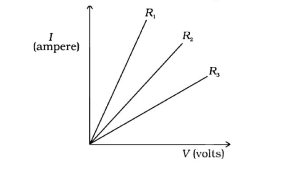
iii. From graph which resistance have high resistance?
OR
What does the slope of V-I graph at any point represent?