Question
In 1827, a German physicist Georg Simon Ohm (1787-1854) found out the relationship between the current I, flowing in metallic wire and the potential difference across its terminals. He stated that the electric current flowing through a metallic wire is directly proportional to the potential difference V, across its ends provided its temperature remains the same.
The resistance of a circuit is defined as the ratio between the voltage applied to the current flowing through it. Rearranging the above relation,
$R=\frac{V}{I}$
Electric charge flows easily through some materials than others. The electrical resistance measures how much the flow of this electric charge is restricted within the circuit.
Image
i. What is the unit of electrical resistance?
ii. Define Ohm's law.
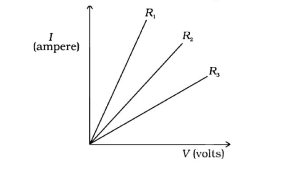
iii. From graph which resistance have high resistance?
OR
What does the slope of V-I graph at any point represent?
Answer

i. Ohm is the unit of electrical resistance.
ii. According to Ohm's law, there is a relation between the current flowing through a conductor and the potential difference across it. It is given by,
$\mathrm{V} \propto \mathrm{I} \mathrm{V}=\mathrm{IR}$
iii. $\mathrm{R}_{3}$ resistance has high resistance.
OR
The slope of V-I graph at any point represents resistance.

Need a full question paper?

Generate a complete, print-ready paper with questions like this in minutes — across 16+ boards, with answer keys.

Start Generating Free

Similar questions

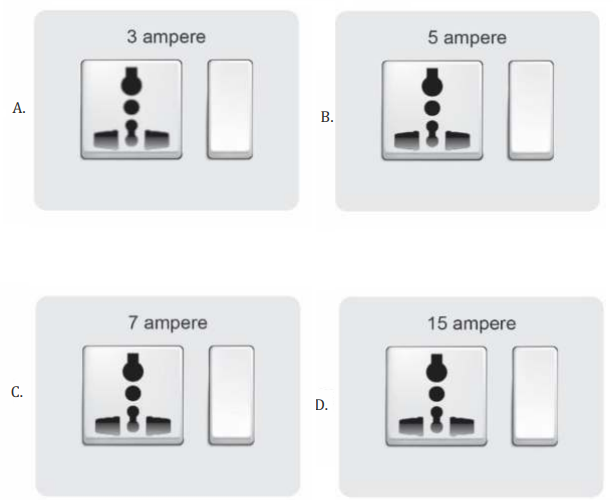
Electrical devices often have an ampere marking to indicate the strength of electric current
required for it to work.
10. Will there be any change in the ammeter reading if the length of the wire in the circuit is doubled?
Explain your answer. 
Image
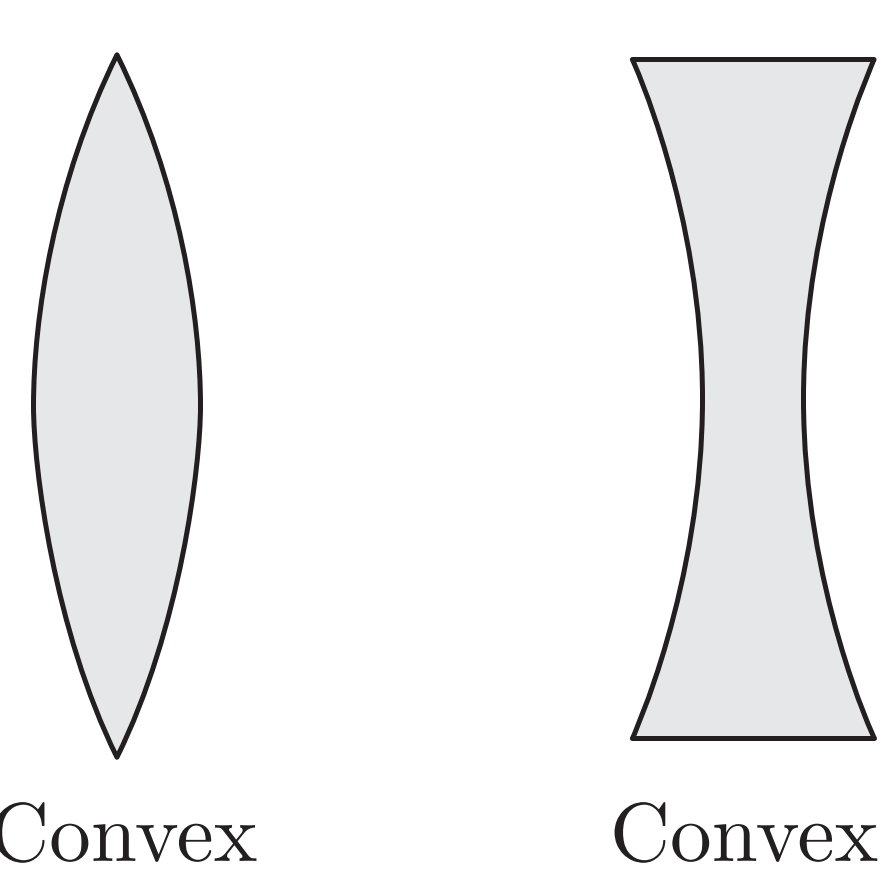
A concave lens is thick at the edges and thin at the centre, while a convex lens is thick at the centre and thin at the edges. We can distinguish between a concave lens and a convex lens without touching them. For this keep a book close to a lens and observe the image of the text of the book through the lens. If the letters appear enlarged, then it is a convex lens and if the letters appear diminished then it is a concave lens.

Convex lens converges light rays and hence known as converging lens. Similarly, concave lens diverges light rays and is known as diverging lens. Linear magnification produced by a lens is equal to the ratio of the image distance to the object distance. Power of a lens is defined as the reciprocal of its focal length.
(i) What type of image is always made by a concave lens?
(ii) If magnification produced by a spherical lens is $+0.75$, then what is the nature of the lens ?
(iii) What is the power of a convex lens with focal length $80 cm$ ?
or
(iii) What kind of lens is present in human eye?
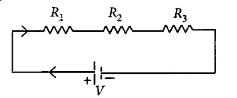
Leena creates an electric circuit with three resistors R1, R2 and R3.
Image
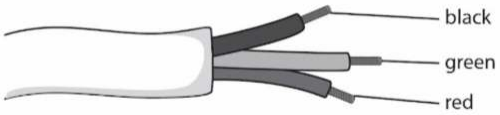
9. Which wire should be connected to the negative terminal of a socket?
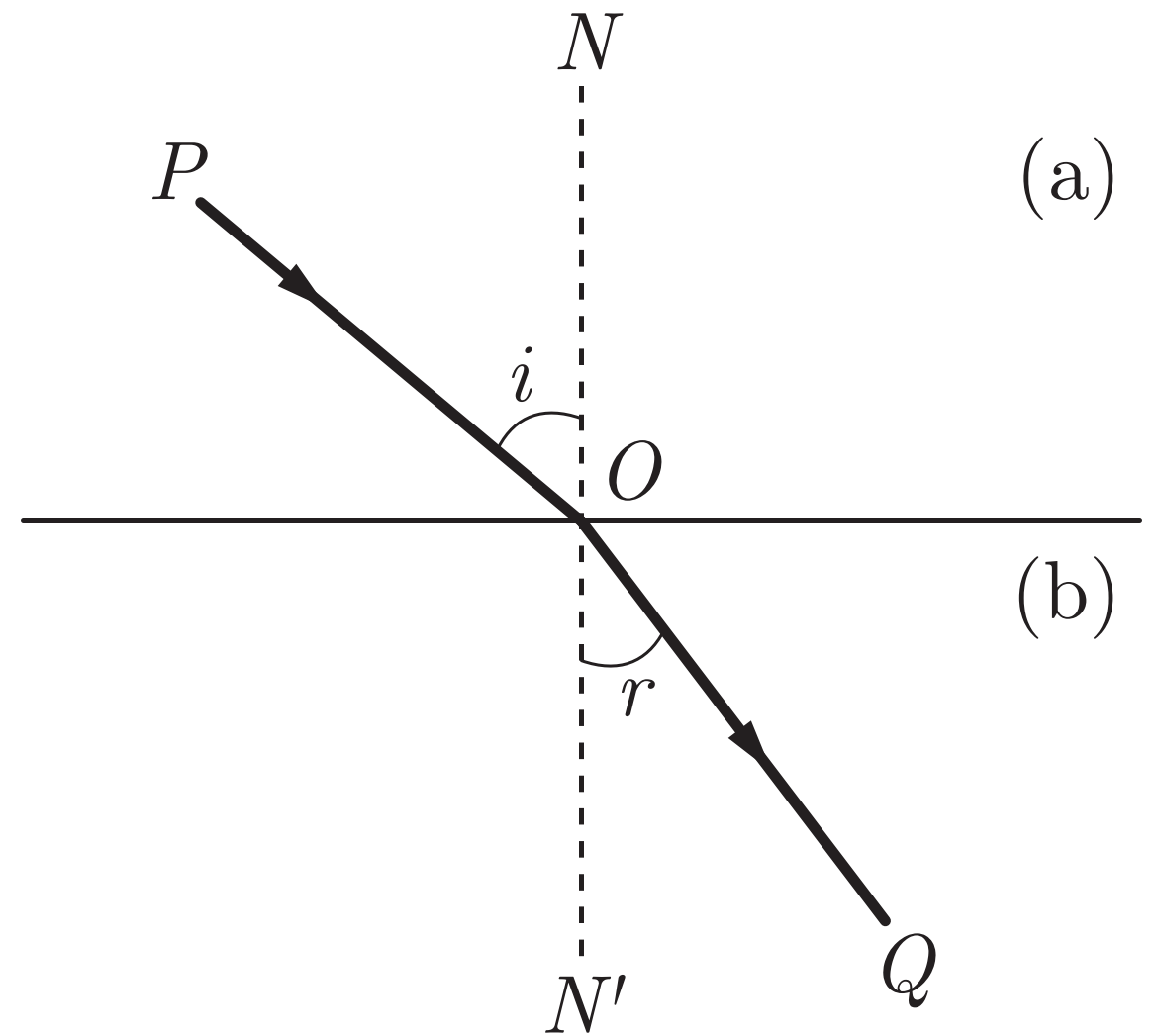
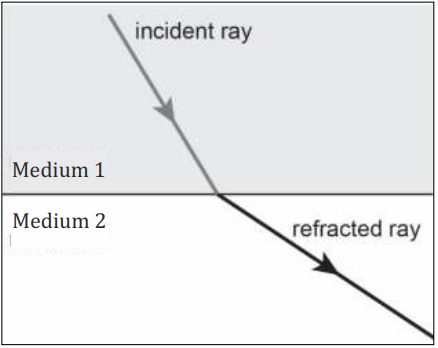
When light ray goes from one transparent medium to another transparent medium, it suffers a change in direction, into second medium. The extent of the change in direction suffered by the phenomenon of change in the path of light rays when going from one medium to another medium is known as refraction. Ray is a given pair of media can be expressed in terms of refractive index. The refractive index is related to an important physical quantity in the relative speed of light in different media.

(i) A ray of light enters into the glass from air. Does it bend towards normal ?
(ii) What is the unit of refractive index?
(iii) Light enters from air to glass having refractive index 1.50. What is the speed of light in the glass? The speed of light in vacuum is $3 \times 10^3 ms ^{-1}$.
or
(iii) When light goes from one medium to another, which of the three parameters, frequency, wavelength, velocity change?
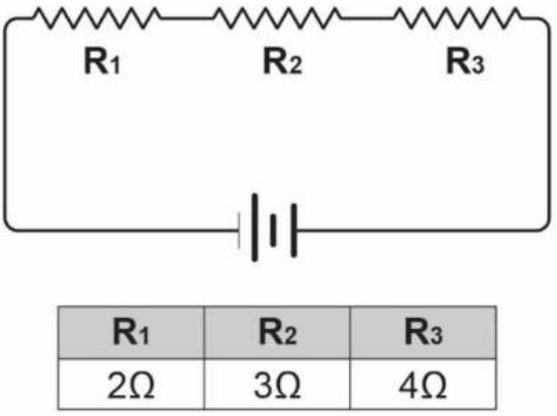
Leena creates an electric circuit with three resistors R1, R2 and R3.
Image
9. What is the equivalent resistance of the circuit?
  A. 3 Ω
  B. 4 Ω
  C. 5 Ω
  D. 9 Ω
Two or more resistances are connected in series or in parallel or both, depending upon whether we want to increase or decrease the circuit resistance.
Image
The two or more resistances are said to be connected in series if the current flowing through each resistor is the same.
i. When the three resistors each of resistance R ohm are connected in series then what will be the equivalent resistance?
ii. There is a wire of length 20 cm and having resistance $20 \Omega$ cut into 4 equal pieces and then joined in series. What is equivalent resistance?
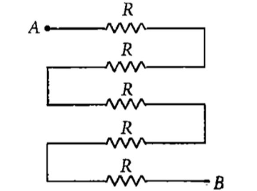
iii. In the following circuit, find the equivalent resistance between A and $\mathrm{B}(\mathrm{R}=2 \Omega)$
Image
OR
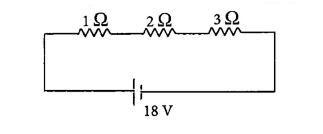
In the given circuit, what is the current in each resistor?
Image

 
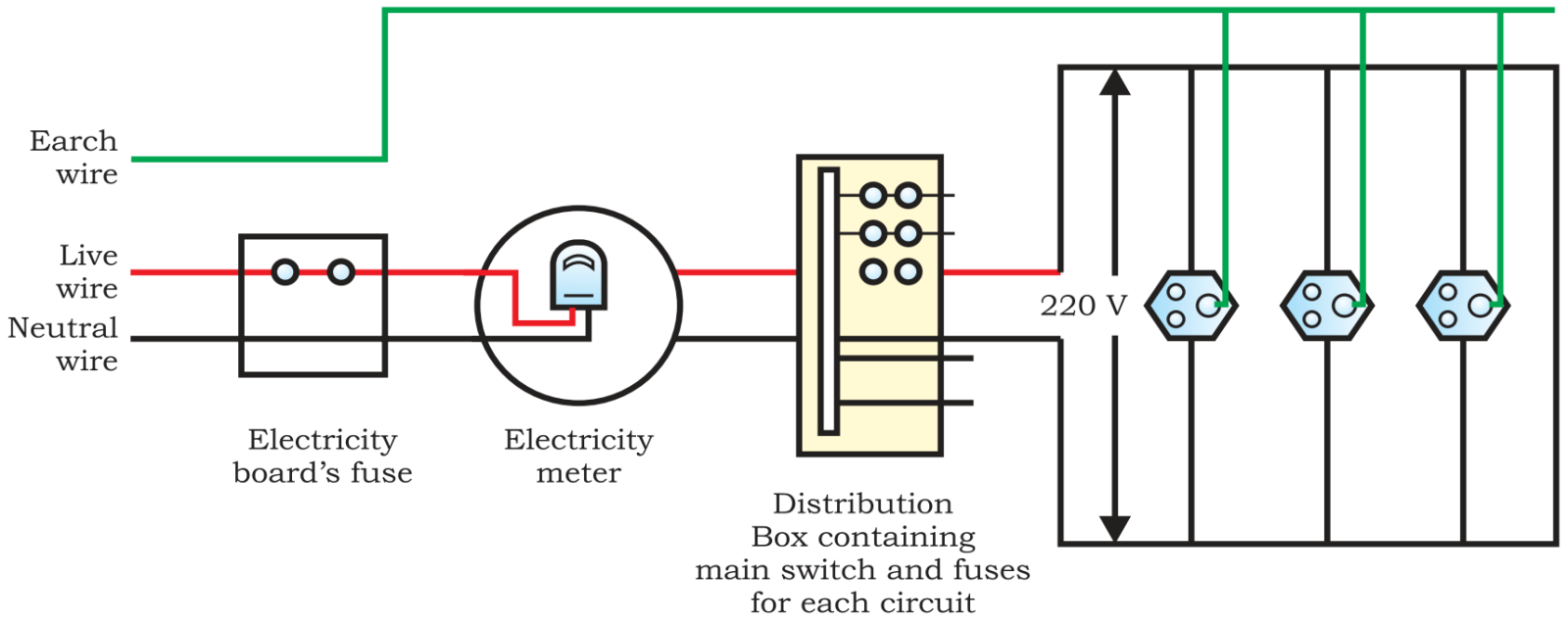
  1. The figure shows a domestic electric circuit. Study this circuit carefully and list any three errors in the circuit and justify your answer.
  2. Give one difference between the wires used in the element of an electric heater and in a fuse.
  3. List two advantages of parallel connection over series connection.1 image attached.
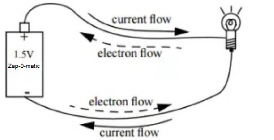
The rate of flow of charge is called electric current. The SI unit of electric current is Ampere (A). The direction of flow of current is always opposite to the direction of flow of electrons in the current.
Image
The electric potential is defined as the amount of work done in bringing a unit-positive test charge from infinity to a point in the electric field. The amount of work done in bringing a unit positive test charge from one point to another point in an electric field is defined as potential difference.
$V_{A B}=V_{B}-V_{A}=\frac{W_{B A}}{q}$
The SI unit of potential and potential difference is volt.
i. Write the formula of voltage in terms of work done, current, time and charge.
ii. What is the number of electrons flowing per second in a conductor if 1 A current is passing through it?
iii. What would be the potential difference between the two terminals of a battery, if 100 joules of work is required to transfer 20 coulombs of charge from one terminal of the battery to other?
OR
The 2 C of charge is flowing through a conductor in 100 ms , then what would be the current in the circuit?