MCQ
Choose the correct answer from alternatives given.
If $\overrightarrow{\text{E}}$ and $\overrightarrow{\text{B}}$ represent electric and magnetic field vectors of an electromagnetic wave, the direction of propagation of the wave is along.
  • A
    $\overrightarrow{\text{B}}\times\overrightarrow{\text{E}}$
  • B
    $\overrightarrow{\text{B}}$
  • C
    $\overrightarrow{\text{E}}$
  • D
    $\overrightarrow{\text{E}}\times\overrightarrow{\text{B}}$
Answer

  1. $\overrightarrow{\text{E}}\times\overrightarrow{\text{B}}$

Explanation:

Electromagnet waves have electric field as well as magnetic field which are perpendicular to each other and the electromagnetic waves propagate in a direction

which is perpendicular to both the fields.

Thus the propagation vector of EM waves $\overrightarrow{\text{k}}=\overrightarrow{\text{E}}\times\overrightarrow{\text{B}}$

Need a full question paper?

Generate a complete, print-ready paper with questions like this in minutes — across 16+ boards, with answer keys.

Start Generating Free

Similar questions

The output of a step-down transformer is measured to be 24V when connected to a 12 watt light bulb. The value of the peak current is:

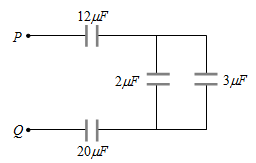
In the circuit diagram shown in the adjoining figure, the resultant capacitance between P and Q is

(a) 47 μF 

(b) 3 μF

(c) 60 μF

(d) 10 μ F

A nucleus of mass 218 amu in free state decays to emit an a-particle. Kinetic energy of the a-particle emitted is 6.7 MeV. The recoil energy (in MeV) of the daughter nucleus is

(a) 1.0

(b) 0.5

(c) 0.25

(d) 0.125

A semiconductor device is connected in a series circuit with a battery and resistance. A current is found to pass through the circuit. If the polarity of the battery is reversed, the current drops almost to zero. The device may be:
 The formula for electrostatic potential is _____________.

A particle is moving in a uniform magnetic field, then

(a) Its momentum changes but total energy remains the same

(b) Both momentum and total energy remain the same

(c) Both will change

(d) Total energy changes but momentum remains the same

A capacitor of capacitance C is charged to a potential V. The flux of the electric field through a closed surface enclosing the capacitor is:
  1. $\frac{\text{CV}}{\in_0}$
  2. $\frac{\text{2CV}}{\in_0}$
  3. $\frac{\text{CV}}{2\in_0}$
  4. $\text{Zero}.$
Huygen's principle cannot explain __________ .
In the electrolysis of NaCl:

If T is the half life of a radioactive material, then the fraction that would remain after a time   is

(a)   

(b)  

(c)  

(d)