Question
Choose the correct answer from the given four options.
The feasible solution for a LPP is shown in. Let Z = 3x - 4y be the objective function.
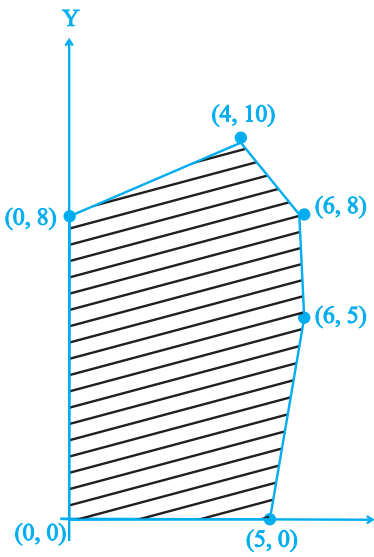
Minimum of Z occurs at:
Answer

  1. (0, 8)
Solution:
Corner points
Corresponding value of Z = 3x - 4y
(0, 0)
(5, 0)
(6, 5)
(6, 8)
(4, 10)
(0, 8)
0
15 - 2
-14
-28
-32 (Minimum)
Hence, the minimum of Z occurs at (0, 8) and its minimum value is (-32).

Need a full question paper?

Generate a complete, print-ready paper with questions like this in minutes — across 16+ boards, with answer keys.

Start Generating Free

Similar questions

The system of equations:
x + y + z = 5
x + 2y + 3z = 9
x + 3y + λz = µ
has a unique solution, if
  1. λ = 5, µ = 13
  2. λ ≠ 5
  3. λ = 5, µ ≠ 13
  4. µ ≠ 13
$\int\frac{\sin\text{x}}{3+4\cos^2\text{x}}\text{ dx}=$
  1. $\log(3+4\cos^2\text{x})+\text{C}$
  2. $\frac{1}{2\sqrt{3}}\tan^{-1}\Big(\frac{\cos\text{x}}{\sqrt{3}}\Big)+\text{C}$
  3. $-\frac{1}{2\sqrt{3}}\tan^{-1}\Big(\frac{2\cos\text{x}}{\sqrt{3}}\Big)+\text{C}$
  4. $\frac{1}{2\sqrt{3}}\tan^{-1}\Big(\frac{2\cos\text{x}}{\sqrt{3}}\Big)+\text{C}$
Let R be a relation on the set N of natural numbers denoted by nRm ⇔ n is a factor of m (i.e. n | m). Then, R is:
  1. Reflexive and symmetric.
  2. Transitive and symmetric.
  3. Equivalence.
  4. Reflexive, transitive but not symmetric.
If $A$ is a square matrix such that $A^2 = I,$ then $(A - I)^3 + (A + I)^3 - 7A$ is equal to:
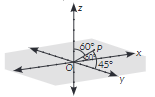
A line $\overrightarrow{O P}$ in space, represented by the figure below; has a magnitude of $2 \sqrt{2}$ units.
Image
Which of these are the direction ratios of $\overrightarrow{O P}$ ?
If $A$ is square matrix of order $3,$ then $∣​\text{adj}(\text{adj}\ \text{A}^2)​∣$
A person writes 4 letters and addresses 4 envelopes. If the letters are placed in the envelopes at random, then the probability that all letters are not placed in the right envelopes, is
The points of discontinuity of the function $\text{f(x)}=\begin{cases}2\sqrt{\text{x}},&0\leq\text{x}\leq1\\4-2\text{x},&1<\text{x}<\frac{5}{2}\\2\text{x}-7,&\frac{5}{2}\leq\text{x}\leq4\end{cases}$ is (are):
  1. $\text{x}=1,\text{x}=\frac{5}{2}$
  2. $\text{x}=\frac{5}{2}$
  3. $\text{x}=1,\frac{5}{2},4$
  4. $\text{x}=0,4$
$Q^+$ is the set of all positive rational numbers with the binary operation $*$ defined by $\text{a}*\text{b}=\frac{\text{ab}}2\ \forall\text{ a, b}\in\text{Q}^+$. The inverse of an element $\text{a}\in\text{Q}^+$ is:
Given that $A$ is a non$-$singular matrix of order $3$ such that $A^2=2 A$, then value of $|2 A|$ is