Question
Choose the correct answer from the given four options. The feasible solution for a LPP is shown in. Let Z = 3x - 4y be the objective function.
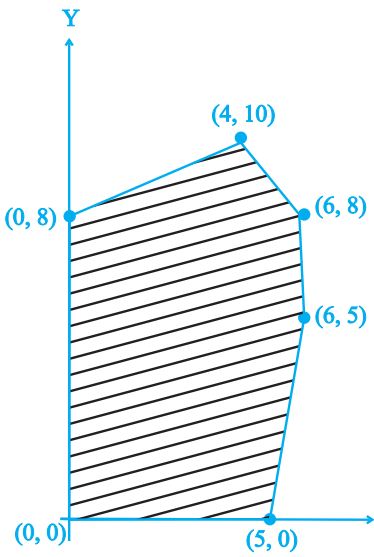
Maximum of Z occurs at:

Answer

  1. (5, 0)
Solution:
Corner points
Corresponding value of Z = 3x - 4y
(0, 0)
(5, 0)
(6, 5)
(6, 8)
(4, 10)
(0, 8)
0
15 (Maxmimum)
-2
-14
-28
-32
Hence, maximum of Z occurs at (5, 0) and its maximum value is 27.

Need a full question paper?

Generate a complete, print-ready paper with questions like this in minutes — across 16+ boards, with answer keys.
Start Generating Free

Similar questions

The area bounded by the curve $x = 3y^2 – 9$ and the line $x = 0, y = 0$ and $y = 1$ is$:$
If $\text{y}=\text{x}^{\text{n}-1}\log\text{x}$ $\text{x}^2\text{y}_2+(3-2\text{n})\text{xy}_1$ is equals to$:$
If $\text{f(x)}=|\log_{10}\text{x}|\text{fx}=\log_{10}\text{x},$ then at x = 1:
  1. f(x) is continuous and $\text{f}'(1^+)=\log_{10}\text{e}$
  2. f(x) is continuous and $\text{f}'(1^+)=\log_{10}\text{e}$
  3. f(x) is continuous and $\text{f}'(1^-)=-\log_{10}\text{e}$
  4. f(x) is continuous and $\text{f}'(1^-)=-\log_{10}\text{e}$
The domain of the function $\cos ^{-1}(2 x-1)$ is
By graphical method, the solution of linear programming problem
Maximize $Z = 3x_1 + 5x_2$
Subject to
$3x_1 + 2x_2 \leq 18$
$x_1 \leq 4$
$x_2 \leq 6$
$x1 \geq 0, x2 \geq 0,$ is:
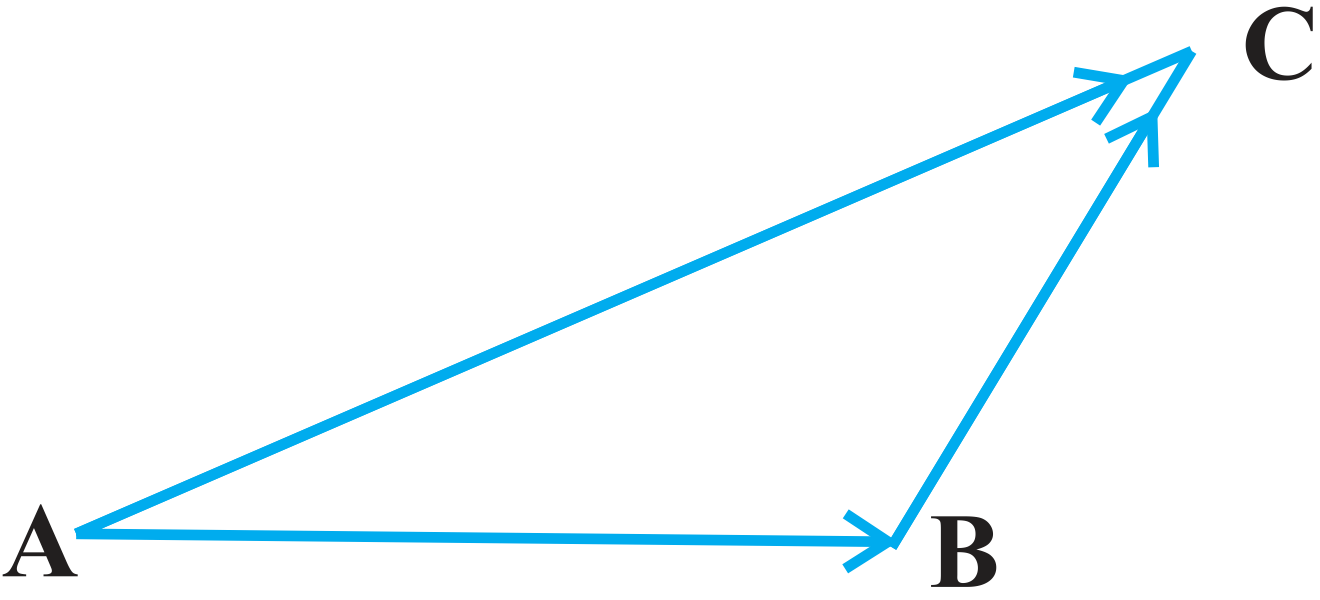
In triangle ABC (Fig 10.18), which of the following is not true:
  1. $\overrightarrow{\text{AB}}+\overrightarrow{\text{BC}}+\overrightarrow{\text{CA}}=\vec{0}$
  2. $\overrightarrow{\text{AB}}+\overrightarrow{\text{BC}}-\overrightarrow{\text{AC}}=\vec{0}$
  3. $\overrightarrow{\text{AB}}+\overrightarrow{\text{BC}}-\overrightarrow{\text{CA}}=\vec{0}$
  4. $\overrightarrow{\text{AB}}-\overrightarrow{\text{CB}}+\overrightarrow{\text{CA}}=\vec{0}$
$\int\limits^{2\text{a}}_0\text{f}(\text{x})\text{dx}$ is equal to:
  1. $2\int\limits^{\text{a}}_0\text{f(x)}\text{dx}$
  2. $0$
  3. $\int\limits^{\text{a}}_0\text{f}(\text{x})\text{dx}+\int\limits^{\text{a}}_0\text{f}(2\text{a}-\text{x})\text{dx}$
  4. $\int\limits^{\text{a}}_0\text{f}(\text{x})\text{dx}+\int\limits^{2\text{a}}_0\text{f}(2\text{a}-\text{x})\text{dx}$
The element in the second row and third column of the matrix $\begin{bmatrix}4&\text{amp; }5&\text{amp; }6 \\3 &\text{amp;}-4&\text{amp; }3\\2 &\text{amp; }1&\text{amp; }0 \end{bmatrix}$ is$:$
What is the value of  $\int_{0}^{1}\frac{\text{d}}{\text{dx}}\{\sin^{-1}(\frac{2\text{x}}{1+\text{x}^2})\}\text{dx}?$
  1. $0$
  2. $\pi$
  3. $-\pi$
  4. $\frac{\pi}{2}$
The equation of the plane parallel to the lines x - 1 = 2y - 5 = 2z and 3x = 4y - 11 = 3z -4 and passing through the point (2, 3, 3) is: