MCQ
Choose the correct answer from the given four options.

The feasible solution for a LPP is shown in. Let Z = 3x - 4y be the objective function.
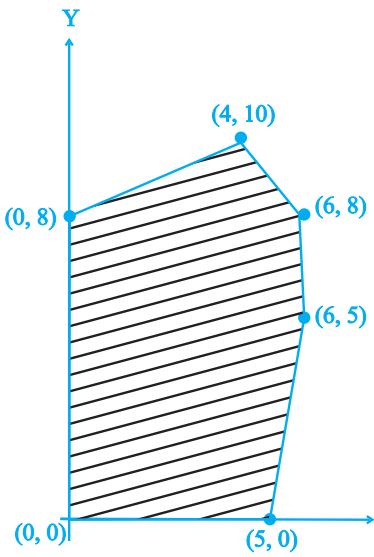
Maximum of Z occurs at:

  • A
    (5, 0)
  • B
    (6, 5)
  • C
    (6, 8)
  • D
    (4, 10)

Answer

  1. (5, 0)

Solution:

Corner points
Corresponding value of Z = 3x - 4y
(0, 0)
(5, 0)
(6, 5)
(6, 8)
(4, 10)
(0, 8)
0
15 (Maxmimum)
-2
-14
-28
-32

Hence, maximum of Z occurs at (5, 0) and its maximum value is 27.

Need a full question paper?

Generate a complete, print-ready paper with questions like this in minutes — across 16+ boards, with answer keys.

Start Generating Free

Similar questions

For $\mathrm{x} \in \mathbb{R}$, let $\mathrm{y}(\mathrm{x})$ be a solution of the differential equation $\left(x^2-5\right) \frac{d y}{d x}-2 x y=-2 x\left(x^2-5\right)^2$ such that $y(2)=7$
The value of $\int_{-\frac{\pi}{2}}^{\frac{\pi}{2}}\left(\frac{1+\sin ^{2} \mathrm{x}}{1+\pi^{\sin \mathrm{x}}}\right)\, \mathrm{dx}$ is
If $\text{A}=\begin{bmatrix} 2 & -1 \\ 3 & -2 \end{bmatrix},$ then An =

  1. $\text{A}=\begin{bmatrix} 1 & 0 \\ 0 & 1 \end{bmatrix},$ if n is an even natural number

  2. $\text{A}=\begin{bmatrix} 1 & 0 \\ 0 & 1 \end{bmatrix},$ if n is an odd natural number

  3. $\text{A}=\begin{bmatrix} -1 & 0 \\ 0 & 1 \end{bmatrix},\text{if n}\in\text{N}$

  4. None of these.

$\int_0^{\pi /2} {\frac{1}{{1 + \sqrt {\tan x} }}} \,dx = $
$\int_0^{\pi /4} {\log (1 + \tan \theta )\,d\theta = } $
$f: A \rightarrow B$ and $g: B \rightarrow C$ be two invertible functions then $(g \circ f)^{-1}=$ _________.
Let $A$ and $B$ be non empty sets in $R$ and $f : A \to B$ is a bijective function.
Statement $1$ : $f$ is an onto function .
Statement $2$ : There exists a function $g : B \to A$ such that $fog = I_B$
The function $g (x) =$ $\left[ \begin{gathered}   \hfill \\   \hfill \\ \end{gathered}  \right.$$\begin{gathered}  x + b,\,\,\,x < 0 \hfill \\   \hfill \\  \cos x,\,\,\,x \geqslant 0 \hfill \\ \end{gathered} $ can be made differentiable at $x = 0.$
Let $P=\left[\begin{array}{ccc}3 & -1 & -2 \\ 2 & 0 & \alpha \\ 3 & -5 & 0\end{array}\right]$, where $\alpha \in \mathbb{R}$. Suppose $Q=\left[q_{i j}\right]$ is a matrix such that $P Q=k I$, where $k \in \mathbb{R}, k \neq 0$ and $I$ is the identity matrix of order $3$ . If $q_{23}=-\frac{k}{8}$ and $\operatorname{det}(Q)=\frac{k^2}{2}$, then

($A$) $\quad \alpha=0, k=8$

($B$) $4 \alpha-k+8=0$

($C$) $\operatorname{det}(P \operatorname{adj}(Q))=2^9$

($D$) $\operatorname{det}(Q \operatorname{adj}(P))=2^{13}$

Choose the correct answer from the given four options.
If $\text{P}(\text{A})=\frac{3}{10},\text{P}(\text{B})=\frac{2}{5}$ and $\text{P}(\text{A}\cup\text{B})=\frac{3}{5},$ then $\text{P}\Big(\frac{\text{B}}{\text{A}}\Big)+\text{P}\Big(\frac{\text{A}}{\text{B}}\Big)$ equas:
  1. $\frac{1}{4}$
  2. $\frac{1}{3}$
  3. $\frac{15}{12}$
  4. $\frac{7}{2}$