MCQ
Choose the correct answer from the given four options.
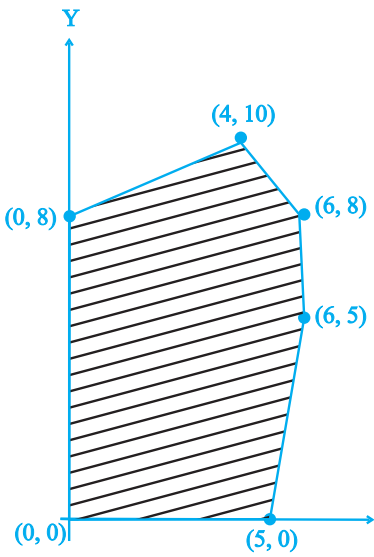
The feasible solution for a LPP shown in Fig. 12.12. Let z = 3x - 4y be objective functio. (Maximum value of Z + Minimum value of Z) is equal to:
  • A
    13.
  • B
    1.
  • C
    -13.
  • D
    -17.

Answer

  1. -17.

Solution:

Corner points
Corresponding value of Z = 3x - 4y
(0, 0)
(5, 0)
(6, 5)
(6, 8)
(4, 10)
(0, 8)
0
15 (Maximum)
-2
-14
-28
-32 (Minimum)

Here, maximum value of Z + minimum value of Z = 15 - 32 = -17.

Need a full question paper?

Generate a complete, print-ready paper with questions like this in minutes — across 16+ boards, with answer keys.

Start Generating Free

Similar questions

The function $f(x) = {x^3} - 6{x^2} + ax + b$ satisfy the conditions of Rolle's theorem in $[1, 3]. $ The values of  $a $ and $ b $ are
If a line makes angles of $90^{\circ}, 135^{\circ}, 45^{\circ}$ with $x, y$ and $z$ axes, then its direction cosines will be :
The probability distribution of a discrete random variable $X$ is given below :
$X$2345
$P(X)$$\frac{5}{k}$$\frac{7}{k}$$\frac{9}{k}$$\frac{11}{k}$
The value of $k$ is
The value of the cofactor of the element of second row and third column in the matrix $\left[\begin{array}{ccc}4 & 3 & 2 \\ 2 & -1 & 0 \\ 1 & 2 & 3\end{array}\right]$ is:
If the centroid of triangle whose vertices are $(a,1, 3), (-2, b, -5)$ and $(4, 7, c)$ be the origin, then the values of $a, b, c$ are
Define a function $f: R \rightarrow R$ by $f(x)=\left\{\begin{array}{cc}\frac{\sin x^2}{x}, & \text { for } x<0 \\ x^2+a x+b, & \text { for } x \geq 0\end{array}\right.$ Suppose $f(x)$ is differentiable of $R$. Then,
Let $A=\left[a_{i j}\right]$ be a real matrix of order $3 \times  3$, such that $a_{i 1}+a_{i 2}+a_{i 3}=1$, for $i=1,2,3$. Then, the sum of all the entries of the matrix $A^{3}$ is equal to:
$\int_{}^{} {\frac{{\tan x}}{{\sec x + \tan x}}\;dx = } $
If w is a non-real cube root of unity and n is not a multiple of 3, then $\begin{vmatrix}1&\omega^{\text{n}}&\omega^{2\text{n}}\\\omega^{2\text{n}}&1&\omega^{\text{n}}\\\omega^{\text{n}}&\omega^{2\text{n}}&1\end{vmatrix}$ is equal to:
  1. $0$
  2. $\omega$
  3. $\omega^2$
  4. $1$
The law a + b = b + a is called:
  1. Closure law.
  2. Associative law.
  3. Commutative law.
  4. Distributive law.