Question
Choose the correct answers from the given four options:
The function $\text{f(x)}=\cot\text{x}$ is discontinuous on the set
  1. $\big\{\text{x}=\text{n}\pi:\text{n}\in\text{Z}\big\}$
  2. $\big\{\text{x}=2\text{n}\pi:\text{n}\in\text{Z}\big\}$
  3. $\Big\{\text{x}=(2\text{n}+1)\frac{\pi}{2};\text{n}\in\text{Z}\Big\}$
  4. $\Big\{\text{x}=\frac{\text{n}\pi}{2};\text{n}\in\text{Z}\Big\}$
Answer

  1. $\big\{\text{x}=\text{n}\pi:\text{n}\in\text{Z}\big\}$

Solution:

Consider, $\text{f(x)}=\cos\text{x}=\frac{\cos\text{x}}{\sin\text{x}}$

We know that, $\big[\sin\text{x}=0\text{ at }\text{x}=\text{n}\pi,\text{n}\in\text{Z}\big]$

Hence, $\text{f(x)}=\cot\text{x}$ is discontinuous on the set $\big\{\text{x}=\text{n}\pi:\text{n}\in\text{Z}\big\}.$ 

Need a full question paper?

Generate a complete, print-ready paper with questions like this in minutes — across 16+ boards, with answer keys.

Start Generating Free

Similar questions

If $\vec{a}=\frac{1}{\sqrt{10}}(3 \hat{i}+\hat{k})$ and $\vec b = \frac{1}{7}\left( {2 \hat{i} + 3 \hat{j} - 6 \hat{k}} \right)$,then the value of  $\left( {2\vec a - \vec b} \right)\cdot\left[ {\left( {\vec a \times \vec b} \right) \times \left( {\vec a + 2\vec b} \right)} \right]$ is
The area bounded by the curve $y=f(x)$, the $x$-axis and $x=1$ and $x=b$ is $(b-1) \sin (3 b+4)$. Which of the following can be $f(x)$ ?
Choose the correct answer from the given four options.

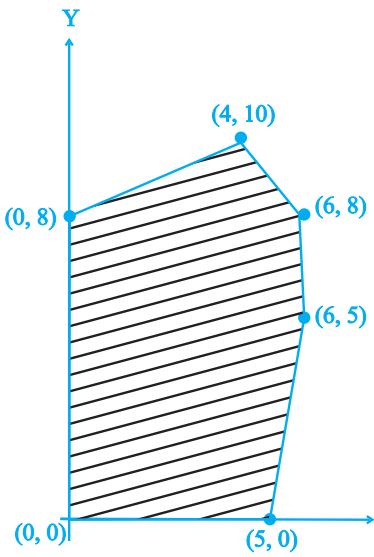
The feasible solution for a LPP is shown in. Let Z = 3x - 4y be the objective function.

Maximum of Z occurs at:

If $y$ = $|cos 4x| + |sin 4x| + |tan 4x|$ then $\frac{{dy}}{{dx}}$ at $x = \frac{\pi }{6}$ is
The direction ratios of the line $x - y + z - 5 = $$0 = x - 3y - 6$ are
Let $y=y(x)$ be the solution of the differential equation $\sec \mathrm{x} d \mathrm{y}+\{2(1-\mathrm{x}) \tan \mathrm{x}+\mathrm{x}(2-\mathrm{x})\}$ $\mathrm{dx}=0$ such that $\mathrm{y}(0)=2$. Then $\mathrm{y}(2)$ is equal to :
If $\int_{0}^{\sqrt{3}} \frac{15 x^{3}}{\sqrt{1+x^{2}+\sqrt{\left(1+x^{2}\right)^{3}}}} d x=\alpha \sqrt{2}+\beta \sqrt{3}$, where $\alpha, \beta$ are integers, then $\alpha+\beta$ is equal to.
For all values of $A,B,C$ and $P,Q,R$, the value of $\left| {\,\begin{array}{*{20}{c}}{\cos (A - P)}&{\cos (A - Q)}&{\cos (A - R)}\\{\cos (B - P)}&{\cos (B - Q)}&{\cos (B - R)}\\{\cos (C - P)}&{\cos (C - Q)}&{\cos (C - R)}\end{array}\,} \right|$ is
The area of ellipse $\frac{\text{x}^2}{4^2}+\frac{\text{y}^2}{9^2}=1$ is:
  1. $6\pi\text{ sq}.\text{units}$
  2. $\frac{\pi(\text{a}^2+\text{b}^2)}{4}\text{ sq}.\text{units}$
  3. $\pi(\text{a+b})\text{ sq}.\text{units}$
  4. $\text{None of these}$
Let $\mathrm{A}=\{1,2,3,4,5\}$. Let $\mathrm{R}$ be a relation on $\mathrm{A}$ defined by $x R y$ if and only if $4 x \leq 5 y$. Let $m$ be the number of elements in $\mathrm{R}$ and $\mathrm{n}$ be the minimum number of elements from $\mathrm{A} \times \mathrm{A}$ that are required to be added to $\mathrm{R}$ to make it a symmetric relation. Then $m+n$ is equal to: