MCQ
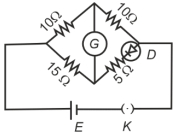
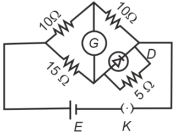
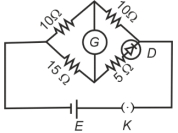
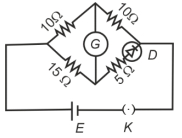
Choose the correct circuit which can achieve the bridge balance.
  • A

  • B

  • C


Answer

Correct option: D.

d
In option ($4$),

$\frac{10}{15}=\frac{10}{5+R_D}$

The diode can conduct and have resistance $R_D=10 \Omega$ because diode have dynamic resistance. In that case bridge will be balanced.

Need a full question paper?

Generate a complete, print-ready paper with questions like this in minutes — across 16+ boards, with answer keys.

Start Generating Free

Similar questions

Assertion : Ohm's law is applicable for all conducting elements.

Reason : Ohm's law is a fundamental law
A rod of a certain metal is $1.0\, m$ long and $0.6\, cm$ in diameter. Its resistance is $3.0 × {10^{ - 3}}\, ohm$. Another disc made of the same metal is $2.0\, cm$ in diameter and $1.0\, mm$ thick. What is the resistance between the round faces of the disc
An insulator plate is passed between the plates of a capacitor. Then, current:
The de Broglie wavelength of an electron moving with kinetic energy of $144 \;eV$ is nearly
$A$. The drift velocity of electrons decreases with the increase in the temperature of conductor.

$B$. The drift velocity is inversely proportional to the area of cross-section of given conductor.

$C$. The drift velocity does not depend on the applied potential difference to the conductor.

$D$. The drift velocity of electron is inversely proportional to the length of the conductor.

$E$. The drift velocity increases with the increase in the temperature of conductor.

Choose the correct answer from the options given below:

Dispersion can take place for
A proton and a deutron ( $\mathrm{q}=+\mathrm{e}, m=2.0 \mathrm{u})$ having same kinetic energies enter a region of uniform magnetic field $\vec{B}$, moving perpendicular to $\vec{B}$. The ratio of the radius $r_d$ of deutron path to the radius $r_p$ of the proton path is:
The mechanism of the heat produced in a conductor when an electric current flows through it, can be explained on the basis of
If $m$ is mass of $_Z{X^A}$  nucleus , $m_n$ and $m_p$ are the masses of neutron and proton respectively so.......
The phase angle between current and voltage in a purely inductive circuit is: