MCQ
Choose the correct option:
  • A
    Zeroth law gives the concept of temperature.
  • B
    Temperature measures the 'hotness' of the body.
  • C
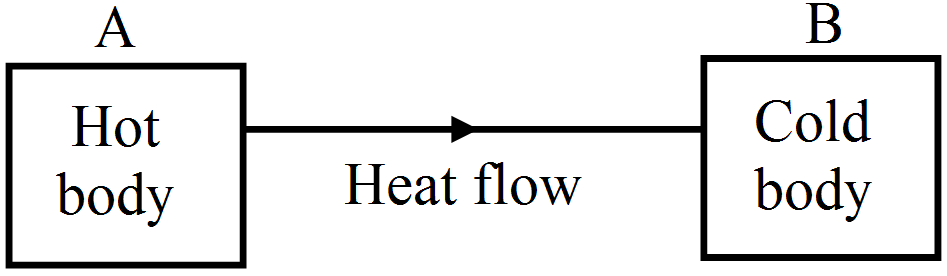
    Heat flows from higher temperature to lower temperature until thermal equilibrium is attained.
  • All of the above.

Answer

Correct option: D.
All of the above.

Heat flows from body $A$ to body $B$ because temperature of body $A$ is higher. At thermal equilibrium, $\text{T}_\text{A}'=\text{T}_\text{B}'$
$A$ in equilibrium with $C$ $A$ in equilibrium with $B$
$B$ in equilibrium with $C$

Need a full question paper?

Generate a complete, print-ready paper with questions like this in minutes — across 16+ boards, with answer keys.
Start Generating Free

Similar questions

Given below are two statements: One is labelled as Assertion $(A)$ and the other is labelled as Reason $(R)$.

Assertion $(A)$: Clothes containing oil or grease stains cannot be cleaned by water wash.

Reason $(R)$: Because the angle of contact between the oil/ grease and water is obtuse. In the light of the above statements, choose the correct answer from the option given below.

Statement $I :$ A cyclist is moving on an unbanked road with a speed of $7\, kmh ^{-1}$ and takes a sharp circular turn along a path of radius of $2 \,m$ without reducing the speed. The static friction coefficient is $0.2$ . The cyclist will not slip and pass the curve $\left( g =9.8\, m / s ^{2}\right)$

Statement $II :$ If the road is banked at an angle of $45^{\circ}$, cyclist can cross the curve of $2\, m$ radius with the speed of $18.5\, kmh ^{-1}$ without slipping.

In the light of the above statements, choose the correct answer from the options given below.

A coin placed on a rotating table just slips when it is placed at a distance of $1\,cm$ from the center. If the angular velocity of the table in halved, it will just slip when placed at a distance of from the centre $............\,cm$
If $g$ is acceleration due to gravity on earth's surface, the gain in potential energy of an object of mass $m$ raised from surface of earth to a height equal to radius $R$ of the earth is:
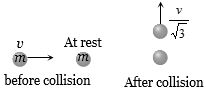
A heavy body moving with a velocity $30\, m/s$ and another small object at rest undergo  an elastic collision. The latter will move with a velocity of .............. $\mathrm{m}/ \mathrm{s}$
Two wheels are connected by a belt. The radius of larger wheel is three times that of the smaller one. What is the ratio of the rotational inertia of larger wheel to the smaller wheel, when both wheels have same angular momentum ?
A uniform disk of mass $m$ and radius $R$ rolls without slipping down an incline plane of length $l$ and inclination $\theta$. Initially the disk was at rest at the top of the incline plane. Its angular momentum about the point of contact with the inclined plane when it reaches the bottom will be equal to :-
When a ceiling fan is switched on, it makes $10$ rotations in first $3\,seconds,$ How many rotations will it make in the next $3\,seconds.$ (Assume uniform angular acceleration)
$A$ small object is attached to a light string which passes through a hollow tube. The tube is held by one hand and the string by the other. The object is stet into rotation in a circle of radius $r_1$. The string is then pulled down, shortening the radius of the circle to $r_2$. The ratio of the new kinetic energy to original kinetic energy is
If $K_{1}$ and $K_{2}$ are the thermal conductivities $L_{1}$ and $L _{2}$ are the lengths and $A _{1}$ and $A _{2}$ are the cross sectional areas of steel and copper rods respectively such that $\frac{K_{2}}{K_{1}}=9, \frac{A_{1}}{A_{2}}=2, \frac{L_{1}}{L_{2}}=2$.

Then, for the arrangement as shown in the figure. The value of temperature $T$ of the steel - copper junction in the steady state will be ........... $^{\circ} C$