Question
Choose the correct relationship between Poisson ratio $(\sigma)$. bulk modulus $( K )$ and modulus of rigidity $(\eta)$ of a given solid object:

Answer

$Y =3 \eta(1+\sigma)$

$Y =3 K (1-\sigma)$

$\Rightarrow 2 \eta(1+\sigma)=3 K (1-2 \sigma)$

$\Rightarrow \sigma=\left(\frac{3 K -2 \eta}{6 K +2 \eta}\right)$

Need a full question paper?

Generate a complete, print-ready paper with questions like this in minutes — across 16+ boards, with answer keys.
Start Generating Free

Similar questions

Which of the following is not due to total internal reflection? 
In a laboratory four convex lenses ${L_1},\,{L_2},\,{L_3}$ and ${L_4}$ of focal lengths $2, 4, 6$ and $8 cm$ respectively are available. Two of these lenses form a telescope of length $10 cm$ and magnifying power $4.$ The objective and eye lenses are
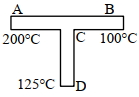
A rod $C D$ of thermal resistance $10.0\; {KW}^{-1}$ is joined at the middle of an identical rod ${AB}$ as shown in figure, The end $A, B$ and $D$ are maintained at $200^{\circ} {C}, 100^{\circ} {C}$ and $125^{\circ} {C}$ respectively. The heat current in ${CD}$ is ${P}$ watt. The value of ${P}$ is ... .
A steel scale measures the length of a copper wire as $80.0\,cm,$ when both are at $20^\circ C$ (the calibration temperature for scale). What would be the scale read for the length of the wire when both are at $40^\circ C$ $?$ (Given $\alpha_{steel} $ = $11 \times {10^{ - 6}}$per$°C$ and $\alpha_{copper}$  = $17 \times {10^{ - 6}}per\,^\circ C$)
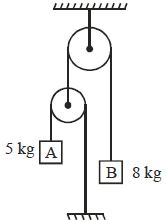
Find the acceleration of block $B$
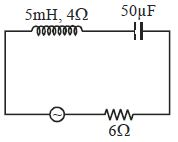
In the circuit shown below, the ac source has voltage $V = 20\, cos \,(\omega t)$ with $\omega  = 2000\,rad/sec$. The amplitude of the current will be nearest to.....$A$
The magnetic field at the origin due to a current element $i\,\overrightarrow {dl} $ placed at position $\vec r$ is

$(i)\,\,\left( {\frac{{{\mu _0}i}}{{4\pi }}} \right)\left( {\frac{{d\vec l\, \times \,\vec r}}{{{r^3}}}} \right)$

$(ii)\,\, - \left( {\frac{{{\mu _0}i}}{{4\pi }}} \right)\left( {\frac{{d\vec l\, \times \,\vec r}}{{{r^3}}}} \right)$

$(iii)\,\left( {\frac{{{\mu _0}i}}{{4\pi }}} \right)\left( {\frac{{\,\vec r \times d\vec l}}{{{r^3}}}} \right)$

$(iv)\, - \left( {\frac{{{\mu _0}i}}{{4\pi }}} \right)\left( {\frac{{\,\vec r \times d\vec l}}{{{r^3}}}} \right)$

A motor-car tyre has a pressure of $2\, atm$ at $27\,^oC$. It suddenly burst's. If $\left( {\frac{{{C_p}}}{{{C_v}}}} \right) = 1.4$ for air, find the resulting temperatures (Given $4^{1/7} = 1.219$)
Between the plates of a parallel plate condenser, a plate of thickness ${t_1}$ and dielectric constant ${k_1}$ is placed. In the rest of the space, there is another plate of thickness ${t_2}$ and dielectric constant ${k_2}$. The potential difference across the condenser will be
In a fission process, nucleus $A$ divides into two nuclei $B$ and $C,$ their binding energies being ${E_a},\;{E_b}$ and ${E_c}$ respectively. Then