MCQ
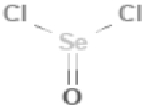
Choose the correct statement regarding $SeOCl_2$ molecule
  • A
    It does not contain plane of symmetry
  • B
    $'Cl - \widehat{Se} - Cl'$ bond angle is greater than $'Cl - \widehat{Se} -O'$ bond  angle
  • C
    Lone pair has greater than $33.3\% \,s-$ character
  • Central atom used one $d-$ orbital in bonding
Answer

Correct option: D.
Central atom used one $d-$ orbital in bonding
d
The structure of $SeOCl _2$ is as follows:

Thus is does have plane of symmetry.

Need a full question paper?

Generate a complete, print-ready paper with questions like this in minutes — across 16+ boards, with answer keys.

Start Generating Free

Similar questions

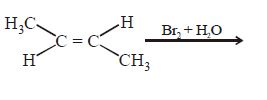
Predict the product of the following reaction.
$17.0\, g$ of $NH _{3}$ completely vapourises at $-33.42^{\circ} C$ and $1\, bar$ pressure and the enthalpy change in the process is $23.4 \,k\,J\, mol ^{-1}$. The enthalpy change for the vapourisation of $85 g$ of $NH _{3}$ under the same conditions is $.....\, kJ .$
Match the following:
Column $I$ Column $II$
$(A)$ $\mathrm{Bi}^{3+} \longrightarrow(\mathrm{BiO})^{+}$ $(P)$ Heat
$(B)$ $\left[\mathrm{AlO}_2\right]^{-} \longrightarrow \mathrm{Al}(\mathrm{OH})_3$ $(Q)$ Hydrolysis
$(C)$ $\mathrm{SiO}_4^{4-} \longrightarrow \mathrm{Si}_2 \mathrm{O}_7^{6-}$ $(R)$ Acidification
$(D)$ $\left(\mathrm{B}_4 \mathrm{O}_7^{2-}\right) \longrightarrow\left[\mathrm{B}(\mathrm{OH})_3\right]$ $(S)$ Dilution by water
$2-$ Butanol $\xrightarrow[\Delta ]{{{H^ + }}}$ Products

If all products formed in the above reaction undergo reaction with $Br_2(CCl_4)$ individually then number of products formed will be :

Major product of reaction is :
Which of the following chemical reactions depict the oxidizing beahviour of $H_2SO_4$ ?
The reaction of ozone with oxygen atoms in the presence of chlorine atoms can occur by a two step process shown below

${O_3}(g)\, + \,C{l^ * }(g)\, \to \,{O_2}(g) + Cl{O^ * }(g)$ ..... $(i)$               $[{K_i} = 5.2 \times {10^9}\,\,L\,mo{l^{ - 1}}\,{s^{ - 1}}]$

$Cl{O^ * }(g) + {O^ * }(g)\, \to \,{O_2}(g) + \,C{l^ * }(g)$ ..... $(ii)$                $[{K_{ii}} = 2.6 \times {10^{10}}\,\,L\,mo{l^{ - 1}}\,{s^{ - 1}}]$

The closest rate constant for the overall reaction 

${O_3}(g){\mkern 1mu}  + {\mkern 1mu} {O^*}(g){\mkern 1mu}  \to {\mkern 1mu} 2{O_2}(g)$ is  ........... $L\,\,mo{l^{ - 1}}\,{s^{ - 1}}$

For sodium atom the number of electrons with $m = 0$ will be
Species have identical shape :-
The deep blue colour produced on adding excess of ammonia to copper sulphate is due to presence of