- AAny charged particle in rest is accompanied by matter waves.
- BAny uncharged particle in rest is accompanied by matter waves.
- CThe matter waves are waves of zero amplitude.
- DThe matter waves are waves of probability amplitude.
Explanation:
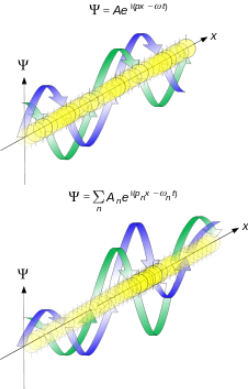
Propagation of de Broglie waves in 1d real part of the complex amplitude is blue, imaginary part is green. The probability (shown as the colour opacity) of finding the particle at a given point x is spread out like a waveform, there is no definite position of the particle.
As the amplitude increases above zero the curvature decreases, so the amplitude decreases again, and vice versa the result is an alternating amplitude: a wave. So, the matter waves are waves of probability amplitude.

Generate a complete, print-ready paper with questions like this in minutes — across 16+ boards, with answer keys.
A coil having N turns carry a current I as shown in the figure. The magnetic field intensity at point P is
|
(a) |
(b) |
(c) |
(d) Zero |
$\lambda_\text{e}=\lambda_\text{p}.$
$\lambda_\text{e}<\lambda_\text{p}.$
$\lambda _\text{e}>\lambda_\text{p}.$
The relation between
Two lenses of power + 12 and – 2 diopters are placed in contact. The combined focal length of the combination will be
|
(a) 8.33 cm |
(b) 1.66 cm |
(c) 12.5 cm |
(d) 10 cm |
If a coil made of conducting wires is rotated between poles pieces of the permanent magnet. The motion will generate a current and this device is called
|
(a) An electric motor |
(b) An electric generator |
|
(c) An electromagnet |
(d) All of above |
The binding energy of the innermost electron in tungsten is 40 keV. To produce characteristic X-rays using a tungsten target in an X-rays tube the potential difference V between the cathode and the anti-cathode should be
|
(a) V< 40 kV |
(b) V ≤ 40 kV |
(c) V > 40 kV |
(d) V >/< 40 kV |
An electron moving in a circular orbit of radius r makes n rotation per second. The magnetic field produced at the centre has a magnitude of
|
(a) |
(b) |
(c) |
(d) Zero |