MCQ
Choose the polar molecule from the following :
- A$\mathrm{CCl}_4$
- B$\mathrm{CO}_2$
- C$\mathrm{CH}_2=\mathrm{CH}_2$
- ✓$\mathrm{CHCl}_3$
$\mu \neq 0$
$\mathrm{CHCl}_3$ is polar molecule and rest all molecules are non-polar.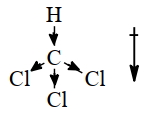
Generate a complete, print-ready paper with questions like this in minutes — across 16+ boards, with answer keys.

$(I)\, s-$ orbital of $A$ and $P_x$ -orbital of $B$
$(II)\, s-$ orbital of $A$ and $P_z$ orbital of $B$
$(Ill)\, p_y$ -orbital of $A$ and $p_z$ orbital of $B$
$(IV)\, s-$ orbital of both $(A)$ and $(B)$
$(1)$ Oxidation of glucose with bromine water gives glutamic acid
$(2)$ The two six-membered cyclic hemiacetal forms of $D-(+)$-glucose ard called anomers
$(3)$ Hydrolysis of sucrose gives dextrorotatory glucose and laevorotatory fructose
$(4)$ Monosaccharides cannot be hydrolysed to give polyhydroxy aldehydes and ketones
