Which of the following statement($s$) is(are) true ?
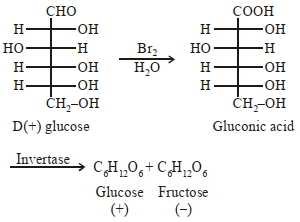
$(1)$ Oxidation of glucose with bromine water gives glutamic acid
$(2)$ The two six-membered cyclic hemiacetal forms of $D-(+)$-glucose ard called anomers
$(3)$ Hydrolysis of sucrose gives dextrorotatory glucose and laevorotatory fructose
$(4)$ Monosaccharides cannot be hydrolysed to give polyhydroxy aldehydes and ketones
IIT 2019, Easy


Download our appand get started for free
Experience the future of education. Simply download our apps or reach out to us for more information. Let's shape the future of learning together!No signup needed.*
Similar Questions
- 1$\alpha$ - helix is found inView Solution
- 2When sugar ' $X$ ' is boiled with dilute $H _{2} SO _{4}$ in alcoholic solution, two isomers ' $A$ ' and ' $B$ ' are formed. $'A'$ on oxidation with $HNO _{3}$ yields saccharic acid where as ' $B$ ' is laevorotatory. The compound ' $X$ ' is ....... .View Solution
- 3The given structure of $\alpha - $ amino acid will exist at which $pH$ ?View Solution
$\,\begin{array}{*{20}{c}}
{\,\,\,\,\,\,\,\,\,\,\,\,\,\,\,\,\,\,\,\,\,\,COOH}\\
{\,\,\,\,\,\,\,\,\,|}\\
{\mathop {N{H_3}}\limits^{\,\, \oplus } - C - H}\\
{\,\,\,\,\,\,\,\,\,\,|}\\
{\,\,\,\,\,\,\,\,\,\,R}
\end{array}\,\,\,$ - 4Assertion : $DNA$ as well as $RNA$ molecules are found in the nucleus of a cell.View Solution
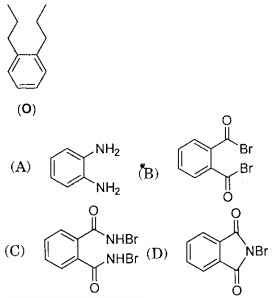
Reason : On heating, the enzymes do not lose their specific activity. - 5Treatment of compound $O$ with $KMnO_4 / \mathrm{H}^{+}$gave $P$, which on heating with ammonia gave $Q$. The compound $Q$ on treatment with $Br_2 / NaOH$ produced $R$. On strong heating, $Q$ gave $S$, which on further treatment with ethyl $2$-bromopropanoate in the presence of $KOH$ followed by acidification, gave a compound $T$.View Solution
(image)
($1$) The compound $R$ is
(image)
($2$) The compound $T$ is
($A$) glycine
($B$) alanine
($C$) valine
($D$) serine
Given the answer question ($1$) and ($2$)
- 6View SolutionThe correct statement in respect of protein haemoglobin is that it
- 7View SolutionA zwitter ion is
- 8View SolutionWhich artificial sweetner contains chlorine?
- 9Match List $- I$ with List $- II.$View Solution
List $- I$
List $- II$
$(a)$ Zymase $(i)$ Stomach $(b)$ Diastase $(ii)$ Yeast $(c)$ Urease $(iii)$ Malt $(d)$ Pepsin $(iv)$ Soyabean Choose the correct answer from the options given below
- 10View SolutionThe standard compound for determination of configuration in the ‘sugar chemistry’ is