MCQ
Coefficient of performance for heat pump is (when heat supplied by system is Q1):
  • A
    $\alpha=\frac{\text{Q}_2}{\text{W}}$
  • B
    $\alpha=\frac{\text{Q}_1}{\text{W}}$
  • C
    $\alpha=\frac{\text{Q}_1}{\text{Q}_2}$
  • D
    $\alpha=\frac{\text{Q}_2}{\text{Q}_1}$

Answer

  1. $\alpha=\frac{\text{Q}_2}{\text{W}}$

Need a full question paper?

Generate a complete, print-ready paper with questions like this in minutes — across 16+ boards, with answer keys.
Start Generating Free

Similar questions

Two wires $A$ and $B $ of same length and of the same material have the respective radii ${r_1}$ and ${r_2}$. Their one end is fixed with a rigid support, and at the other end equal twisting couple is applied. Then the ratio of the angle of twist at the end of $A$ and the angle of twist at the end of $B $ will be
Four identical spheres each of mass $m$ are placed at the corners of square of side $2\,metre$. Taking the point of intersection of the diagonals as the origin, the co-ordinates of the centre of mass are
Mechanical waves on the surface of a liquid are
The dimensions of Stefan constant is :
A beaker is completely filled with water at $4°C$. It will overflow if
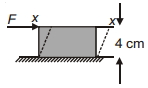
A steel plate of face area $1 \,cm ^2$ and thickness $4 \,cm$ is fixed rigidly at the lower surface. A tangential force $F=10 \,kN$ is applied on the upper surface as shown in the figure. The lateral displacement $x$ of upper surface w.r.t. the lower surface is .............. $m$ (Modulus of rigidity for steel is $8 \times 10^{11} \,N / m ^2$ )
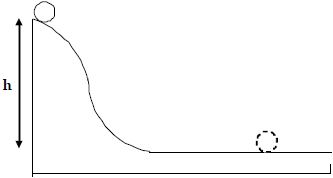
An object of mass $m$ is sliding down a hill of arbitrary shape and after traveling a certain horizontal path stops because of friction. The friction coefficient is different for different segments of the entire path but it is independent of the velocity and direction of motion. The work done that a force must perform to return the object  its initial position along the same path would be :-
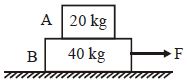
In figure, the coefficient of friction between the floor and the block $B$ is $0.2$ and  between blocks $A$ and $B$ is $0.3$. ........ $N$  is the maximum horizontal force $F$ can be  applied to the block $B$ so that both blocks move together .
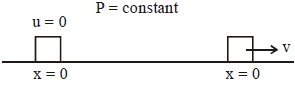
A body of mass $2\, kg$ is driven by an engine delivering a constant power $1\, J / s$. The body starts from rest and moves in a straight line. After $9$ seconds, the body has moved a distance (in $m )$
Match the columns

  Column $-I$
    $R/H_{max}$
  Column $-II$
  Angle of projection $\theta $
   $A.$ $1$    $1.$ ${60^o}$
   $B.$ $4$    $2.$ ${30^o}$
   $C.$ $4\sqrt 3$    $3.$ ${45^o}$
   $D.$ $\frac {4}{\sqrt 3}$    $4.$ $tan^{-1}\,4\,=\,{76^o}$