MCQ
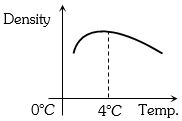
A beaker is completely filled with water at $4°C$. It will overflow if
  • A
    Heated above $4°C$
  • B
    Cooled below $4°C$
  • Both heated and cooled above and below $4°C$ respectively
  • D
    None of the above

Answer

Correct option: C.
Both heated and cooled above and below $4°C$ respectively
c
(c) Water has maximum density at $4°C$, so if the water is heated above $4°C$ or cooled below $4°C$ density decreases i.e. volume increases.

In other words, it expands so it overflows in both the cases.
Need a full question paper?

Generate a complete, print-ready paper with questions like this in minutes — across 16+ boards, with answer keys.
Start Generating Free

Similar questions

Two particles are projected from the same point with the same speed at different angles $\theta _1$ and $\theta _2$ to the horizontal. They have the same range. Their times of flight are $t_1$ and $t_2$ respectively.
A projectile is thrown at an angle $\theta$ with the horizontal and its range is $R_1$. It is then thrown at an angle $\theta$ with vertical and the range is $R_2$, then
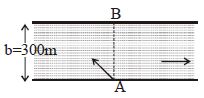
A river is flowing with velocity $5\ km/hr$ as shown in the figure. A boat starts from $A$ and reaches the other bank by covering shortest possible distance . Velocity of boat in still water is $3\ km/ hr$. The distance boat covers is    ......... $m$
The correct statement of the law of equipartition of energy is:
A particle is projected with an angle of projection $\theta$ to the horizontal line passing through the points $( P , Q )$ and $( Q , P )$ referred to horizontal and vertical axes (can be treated as $x$-axis and $y$-axis respectively).

The angle of projection can be given by

$Assertion$ : If a body is thrown upwards, the distance covered by it in the last second of upward motion is about $5\, m$ irrespective of its initial speed
$Reason$ : The distance covered in the last second of upward motion is equal to that covered in the first second of downward motion when the particle is dropped.
A block of metal weighing $2 \,kg$ is resting on a frictionless plane. It is struck by a jet releasing water at a rate of $1\, kg/sec$ and at a speed of $5\, m/sec$. The initial acceleration of the block will be .......... $m/\sec^2$
A particle is in linear simple harmonic motion between two points A and B, 10cm apart Take the direction from A to B as the + ve direction and choose the correct statements:

Given below are two statements : one is labelled as Assertion $(A)$ and the other is labelled as Reason $(R)$,

Assertion $(A)$ :When a fire cracker (rocket) explodes in mid air, its fragments fly in such a way that they continue moving in the same path, which the fire cracker would have followed, had it not exploded

Reason $(R)$:Explosion of cracker (rocket) occurs due to internal forces only and no external force acts for this explosion.

In the light of the above statements, choose the most appropriate answer from the options given below :
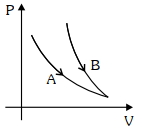
Choose the correct statement for processes $A$  & $B$ shown in figure.