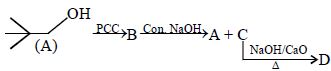
- ✓two optically active isomers: $d$ and $l$ forms
- Bthree optically active isomers: $d, l$ and meso forms
- Cfour optically active isomers: cis, $d$ and $l$ isomers and trans $d$ and $l$ isomers
- Dnone of these
Generate a complete, print-ready paper with questions like this in minutes — across 16+ boards, with answer keys.


$3\underset{\raise0.3em\hbox{$\smash{\scriptscriptstyle-}$}}{B} \xrightarrow{{4\,HCl}}\mathop {2C}\limits_{(Purple)} + Mn{O_2} + 2{H_2}O$
$3\underset{\raise0.3em\hbox{$\smash{\scriptscriptstyle-}$}}{C} \xrightarrow{{{H_2}O,KI}}2\underset{\raise0.3em\hbox{$\smash{\scriptscriptstyle-}$}}{A} + 2KOH + \underset{\raise0.3em\hbox{$\smash{\scriptscriptstyle-}$}}{D} $
In the above sequence of reactions, $\underset{\raise0.3em\hbox{$\smash{\scriptscriptstyle-}$}}{A}$ and $\underset{\raise0.3em\hbox{$\smash{\scriptscriptstyle-}$}}{D} $ , respectively are
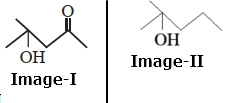
Assertion $A$ : $Image-I$ can be easily reduced using $Zn - Hg / HCl$ to $Image-II$
Reason $R : Zn - Hg / HCl$ is used to reduce carbonyl group to $- CH _2-$ group.
In the light of the above statements, choose the correct answer from the options given below: