MCQ
Cohesive force is experienced between
  • A
    Magnetic substances
  • B
    Molecules of different substances
  • Molecules of same substances
  • D
    None of these

Answer

Correct option: C.
Molecules of same substances
c
(c)The cohesive force is the force of attraction between the molecules of same substance.

Need a full question paper?

Generate a complete, print-ready paper with questions like this in minutes — across 16+ boards, with answer keys.
Start Generating Free

Similar questions

A liquid is flowing in a horizontal uniform capillary tube under a constant pressure difference $P$. The value of pressure for which the rate of flow of the liquid is doubled when the radius and length both are doubled is
A bullet of mass $10 \;g$ leaves a rifle at an initial velocity of $1000 \;m/s$ and strikes the earth at the same level with a velocity of $500\; m / s$. The work done ($Joule$) in joule overcoming the resistance of air will be
A particle is moving on a circular path of radius $r$ with uniform speed $v$. What is the displacement of the particle after it has described an angle of $60^o$ ?
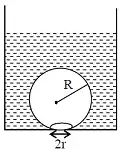
On heating water, bubbles being formed at the bottom of the vessel detach and rise. Take the bubbles to be spheres of radius $R$ and making a circular contact of radius $r$ with the bottom of the vessel. If $r < < R$, and the surface tension of water is $T$, value of $r$ just before bubbles detach is (density of water is $\rho_{w}$)
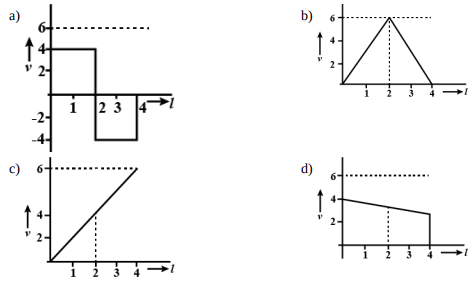
A body has speed $V, 2V$ and $3V$ in first $1/3$ of distance $S$, seconds $1/3$ of $S$ and third $1/3$ of $S$ respectively. Its average speed will be
A planet moving along an elliptical orbit is closest to the sun at a distance $r_1$ and farthest away at a distance of $r_2$. If $v_1$ and $v_2$ are the linear velocities at these points respectively, then the ratio $\frac{v_1}{v_2}$ is
A particle moves so that its position vector is given by $\overrightarrow {\;r} = cos\omega t\,\hat x + sin\omega t\,\hat y$ , where $\omega$ is a constant.  Which of the following is true?  
A particle is projected with velocity $v_{0}$ along $x-$ axis. A damping force is acting on the particle which is proportional to the square of the distance from the origin i.e., $ma =-\alpha x ^{2}.$ The distance at which the particle stops:
$\vec{A}$ is a vector quantity such that $|\vec{A}|=$ nonzero constant. Which of the following expressions is true for $\vec{A}$ $?$