MCQ 11 Mark
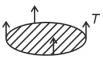
A thin flat circular disc of radius $4.5 \mathrm{~cm}$ is placed gently over the surface of water. If surface tension of water is $0.07 \mathrm{~N} \mathrm{~m}^{-1}$, then the excess force required to take it away from the surface is
- A
$198 \mathrm{~N}$
- B
$1.98 \mathrm{mN}$
- C
$99 \mathrm{~N}$
- ✓
$19.8 \mathrm{mN}$
AnswerCorrect option: D. $19.8 \mathrm{mN}$
d
$\text { Excess force }=T \times 2 \pi R$
$=\frac{7}{100} \times 2 \times 3.14 \times \frac{4.5}{100}$
$=197.82 \times 10^{-4}$
$=19.8 \times 10^{-3} \mathrm{~N}$
$=19.8 \mathrm{mN}$
View full question & answer→MCQ 21 Mark
The amount of energy required to form a soap bubble of radius $2\,cm$ from a soap solution is nearly $..........\,\times 10^{-4}\,J$: (surface tension of soap solution $=0.03\,N\,m ^{-1}$ )
- A
$50.1$
- B
$30.16$
- C
$5.06$
- ✓
$3.01$
AnswerCorrect option: D. $3.01$
d
$E =2 T \left(4 \pi R ^3\right)$
$=2(0.03)(4)(3.14)\left(2 \times 10^{-2}\right)^2$
$=3.01 \times 10^{-4}\,J$
View full question & answer→MCQ 31 Mark
If a soap bubble expands, the pressure inside the bubble:
- A
- B
- C
is equal to the atmospheric pressure
- ✓
Answerd
$P=P_{0}+\frac{4 T}{R}$
$\Rightarrow R$ increases and $P$ decreases
View full question & answer→MCQ 41 Mark
A capillary tube of radius $r$ is immersed in water and water rises in it to a helght $h$. The mass of the water in the capillary is $5\,g.$ Another capillary tube of radlus $2\, r$ is immersed in water. The mass of water that will rise in this tube is $........\;g$
- A
$20.0$
- B
$2.5$
- C
$5.0$
- ✓
$10.0$
AnswerCorrect option: D. $10.0$
d
$h=\frac{2 T \cos \theta}{r \rho g}$
Mass of water in the firsr tube,
$m=\pi r^{2} h \rho=\pi r^{2} \times\left(\frac{2 T \cos \theta}{r \rho g}\right) \times \rho$
$=\frac{2 \pi r T \cos \theta}{g}$
$m \propto r$
$\frac{ m _{2}}{ m _{1}}=\frac{ r _{2}}{ r _{1}}$
$\frac{ m _{2}}{5}=\frac{2 r }{ r }$
$m _{2}=10 g$
View full question & answer→MCQ 51 Mark
A liquid does not wet the solid surface if angle of contact is
AnswerCorrect option: D. greater than $90^{\circ}$
d
If angle of contact is greater than $90^{\circ},$ then liquid will not wet the wall of container.
View full question & answer→MCQ 61 Mark
A soap bubble, having radius of $1\; \mathrm{mm}$, is blown from a detergent solution having a surface tension of $2.5 \times 10^{-2}\; N / m$. The pressure inside the bubble equals at a point $Z_{0}$ below the free surface of water in a container. Taking $g=10\; \mathrm{m} / \mathrm{s}^{2}$ density of water $=10^{3} \;\mathrm{kg} / \mathrm{m}^{3},$ the value of $\mathrm{Z}_{0}$ is......$cm$
Answerc
$P=P_{0}+\rho g Z_{0}\ldots(i)$
Also, $\mathrm{P}=\mathrm{P}_{0}+\frac{4 \mathrm{T}}{\mathrm{R}}\ldots$ (ii)
From $(i) \;and\; (ii)$
$\rho g Z_{0}=\frac{4 \mathrm{T}}{\mathrm{R}}$
$\mathrm{z}_{0}=\frac{4 \mathrm{T}}{\mathrm{pgR}}$
$=\frac{4 \times 2.5 \times 10^{-2}}{10^{3} \times 10 \times 10^{-3}}=10^{-2} \mathrm{m}=1 \;\mathrm{cm}$
View full question & answer→MCQ 71 Mark
A rectangular film of liquid is extended from $(4 \,\,cm \times 2\, cm)$ to $(5\,\, cm \times 4\, cm).$ If the work done is $3 \times 10^{-4}\, J,$ the value of the surface tension of the liquid is ............ $Nm^{-1}$
- A
$0.2$
- B
$8.0$
- C
$0.250$
- ✓
$0.125$
AnswerCorrect option: D. $0.125$
d
$work\,done = Surface\,tension\,of\,film \times $
$Change\,in\,area\,of\,the\,film$
$or,\,\,W = T \times \Delta A$
$Here,{A_1} = 4\,cm \times 2\,cm = 8\,c{m^2}$
${A_2} = 5\,cm \times 4\,cm = 20\,c{m^2}$
$\Delta A = 2\,\left( {{A_2} - {A_1}} \right) = 24\,c{m^2} = 24 \times {10^{ - 4}}{m^2}$
$W = 3 \times {10^{ - 4}}J,T = ?$
$\therefore \,\,T = \frac{W}{{\Delta A}} = \frac{{3 \times {{10}^{ - 4}}}}{{24 \times {{10}^{ - 4}}}} = \frac{1}{8} = 0.125\,N\,{m^{ - 1}}$
View full question & answer→MCQ 81 Mark
Three liquids of densities $\rho _1,\rho _2$ and $\rho _3$ (with $\rho _1 > \rho _2 > \rho_3),$ having the same value of surface tension $T,$ rise to the same height in three identical capillaries. The angles of contact $\theta_1 \,,\theta_2$ and $\theta_3$ obey
- A
$\frac{\pi }{2} < {\theta _1} < {\theta _2} < {\theta _3} < \pi \;$
- B
$\;\pi > {\theta _1} > {\theta _2} > {\theta _3} > \frac{\pi }{2}$
- C
$\;\frac{\pi }{2} > {\theta _1} > {\theta _2} > {\theta _3} > 0$
- ✓
$\;0 \le {\theta _1} < {\theta _2} < {\theta _3} < \frac{\pi }{2}$
AnswerCorrect option: D. $\;0 \le {\theta _1} < {\theta _2} < {\theta _3} < \frac{\pi }{2}$
d
$Capillary\,rise,\,h = \frac{{2T\cos \theta }}{{r\rho g}}$
$For\,given\,value\,of\,T\,and\,r,h \propto \frac{{\cos \theta }}{\rho }$
$Also,{h_1} = {h_2} = {h_3}\,\,or\,\,\frac{{\cos {\theta _1}}}{{{\rho _1}}} = \frac{{\cos {\theta _2}}}{{{\rho _2}}} = \frac{{\cos {\theta _3}}}{{{\rho _3}}}$
$Since\,{\rho _1} > {\rho _2} > {\rho _{3'}}\,so\,\cos {\theta _1} > \cos {\theta _2} > \cos {\theta _3}$
$For\,0 \le \theta < \frac{\pi }{2},{\theta _1} < {\theta _2} < {\theta _3}$
$Hence,\,0 \le {\theta _1} < {\theta _2} < {\theta _3} < \frac{\pi }{2}$
View full question & answer→MCQ 91 Mark
A square frame of side $L$ is dipped in a liquid. On taking out, a membrane is formed. If the surface tension of the liquid is $T$, the force acting on the frame will be
- A
$2\, TL$
- B
$4 \,TL$
- ✓
$8 \,TL$
- D
$10\, TL$
AnswerCorrect option: C. $8 \,TL$
c
(c) Force on each side $ = 2\,TL$ (due to two surfaces)
$\therefore $ Force on the frame = $ 4(2\,TL) = 8\,TL$
View full question & answer→MCQ 101 Mark
Force necessary to pull a circular plate of $5\, cm$ radius from water surface for which surface tension is $75\, dynes/cm,$ is
- A
$30\,dyne$
- B
$60 \,dynes$
- C
$750 \,dynes$
- ✓
$750 \,\pi \,dynes$
AnswerCorrect option: D. $750 \,\pi \,dynes$
d
(d) The total length of the circular plate on which the force will act $ = 2\pi R$
Force to pull $ = 2\pi RT = 2 \times \pi \times 5 \times 75 = 750\pi \, dynes$
View full question & answer→MCQ 111 Mark
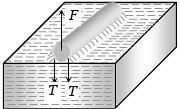
The maximum force, in addition to the weight required to pull a wire of $ 5.0\, cm$ long from the surface of water at temperature $20^\circ C$, is $728 $ dynes. The surface tension of water is
- A
$7.28 \,N/cm$
- B
$7.28 \,dyne/cm$
- ✓
$72.8\, dyne/cm$
- D
$7.28×10^2\, dyne/cm$
AnswerCorrect option: C. $72.8\, dyne/cm$
c
(c) $T = \frac{F}{{2l}} = \frac{{728}}{{2 \times 5}}$
$T = 72.8\;dyne/cm$
View full question & answer→MCQ 121 Mark
A $10\, cm$ long wire is placed horizontally on the surface of water and is gently pulled up with a force of $2 ×10^{-2}\,N$ to keep the wire in equilibrium. The surface tension, in $Nm^{-1}$, of water is
- ✓
$0.1$
- B
$0.2$
- C
$0.001$
- D
$0.002$
Answera
(a) $T = \frac{F}{{2l}} = \frac{{2 \times {{10}^{ - 2}}}}{{2 \times 10 \times {{10}^{ - 2}}}} = 0.1\;N/m$
View full question & answer→MCQ 131 Mark
The force required to separate two glass plates of area ${10^{ - 2}}{m^2}$ with a film of water $0.05\, mm$ thick between them, is ...... $N$ (Surface tension of water is $70 \times {10^{ - 3}}\,N/m$)
Answera
(a) Force required to separate the plates
$F = \frac{{2TA}}{t} = \frac{{2 \times 70 \times {{10}^{ - 3}} \times {{10}^{ - 2}}}}{{0.05 \times {{10}^{ - 3}}}} = 28N$
View full question & answer→MCQ 141 Mark
A wooden stick $2\,m$ long is floating on the surface of water. The surface tension of water $0.07\, N/m$. By putting soap solution on one side of the sticks the surface tension is reduced to $0.06 \,N/m.$ The net force on the stick will be ....... $N$
- A
$0.07$
- B
$0.06$
- C
$0.01$
- ✓
$0.02$
AnswerCorrect option: D. $0.02$
d
(d) Net force on stick $ = {F_1} - {F_2} = ({T_1} - {T_2})l$
$ = (0.07 - 0.06)l = 0.01 \times 2 = 0.02N$
View full question & answer→MCQ 151 Mark
The force required to take away a flat circular plate of radius $2\, cm$ from the surface of water, will be (the surface tension of water is $70\, dyne/cm$)
- ✓
$280\pi \,dyne$
- B
$250\pi \,dyne$
- C
$140\pi \,dyne$
- D
$210\pi \,dyne$
AnswerCorrect option: A. $280\pi \,dyne$
a
(a) Force required, $F = 2\pi rT = 2\pi \times 2 \times 70 = 280\pi Dyne$
View full question & answer→MCQ 161 Mark
A soap film of surface tension $3 \times {10^{ - 2}}\,N{m^{ - 1}}$ formed in rectangular frame, can support a straw. The length of the film is $10\, cm$. Mass of the straw the film can support is ........ $gm$
Answerb
(b) The weight of straw will be balanced by the force of surface tension
$mg = 2Tl$==> $m = \frac{{2Tl}}{g}$
$ = \frac{{2 \times 3 \times {{10}^{ - 2}} \times 10 \times {{10}^{ - 2}}}}{{9.8}}kg = 0.6gm$
View full question & answer→MCQ 171 Mark
A razor-blade floats on the surface of water contained in a glass. When the glass is gently shaken, the razor-blade sinks. Mark the incorrect statement
- A
Volume of displaced water is lesser than blades own volume
- B
When the razor-blade sinks, the height of the water decreases.
- ✓
For a floating body of greater density than water its weight is balanced by the compressive forces of the water below it.
- D
Weight of razor-blade is equal to the weight of the displaced water due to volume occupied by the razor-blade and some additional region affected by surface tension.
AnswerCorrect option: C. For a floating body of greater density than water its weight is balanced by the compressive forces of the water below it.
c
Force is developed due to property of liquid called surface tension.
View full question & answer→MCQ 181 Mark
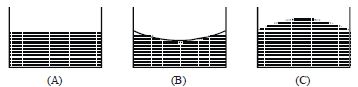
Three surfaces of liquid are shown here. Find the correct statements
- A
the surface tension of liquid $A$ is infinite and such a surface is not possible practically
- B
in case of liquid $B$ , the resultant force on a molecule on the surface would be downward, and the surface is concave
- ✓
in case of liquid $C$ , the resultant force due to surface tension is directed downwards
- D
the surfaces of all three liquids $A, B$ and $C$ are in equilibrium and so the net force due to surface tension is the same
AnswerCorrect option: C. in case of liquid $C$ , the resultant force due to surface tension is directed downwards
View full question & answer→MCQ 191 Mark
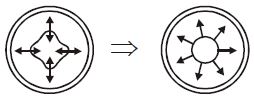
A soap film is formed on a circular frame. A loop of thread is lying on film. If the film inside the loop is broken, then tension in the thread will be : ($R =$ radius of loop, $T =$ surface tension of liquid)
- A
$2\pi RT$
- B
$\pi RT$
- ✓
$RT$
- D
$\pi {R^2}T$
Answerc
$\Rightarrow 2 \mathrm{T}^{\prime} \sin \theta=\mathrm{T} \delta \ell$
$2 \mathrm{T}^{\prime} \theta=\mathrm{T}(2 \theta . \mathrm{R})$
Tension $\left.\mathrm{T}^{\prime}=\mathrm{RT}\right]$
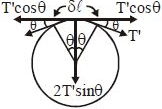
View full question & answer→MCQ 201 Mark
The length of needle floating on the surface of water is $1.5\,cm$. The force in addition to its weight required to lift the needle from water surface will be...... $N$ (surface tension of water $= 7.5\,N/cm$ )
- ✓
$22.5$
- B
$2.25$
- C
$0.25$
- D
$225$
AnswerCorrect option: A. $22.5$
a
Force $= T \times $ Contact length
$F = 7.5 \times 2 \times 1.5$
$F = 22.5\, N$
View full question & answer→MCQ 211 Mark
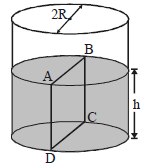
Water is filled up to a height $h$ in a beaker of radius $R$ as shown in the figure. The density of water is $\rho$, the surface tension of water is $T$ and the atmospheric pressure is $P_0$. Consider a vertical section $ABCD$ of the water column through a diameter of the beaker. The force on water on one side of this section by water on the other side of this section has magnitude
- A
$| 2P_0Rh + \pi R^2\rho gh - 2RT |$
- ✓
$| 2P_0Rh + R\rho gh^2 - 2RT |$
- C
$| P_0\pi R^2 + R\rho gh^2 - 2RT |$
- D
$| P_0\pi R^2 + R\rho gh^2 + 2RT |$
AnswerCorrect option: B. $| 2P_0Rh + R\rho gh^2 - 2RT |$
b
$Net\,force = Average\,pressure \times Area - T \times 2R$
$\left( {{P_0} + \rho g\frac{h}{2}} \right)\left( {2Rh} \right) - T2R$
$ \Rightarrow \left| {2\,{P_0}Rh + R\rho g{h^2} - 2RT} \right|$
View full question & answer→MCQ 221 Mark
A $U-$shaped wire is dipped in a soap solution, and removed. The thin soap film formed between the wire and the light slider supports a weight of $1.5 \times 10^{-2}\; N$ (which includes the small weight of the slider). The length of the slider is $30 \;cm .$ What is the surface tension of the film?
- A
$6.32 \times 10^{-3}\; N m ^{-1}$
- B
$5.25 \times 10^{-4}\; N m ^{-1}$
- C
$6.8 \times 10^{-3}\; N m ^{-1}$
- ✓
$2.5 \times 10^{-2}\; N m ^{-1}$
AnswerCorrect option: D. $2.5 \times 10^{-2}\; N m ^{-1}$
d
The weight that the soap film supports, $W=1.5 \times 10^{-2} N$
Length of the slider, $l=30 cm =0.3 m$
A soap film has two free surfaces.
$\therefore$ Total length $=2 l=2 \times 0.3=0.6 m$
Surface tension, $S=\frac{\text { Force o-Weight }}{2 l}$ $=\frac{1.5 \times 10^{-2}}{0.6}$$=2.5 \times 10^{-2} N / m$
Therefore, the surface tension of the film is $2.5 \times 10^{-2}\; N m ^{-1}$
View full question & answer→MCQ 231 Mark
A massless inextensible string in the form of a loop is placed on a horizontal film of soap solution of surface tension $T$. If film is pierced inside the loop and it convert into a circular loop of diameter $d$, then the tension produced in string is ..........
- ✓
$Td$
- B
$\pi T d$
- C
$\pi d^2 T$
- D
$\frac{\pi d^2 T}{4}$
Answera
(a)
By force balancing in vertical direction
$S_F=2 T \sin \theta$
$S_F=2 T \theta$ $\left\{\begin{array}{l}\because \theta \text { is small } \\ \sin \theta=\theta\end{array}\right.$
$S \times 2 r \times 2 \theta=2 \times T \times \theta$
$S \times 2 r=$ Tension
$S \times d=$ Tension $\left\{\begin{array}{l}r \text {-radius } \\ d \text {-diameter }\end{array}\right.$
$\because S=T$
So, Tension $=T d$ $\left\{\begin{array}{l}\text { Where, } \\ S_F=\text { Force due to surface tension } \\ T=\text { Tension in string } \\ \theta=\text { Small angle } \\ S=\text { Surface tension }\end{array}\right.$
View full question & answer→MCQ 241 Mark
Energy needed in breaking a drop of radius $R$ into $n$ drops of radii $ r$ is given by
AnswerCorrect option: A. $4\pi T(n{r^2} - {R^2})$
a
(a) Energy needed = Increment in surface energy
= (surface energy of $n$ small drops) -(surface energy of
one big drop)
$ = n4\pi {r^2}T - 4\pi {R^2}T = 4\pi T(n{r^2} - {R^2})$
View full question & answer→MCQ 251 Mark
A drop of liquid of diameter $2.8\, mm$ breaks up into $125$ identical drops. The change in energy is nearly ........ $erg$ (S.T. of liquid = $75\, dynes/cm$)
Answerd
(d) $E = 4\pi {R^2}T({n^{1/3}} - 1)$
= $4 \times 3.14 \times {(1.4 \times {10^{ - 1}})^2} \times 75({125^{1/3}} - 1)$$ = 74\;erg$
View full question & answer→MCQ 261 Mark
Radius of a soap bubble is $'r'$, surface tension of soap solution is $T$. Then without increasing the temperature, how much energy will be needed to double its radius
- A
$4\pi {r^2}T$
- B
$2\pi {r^2}T$
- C
$12\pi {r^2}T$
- ✓
$24\pi {r^2}T$
AnswerCorrect option: D. $24\pi {r^2}T$
d
(d) $W = 8\pi T(R_2^2 - R_1^2) = 8\pi T[{(2r)^2} - {(r)^2}] = 24\pi {r^2}T$
View full question & answer→MCQ 271 Mark
A spherical liquid drop of radius $R$ is divided into eight equal droplets. If surface tension is $T$, then the work done in this process will be
- A
2$\pi {R^2}T$
- B
3$\pi {R^2}T$
- ✓
4$\pi {R^2}T$
- D
2$\pi R{T^2}$
AnswerCorrect option: C. 4$\pi {R^2}T$
c
(c)$W = 4\pi {R^2}T({r^{1/3}} - 1) = 4\pi {R^2}T({8^{1/3}} - 1) = 4\pi {R^2}T$
View full question & answer→MCQ 281 Mark
The amount of work done in blowing a soap bubble such that its diameter increases from $d$ to $D$ is ($T=$ surface tension of the solution)
- A
$4\pi ({D^2} - {d^2})T$
- B
$8\pi ({D^2} - {d^2})T$
- C
$\pi ({D^2} - {d^2})T$
- ✓
$2\pi ({D^2} - {d^2})T$
AnswerCorrect option: D. $2\pi ({D^2} - {d^2})T$
d
(d)$W = T \times 8\pi (r_2^2 - r_1^2) = T \times 8\pi \left( {\frac{{{D^2}}}{4} - \frac{{{d^2}}}{4}} \right)$
$ = 2\pi ({D^2} - {d^2})T$
View full question & answer→MCQ 291 Mark
If $T$ is the surface tension of soap solution, the amount of work done in blowing a soap bubble from a diameter $D$ to $2D$ is
- A
$2\pi {D^2}T$
- B
$4\pi {D^2}T$
- ✓
$6\pi {D^2}T$
- D
$8\pi {D^2}T$
AnswerCorrect option: C. $6\pi {D^2}T$
c
(c) Work done to increase the diameter of bubble from $d$ to $D$
$W = 2\pi ({D^2} - {d^2})T = 2\pi [{(2D)^2} - {(D)^2}]\;T = 6\pi {D^2}T$
View full question & answer→MCQ 301 Mark
If work $W$ is done in blowing a bubble of radius $R$ from a soap solution, then the work done in blowing a bubble of radius $2R$ from the same solution is
- A
$W/2$
- B
$2W$
- ✓
$4W$
- D
$2\frac{1}{3}W$
Answerc
(c) $W = 8\pi {R^2}T$
$W \propto {R^2}$ ($T$ is constant)
If radius becomes double then work done will become four times.
View full question & answer→MCQ 311 Mark
A spherical drop of oil of radius $1\, cm$ is broken into $1000$ droplets of equal radii. If the surface tension of oil is $50$ dynes/cm, the work done is
- A
$18\pi $ ergs
- B
$180\pi $ ergs
- ✓
$1800\pi $ ergs
- D
$8000\pi $ ergs
AnswerCorrect option: C. $1800\pi $ ergs
c
(c) $W = 4\pi {R^2}T({n^{1/3}} - 1)$$ = 4\pi \times 1 \times 50({10^{3/3}} - 1)$ = $1800\pi \;erg$
View full question & answer→MCQ 321 Mark
The work done in blowing a soap bubble of radius $r$ of the solution of surface tension $T$ will be
- ✓
$8\pi {r^2}T$
- B
$2\pi {r^2}T$
- C
$4\pi {r^2}T$
- D
$\frac{4}{3}\pi {r^2}T$
AnswerCorrect option: A. $8\pi {r^2}T$
a
(a) work done $=T . T . \times$ area of soap bubble
$=T \times\left(4 \pi r^{2}\right) \times 2=8 \pi T r^{2}$
View full question & answer→MCQ 331 Mark
The surface tension of a soap solution is $2 \times {10^{ - 2}}N/m.$ To blow a bubble of radius $1 \,cm,$ the work done is
- A
$4\pi \times {10^{ - 6}}J$
- B
$8\pi \times {10^{ - 6}}J$
- C
$12\pi \times {10^{ - 6}}J$
- ✓
$16\pi \times {10^{ - 6}}J$
AnswerCorrect option: D. $16\pi \times {10^{ - 6}}J$
d
(d)$W = 8\pi {R^2}T = 8 \times \pi \times {({10^{ - 2}})^2} \times 2 \times {10^{ - 2}}$$ = 16\pi \times {10^{ - 6}}J$
View full question & answer→MCQ 341 Mark
A mercury drop of $1\, cm$ radius is broken into ${10^6}$ small drops. The energy used will be (surface tension of mercury is $35 \times {10^{ - 3}}N/cm)$
- ✓
$4.4 \times {10^{ - 3}}\,J$
- B
$2.2 \times {10^{ - 4}}\,J$
- C
$8.8 \times {10^{ - 4}}\,J$
- D
${10^4}\,J$
AnswerCorrect option: A. $4.4 \times {10^{ - 3}}\,J$
a
(a) $E = 4\pi {R^2}T({n^{1/3}} - 1)$
$ = 4 \times 3.14 \times {10^{ - 4}} \times 35 \times {10^{ - 1}}({10^{6/3}} - 1)$ $ = 4.4 \times {10^{ - 3}}\,J$
View full question & answer→MCQ 351 Mark
Surface tension of a soap solution is $1.9 \times {10^{ - 2}}N/m$. Work done in blowing a bubble of $2.0\, cm$ diameter will be
- A
$7.6 \times {10^{ - 6}}\pi $ joule
- ✓
$15.2 \times {10^{ - 6}}\pi $ joule
- C
$1.9 \times {10^{ - 6}}\pi $ joule
- D
$1 \times {10^{ - 4}}$ joule
AnswerCorrect option: B. $15.2 \times {10^{ - 6}}\pi $ joule
b
(b) $W = 8\pi {R^2}T = 8\pi \times {(1 \times {10^{ - 2}})^2} \times 1.9 \times {10^{ - 2}}$=$15.2 \times {10^{ - 6}}\pi\, J$
View full question & answer→MCQ 361 Mark
What is ratio of surface energy of $1$ small drop and $1$ large drop, if $1000$ small drops combined to form $1$ large drop
- A
$100:1$
- B
$1000 : 1$
- C
$10:1$
- ✓
$1 : 100$
AnswerCorrect option: D. $1 : 100$
d
(d) Volume of liquid remain same i.e. volume of $1000$ small drops will be equal to volume of one big drop
$n\frac{4}{3}\pi {r^3} = \frac{4}{3}\pi {R^3}$ $⇒$ $1000{r^3} = {R^3}$ $⇒$ $R = 10r$
$\therefore \frac{r}{R} = \frac{1}{{10}}$
$\frac{{{\rm{surface \,energy \,of \,one\, small\, drop}}}}{{{\rm{surface\, energy \,of\, one \,big\, drop}}}} = \frac{{4\pi {r^2}T}}{{4\pi {R^2}T}} = \frac{1}{{100}}$
View full question & answer→MCQ 371 Mark
A liquid drop of diameter $D$ breaks upto into $27$ small drops of equal size. If the surface tension of the liquid is $\sigma$, then change in surface energy is
- A
$\pi {D^2}\sigma $
- ✓
$2\pi {D^2}\sigma $
- C
$3\pi {D^2}\sigma $
- D
$4\pi {D^2}\sigma $
AnswerCorrect option: B. $2\pi {D^2}\sigma $
b
(b) Work done = $4\pi {R^2}T({n^{1/3}} - 1)$$ = 4\pi {\left( {\frac{D}{2}} \right)^2}\sigma ({n^{1/3}} - 1)$
$ = \pi {D^2}\sigma ({27^{1/3}} - 1)$$ = 2\pi {D^2}\sigma $
View full question & answer→MCQ 381 Mark
One thousand small water drops of equal radii combine to form a big drop. The ratio of final surface energy to the total initial surface energy is
- A
$1000:1$
- B
$1 : 1000$
- C
$10:1$
- ✓
$1:10$
AnswerCorrect option: D. $1:10$
d
(d) As volume remain constant therefore $R = {n^{1/3}}r$
$\frac{{{\rm{surface\, energy\, of\, one \,big \,drop}}}}{{{\rm{surface \,energy \,of \,}}n{\rm{ drop}}}} = \frac{{4\pi {R^2}T}}{{n \times 4\pi {r^2}T}}$
$\frac{{{R^2}}}{{n{r^2}}} = \frac{{{n^{2/3}}{r^2}}}{{n{r^2}}}$ = $\frac{1}{{{n^{1/3}}}} = \frac{1}{{{{(1000)}^{1/3}}}} = \frac{1}{{10}}$
View full question & answer→MCQ 391 Mark
If $\sigma$ be the surface tension, the work done in breaking a big drop of radius R in n drops of equal radius is
- A
$R{n^{2/3}}\sigma $
- B
$({n^{2/3}} - 1)R\sigma $
- C
$({n^{1/3}} - 1)R\sigma $
- ✓
$4\pi {R^2}({n^{1/3}} - 1)\sigma $
AnswerCorrect option: D. $4\pi {R^2}({n^{1/3}} - 1)\sigma $
d
(d) Volume will be conserved
$\frac{4}{3} \pi R^{3}=n \frac{4}{3} \pi r^{3}$
$r=n^{-1 / 3} R$
workdone $=$ $final energy - initial energy$
$=\left[n 4 \pi n^{-2 / 3} R^{2}-4 \pi R^{2}\right] \sigma$
$=4 \pi R^{2}\left(n^{1 / 3}-1\right) \sigma$
View full question & answer→MCQ 401 Mark
A big drop of radius $R$ is formed by $1000 $ small droplets of water, then the radius of small drop is
- A
$R/2$
- B
$R/5$
- C
$R/6$
- ✓
$R/10$
AnswerCorrect option: D. $R/10$
d
(d) $\frac{4}{3}\pi {R^3} = 1000 \times \frac{4}{3}\pi {r^3}$ (As volume remains constant)
${R^3} = 1000{r^3}$ $⇒$ $R = 10r \Rightarrow r = \frac{R}{{10}}$
View full question & answer→MCQ 411 Mark
When ${10^6}$small drops coalesce to make a new larger drop then the drop
Answerc
(c)Because energy is liberated
View full question & answer→MCQ 421 Mark
$8000$ identical water drops are combined to form a big drop. Then the ratio of the final surface energy to the initial surface energy of all the drops together is
- A
$1:10$
- B
$1:15$
- ✓
$1:20$
- D
$1:25$
AnswerCorrect option: C. $1:20$
c
(c) As volume remains constant ${R^3} = 8000{r^3}$
$\therefore R = 20r$
$\frac{{{\rm{Surface \,energy\, of \,one \,big \,drop}}}}{{{\rm{Surface \,energy \,of \,8000 \,small\, drop}}}} = \frac{{4\pi {R^2}T}}{{8000\;4\pi {r^2}T}}$
$ = \frac{{{R^2}}}{{8000{r^2}}} = \frac{{{{\left( {20r} \right)}^2}}}{{8000{r^2}}} = \frac{1}{{20}}$
View full question & answer→MCQ 431 Mark
$8$ mercury drops coalesce to form one mercury drop, the energy changes by a factor of
Answerc
(c) As volume remains constant therefore $R = {n^{1/3}}r$
$\frac{{{\rm{Energy\, of \,big \,drop}}}}{{{\rm{Energy \,of\, small\, drop}}}} = \frac{{4\pi {R^2}T}}{{4\pi {r^2}T}} = \frac{{{R^2}}}{{{r^2}}}$$ = {(8)^{2/3}} = 4$
View full question & answer→MCQ 441 Mark
A film of water is formed between two straight parallel wires of length $10\,cm$ each separated by $0.5\, cm$. If their separation is increased by $1\, mm$ while still maintaining their parallelism, how much work will have to be done (Surface tension of water = $7.2 \times {10^{ - 2}}\,N/m)$
- A
$7.22 \times {10^{ - 6}}\,Joule$
- ✓
$1.44 \times {10^{ - 5}}\,Joule$
- C
$2.88 \times {10^{ - 5}}\,Joule$
- D
$5.76 \times {10^{ - 5}}\,Joule$
AnswerCorrect option: B. $1.44 \times {10^{ - 5}}\,Joule$
b
(b) Increment in area of soap film = ${A_2} - {A_1}$
$ = 2 \times [(10 \times 0.6) - (10 \times 0.5)] \times {10^{ - 4}} = 2 \times {10^{ - 4}}{m^2}$
Work done = $T \times \Delta A$
$ = 7.2 \times {10^{ - 2}} \times 2 \times {10^{ - 4}} = 1.44 \times {10^{ - 5}}J$
View full question & answer→MCQ 451 Mark
A drop of mercury of radius $2\, mm$ is split into $8$ identical droplets. Find the increase in surface energy ....... $\mu J$. (Surface tension of mercury is $0.465\;J/{m^2}$)
- ✓
$23.4$
- B
$18.5$
- C
$26.8$
- D
$16.8$
AnswerCorrect option: A. $23.4$
a
(a) Increase in surface energy or work done in splitting a big drop $ = 4\pi {R^2}T({n^{1/3}} - 1)$
$ \Rightarrow W = 4\pi \times {(2 \times {10^{ - 3}})^2} \times 0.465({8^{1/3}} - 1) = 23.4\;\mu \,J$
View full question & answer→MCQ 461 Mark
If two soap bubbles of equal radii $r$ coalesce then the radius of curvature of interface between two bubbles will be
Answerc
(c) $r = \frac{{{r_1}{r_2}}}{{{r_2} - {r_1}}} = \infty \;\sin ce\;{r_1} = {r_2}$
View full question & answer→MCQ 471 Mark
A liquid is coming out from a vertical tube. The relation between the weight of the drop $W$, surface tension of the liquid $T$ and radius of the tube $r$ is given by, if the angle of contact is zero
AnswerCorrect option: B. $W = 2\pi rT$
b
(b) The weight of liquid drop is equal to surface tension force.
Therefore, $W=S . T=2 \pi r . T$
View full question & answer→MCQ 481 Mark
Energy required to form a soap bubble of diameter $20 \,cm$ will be (Surface tension for soap solution is $30$ dynes/cm)
- A
$12000\, \pi$ ergs
- B
$1200 \,\pi$ ergs
- C
$2400 \,\pi$ ergs
- ✓
$24000\,\pi$ ergs
AnswerCorrect option: D. $24000\,\pi$ ergs
d
(d) $E = 8\pi {r^2}T = 8\pi {(10)^2} \times 30 = 24000\;\pi \;erg$
View full question & answer→MCQ 491 Mark
If the work done in blowing a bubble of volume $V$ is $W$, then the work done in blowing the bubble of volume $2V$ from the same soap solution will be
- A
$W/2$
- B
$\sqrt 2 $$W$
- C
$\sqrt[3]{2}$ $W$
- ✓
$\sqrt[3]{4}$$W$
AnswerCorrect option: D. $\sqrt[3]{4}$$W$
d
(d) Work done to form a soap bubble
$W = 8\pi {R^2}T$(As $V \propto {R^3}$ $\therefore R \propto {V^{1/3}}$)
$\therefore W \propto {V^{2/3}}$
$\frac{{{W_2}}}{{{W_1}}} = {\left( {\frac{{{V_2}}}{{{V_1}}}} \right)^{2/3}} = {(2)^{2/3}}$==> ${W_2} = {(4)^{1/3}}W$
View full question & answer→MCQ 501 Mark
Surface tension of soap solution is $ 2 ×10^{-2} N/m$. The work done in producing a soap bubble of radius $2 \,cm$ is
- ✓
$64\pi \times {10^{ - 6}}J$
- B
$32\pi \times {10^{ - 6}}J$
- C
$16\pi \times {10^{ - 6}}J$
- D
$8\pi \times {10^{ - 6}}J$
AnswerCorrect option: A. $64\pi \times {10^{ - 6}}J$
a
(a) $W = 8\pi {R^2}T$$ = 8 \times \pi \times {(2 \times {10^{ - 2}})^2} \times 2 \times {10^{ - 2}}$$ = 64\pi \times {10^{ - 6}}J$
View full question & answer→