Question
Column I (Phenomena)Column II (Effect)
(1) Eutrophication(a) Soil erosion
(2) Biomagnification(b) Prevention of extinction
(3) Conservation(c) Accumulation of non-biodegradable substance
(4) Deforestation(d) Death of aquatic ecosystem

Answer

Column I (Phenomena)Column II (Effect)
(1) Eutrophication(d) Death of aquatic ecosystem
(2) Biomagnification(c) Accumulation of non-biodegradable substance
(3) Conservation(b) Prevention of extinction
(4) Deforestation(a) Soil erosion

Need a full question paper?

Generate a complete, print-ready paper with questions like this in minutes — across 16+ boards, with answer keys.

Start Generating Free

Similar questions

Distinguish between: Phase of cell division and Phase of cell enlargement
Read the following and answer any four questions from (i) to (v) given below:
The pollen grains or microspores are the male reproductive bodies of a flower and are contained in the pollen sac or microsporangia. Each pollen grain consists of a single microscopic cell, possessing two coats: the exine and the in tine. The exine of a pollen grain is made of chemically stable material. Because of this, pollen grains are often very well preserved for thousands of years in soil and sediments.
  1. One of the most resistant biological material present in the exine of pollen grain is:
  1. Pectocellulose.
  2. Sporopollenin.
  3. Suberin.
  4. Cellulose.
  1. The exine possesses one or more thin places known as:
  1. Raphe.
  2. Germ pores.
  3. Hilum.
  4. Endothecium.
  1. What is the function of germ pore?
  1. Emergence of radicle.
  2. Absorption of water for seed germination.
  3. Initiation of pollen tube.
  4. All of these.
  1. What is the key advantage to the plant for having such strong pollen grain walls?
  1. It protects the vital genetic material in the pollen grain.
  2. It allows pollen to serve as a valuable fossil record for the study of ancient plants.
  3. It prevents the pollen tube from growing out before the pollen grain reaches the stigma of a compatible species.
  4. It gives weight to the pollen grain, allowing it to cling better to the body surfaces of insect pollinators.
  1. The number of germ pores in dicots and monocots respectively are:
  1. One and three.
  2. Three and two.
  3. Two and three.
  4. Three and one.
Read the following and answer any four questions from (i) to (v) given below:
While studying inheritance of characters, a teacher gave the example of inheritance of attached earlobe and hypertrichosis of the ear to her students. A man with attached earlobes and extensive hair on pinna married a woman having free earlobes. The couple had four children, one son with attached earlobes and hairy pinna, one son with a free earlobes and hairy pinna and two daughters with attached earlobes. One of the daughters married a man with free earlobes and sparse hair on pinna. Teacher said if this couple would have sons there would be equal chances for both having free or attached earlobes and sparse hair on pinnae.
  1. Attached and free earlobe are respective example of?
  1. Dominant and recessive traits.
  2. Recessive and recessive traits.
  3. Recessive and dominant traits.
  4. Dominant and dominant traits.
  1. Hypertrichosis of the ear is.
  1. X linked trait
  2. Y linked trait
  3. Autosomal dominant trait
  4. Autosomal recessive trait.
  1. If a female with attached earlobe married a male homozygous for free earlobe sparse hair on pinna then what would be the chances of daughter to have attached earlobe?
  1. 0%
  2. 100%
  3. 25%
  4. 75%
  1. If a man with attached earlobe and hairy pinna married a woman with attached earlobe then what would be the chances of son to have hairy pinna?
  1. 50%
  2. 100%
  3. 75%
  4. 0%
  1. A male with attached earlobe, sparse hair on pinna married a female with attached earlobe. Which of the following is correct regarding their progenies?
  1. All sons have a free earlobe with hairy pinna.
  2. All daughters have an attached earlobe.
  3. 50% daughters have an attached earlobe whereas 50% daughters have a free earlobe.
  4. 50% sons have attached earlobe with hairy pinna and 50% sons have a free earlobe
Distinguish Between: Turner’s syndrome and Klinefelter’s syndrome.
CellsFunctions
(1) T-lymphocytes(a) Phagocytic in function
(2) Neutrophils(b) Responsible for Humoral immunity
(3) Eosinophils/Acidophils(c) Responsible for cell-medicated immunity
(4) B-lymphocytes(d) Anti-allergic [Antihistamine] in function
Read the following and answer any four questions from (i) to (v) given below:
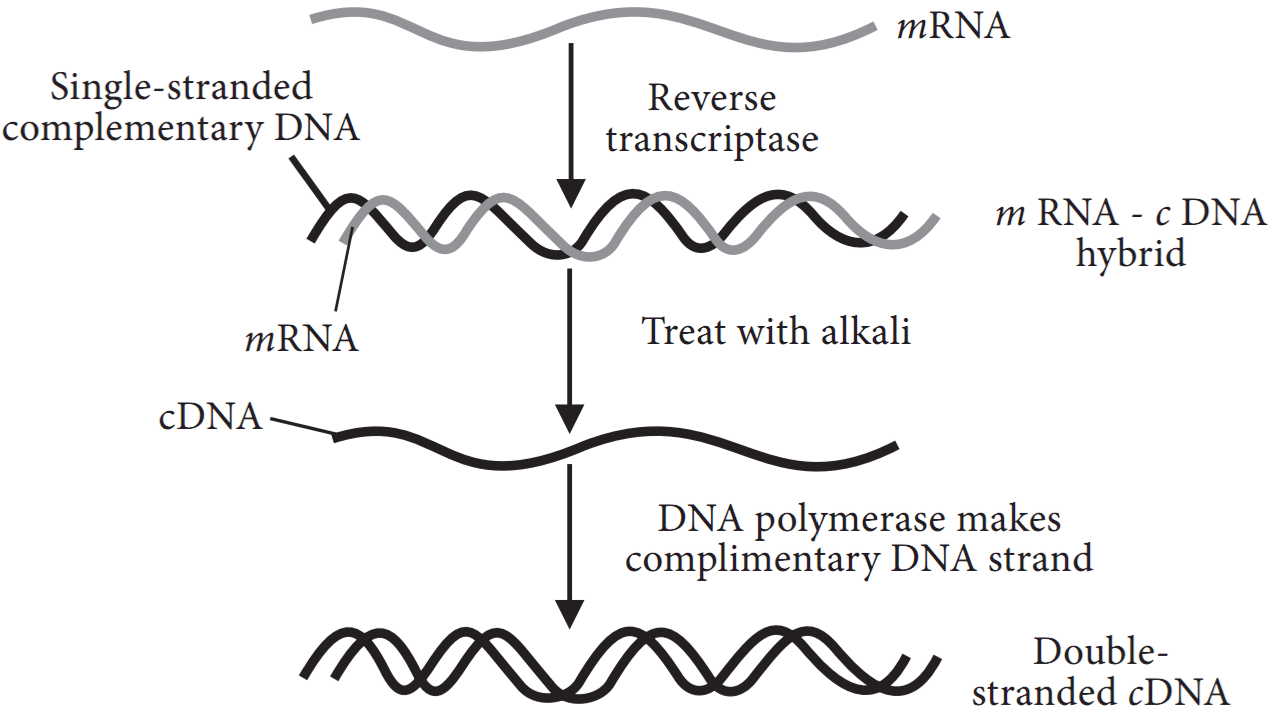
The DNA, which is transferred from one organism into another by joining it with the vehicle DNA is called passenger or foreign DNA. Generally three types of passenger DNAs are used. These are complementary DNA (cDNA), synthetic DNA (sDNA) and random DNA. Complementary DNA (cDNA) is synthesized on RNA template (usually mRNA) with the help of reverse transcriptase. Synthetic DNA (sDNA) is synthesized on DNA template or without a template. Random DNA are small fragments fanned by breaking a chromosome of an organism in the presence of restriction endonucleases.
  1. Reverse transcriptase enzyme was discovered by:
  1. Temin and Baltimore.
  2. Cohen and Boyer.
  3. Arber and Nathan.
  4. Paul Berg.
  1. During cDNA formation, what would happen if DNA formed by reverse transcriptase is not treated with the alkali?
  1. cDNA will not be digested.
  2. mRNA will not be digested.
  3. Hydrogen bonds will not form between base pairs.
  4. rnRNA will not be formed.
  1. Enzyme that helps in the formation of double stranded cDNA is:
  1. DNA synthetase
  2. Ligase
  3. DNA polymerase
  4. Helicase.
  1. DNA polymerase can be obtained form:
  1. Retrovirus.
  2. Agrobacteriurn.
  3. Tobacco mosaic virus.
  4. Thermus aquaticus.
  1. DNA synthesised without a template is referred to as:
  1. Complementary DNA.
  2. Random DNA.
  3. Synthetic DNA.
  4. Z-DNA..
Respiratory organsAlternative name
(1) Larynx(a) Lid of larynx
(2) Trachea(b) Air sacs
(3) Alveoli(c) Sound box
(4) Epiglottis(d) Windpipe
Column IColumn II
(1) Parturition(a) Attachment of embryo to endometrium
(2) Gestation(b) Release of egg from Graafian follicle
(3) Ovulation(c) Delivery of baby from uterus
(4) Implantation(d) Duration between pregnancy and birth
Read the following and answer any four questions from (i) to (v) given below:
ln many species of fig trees, there is a tight one-to-one relationship with the pollinator species of wasp. It means that a given fig species can be pollinated only by its 'partner' wasp species and no other species. The wasp pollinates the fig inflorescence while looking for suitable egg-laying sites. ln return for the favour of pollination, the fig offers the wasp some of its developing seeds as food for the developing wasp larvae.
  1. The interaction between fig trees and wasp is an example of:
  1. Mutualism
  2. Commensalism
  3. Amensalism
  4. Parasitism
  1. AD the given interactions are similar to interaction between fig trees and wasp, except.
  1. Plant and animal relation for pollination.
  2. Association of algae and fungi in lichens.
  3. Association of cattle egret and grazing cattle.
  4. Association of fungi and roots of higher plants in mycorrhiza.
  1. In which of the following interactions both partners are adversely affected?
  1. Parasitism
  2. Mutualism
  3. Competition
  4. Predation
  1. ln relationship between fig and wasp:
  1. One benefitted other harmed.
  2. Both are benefitted.
  3. One benefitted other unaffected.
  4. One inhibited, other unaffected.
  1. Assertion: Fig and wasp cannot complete their life cycle without each other.
Reason: They show mutualistic relationship.
  1. Both assertion and reason are true and reason is the correct explanation of assertion.
  2. Both assertion and reason are true but reason is not the correct explanation of assertion.
  3. Assertion is true but reason is false.
  4. Both assertion and reason are false.
Read the following and answer any four questions from (i) to (v) given below:
Regular change in temperature that occurs at specific intervals of time is called thennoperiodicity. It is of two types-diurnal and seasonal thermoperiodicity. Diumal periodicity refers to temperatures of day and night. It determines periods ofannual activity. In season periodicity different temperature prevails in different seasons of the year. 'Tiley favour different aspects of plant and animal life termed as phenology. For example in wheat, leaf growth requires a temperature of 10º-25ºC. Apple requires temperature below 7ºC for a period of 800 hrs before flowering and fruiting can occur. Low temperature is required for germination of some seeds as well as flowering in some plants. It also determines growth, reproduction, colour and morphology of animals. Both low and high temperature cause stress in organisms which is overcome by particular adaptations.
  1. Some plants require low temperature treatment for flowering. This phenomenon is known as:
  1. Photoperiodism.
  2. Vemalisation.
  3. Thermoperiodism.
  4. None of these.
  1. Animals found in arctic zones are called.
  1. microtherms
  2. Megatherms
  3. Mesotherms
  4. Hekistotherms
  1. Which of the following parts of wheat plant grows maximum in temperature around 10º-25ºC?
  1. Root
  2. Seeds
  3. Leaf
  4. Stem
  1. "Different temperatures prevail in different seasons of the year." It represents:
  1. Diurnal thermoperiodicity.
  2. Seasonal periodicity.
  3. Homeostasis.
  4. Thermoregulation.
  1. Assertion: Low and high temperature causes stress in organisms.
Reasons: Organisms show specific adaptations to overcome stressful condition.
  1. Both assertion and reason are true and reason is the correct explanation of assertion
  2. Both assertion and reason are true but reason is not the correct explanation of assertion.
  3. Assertion is true but reason is false.
  4. Both assertion and reason are false.