Question
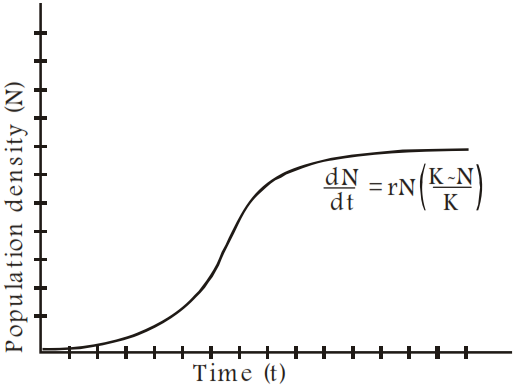
Comment on the growth curve given below.
Answer

A population growing in a habitat with limited resources show initially a lag phase, followed by phases of acceleration and deceleration and finally an asymptote, when the population density reaches the carrying capacity. A’ plot of N in relation to time (t) results in a sigmoid curve. This type of population growth is called Verhulst-Pearl Logistic Growth and is described by the following equation:
$\frac{\text{dN}}{\text{dt}}=\text{rN}\Big(\frac{\text{K}-\text{N}}{\text{K}}\Big)\\\ \ \\\frac{\text{dN}}{\text{dt}}=\text{rN}\Big(1-\frac{\text{N}}{\text{K}}\Big)$
$\Big(1-\frac{\text{N}}{\text{K}}\Big)$ Environmental resistance.

Need a full question paper?

Generate a complete, print-ready paper with questions like this in minutes — across 16+ boards, with answer keys.

Start Generating Free

Similar questions

Explain the process of transcription in a prokaryote.

OR

 Describe the process of transcription in a bacterium.

One chromosome contains one molecule of DNA. In eukaryotes the length of the DNA molecule is enormously large. Explain how such a long molecule fits into the tiny chromosomes seen at metaphase.
Read the following and answer any four questions from (i) to (v) given below:

Transgenic animals can serve as factories that in some cases, may produce large amount of proteins more efficiently. Transgenic mice have been engineered to express human antibodies by introducing large segment of human DNA encoding human immunoglobulin genes. In transgenic large animals such as cow or sheep proteins of pharmaceutical value can be produced in large quantities in milk which is later purified. Transgenesis can be used to alter many phenotypic properties including growth rate, fat composition, milk production, hair texture, etc.

  1. The production of transgenic animals includes
  1. Identification and separation of desired gene.
  2. Combining the desired gene with appropriate vector.
  3. Introduction of vector in cells, tissues or embryos.
  4. All of these.
  1. In transgenic animals, i.e., cow and sheep proteins of pharmaceutical value are produced in large quantities in the
  1. Blood.
  2. Accumulated fat.
  3. Mammary glands.
  4. None of these.
  1. Mouse is mostly preferred animal for studies on gene transfer because.
  1.  Short oestrous cycle.
  2. Long gestation period.
  3. Short generation time.
  4. Production of one or two offspring per pregnancy.
  1. Both (A) and (C)
  2. Both (A) and (B)
  3. Only D
  4. Both (C) and (D).
  1. Transgenic genes alter many phenotypic properties including:
  1. Growth rate.
  2. Fat composition.
  3. Milk production.
  4. All of these.
  1. Assertion: Transgenic mice have been engineered to express human antibodies.

Reason: Large segment of human DNA encoding human immunoglobulin have been transferred to mice.

  1. Both assertion and reason are true and reason is the correct explanation of assertion.
  2. Both assertion and reason are true but reason is not the correct explanation of assertion.
  3. Assertion is true but reason is false.
  4. Both assertion and reason are false.
  1. Explain with the help of Griffith's experiment, how the search for genetic material was conducted and what was the conclusion drawn.
  2. How did Mac Leod, Mc Carty and Avery establish the Biochemical nature of the socalled. "genetic material' identified by Griffith in his experiments?
Which methodology is used while sequencing the total DNA from a cell? Explain it in detail.
It is commonly observed that parents feel embarrassed to discuss freely with their adolescent children about sexuality and reproduction. The result of this parental inhibition is that the children go astray sometimes.
  1. Explain the reasons that you feel are behind such embarrassment amongst some parents to freely discuss such issues with their growing children.
  2. By taking one example of a local plant and animal, how would you help these parents to overcome such inhibitions about reproduction and sexuality?
Write the causes, symptoms and prevention measures of diphtheria.
When and how does placenta develop in human female?
Discuss transgenic animals. Explain any four ways in which such animals can be beneficial for humans.
Draw a diagram of L.S. of an anatropous ovule of an angiosperm and label the following parts
  1. Nucellus
  2. Integuments
  3. Antipodal cells
  4. Secondary nucleus.