Question
Compare and explain three distinguishing features observed in Young’s double slit interference pattern with those seen for a coherently illuminated single slit producing diffraction pattern.

Answer

Interference Diffraction
  1. Equally spaced fringes.
  2. All maxima have equal brightness.
  3. Formed by superposition of wavefronts from two coherent sources.
  4. There is a maxima at the angle $\lambda$/a.
  5. Quite a large number of fringes are easily observable.
  1. Fringes are not equally spaced.
  2. Intensity of maxima keeps on decreasing.
  3. Formed through superposition of wavelets from a single wavefront.
  4. First minima occurs at an angle $\lambda$/a.
  5. It becomes difficult to distinguish maxima and minima after a few fringes.

Need a full question paper?

Generate a complete, print-ready paper with questions like this in minutes — across 16+ boards, with answer keys.
Start Generating Free

Similar questions

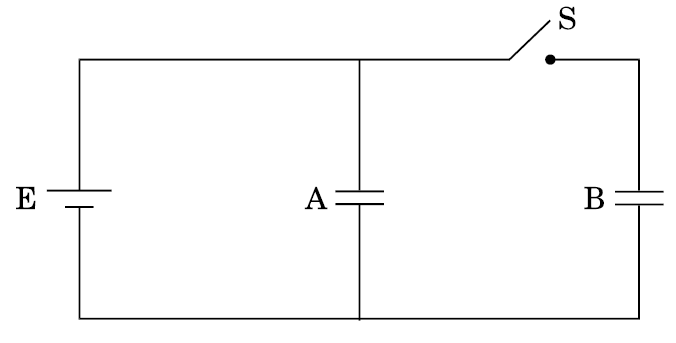
Two identical parallel plate capacitors A and B are connected to a battery of V volts with the switch S closed. The switch is now opened and the free space between the plates of the capacitors is filled with a dielectric of dielectric constant K. Find the ratio of the total electrostatic energy stored in both capacitors before and after the introduction of the dielectric.
  1. Draw a plot showing the variation of photoelectric current with collector potential for different frequencies but same intensity of incident radiation.
  2. Use Einstein’s photoelectric equation to explain the observations from this graph.
  3. What change will you observe if intensity of incident radiation is changed but the frequency remains the same?
Hydrogen atom in its ground state is excited by means of monochromatic radiation of wavelength $975 \stackrel{\circ}{A}$.
$i.$ How many different lines are possible in the resulting spectrum?
$ii.$ Calculate the longest wavelength amongst them. You may assume the ionization energy for hydrogen atom as $13.6 eV .$
Get the electric field due to a uniformly charged infinite plane sheet.
A light ray falling at an angle of 45° with the surface of a clean slab of ice of thickness 1m is refracted into it at an angle of 30°. Calculate the time taken by the light rays, to cross the slab. Speed of light in vacuum $= 3 \times 10^8m/s$
A solenoid of length 1.0m, radius 1cm and total turns 1000 wound on it, carries a current of 5A. Calculate the magnitude of the axial magnetic field inside the solenoid. If an electron was to move with a speed of $104ms^{–1}$ along the axis of this current carrying solenoid, what would be the force experienced by this electron?
An electric bulb, when connected across a power supply of 220V, consumes a power of 60W. If the supply drops to 180V, what will be the power consumed? If the supply is suddenly increased to 240V, what will be the power consumed?
Indium antimonide has a band gap of 0.23eV between the valence and the conduction band. Find the temperature at which kT equals the band gap.
A straight wire carrying an electric current is placed along the axis of a uniformly charged ring. Will there be a magnetic force on the wire if the ring starts rotating about the wire? If yes, in which direction?
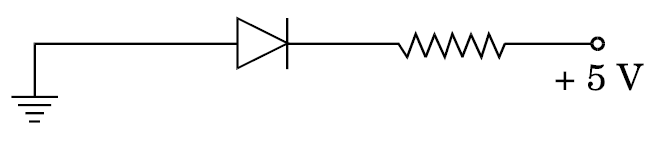
  1. In the following diagram, is the junction diode forward biased or reverse biased?
  1. Draw the circuit diagram of a full wave rectifier and state how it works.