MCQ
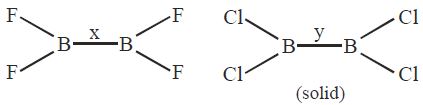
Compare $B—B$ bond length in following molecules :
- A$x > y$
- ✓$y > x$
- C$x = y$
- DNone of these
Fluorine is more electronegative than chlorine. Hence, the electrons of $\mathrm{F}-\mathrm{B}$ bond are more towards $\mathrm{F}$ than the electrons of $\mathrm{Cl}-\mathrm{B}$ bond. Thus, the partial positive charge on $\mathrm{B}$ atom is more in fluoro derivative than in chloro derivative.
Hence, the attraction for the bond pair of electrons of $\mathrm{B}-\mathrm{B}$ bond is greater for the fluoro
compound than for chloro compound.
Hence, $\mathrm{y}>\mathrm{x}$
Generate a complete, print-ready paper with questions like this in minutes — across 16+ boards, with answer keys.
$\begin{array}{|l|l|l|} \hline P_0\,\,(mmHg) & 250 & 300 \\ \hline t_{1/2}\,\,(minutes) & 135 & 112.5 \\ \hline \end{array}$
The order of reaction is -
If $Y$ gives precipitate with $AgNO_3 ,$ then $Z$ does not undergo reaction with
$(i)$ Enzymes lack in nucleophilic groups
$(ii)$ Enzymes are highly specific both in binding chiral substrates and in catalyzing their reactions
$(iii)$ Enzymes catalyse chemical reactions by lowering the activation energy
$(iv)$ Pepsin is a proteolytic enzyme