Question
Compare the properties of ionic compounds and covalent compounds.

Answer

Ionic compounds
  1. Ionic compounds are usually crystalline solids.
  2. Ionic compounds have high melting and boiling points.
  3. Ionic compounds are usually soluble in water.
Covalent compounds
  1. Covalent compounds are usually liquids or gases.
  2. Covalent compounds have low melting and boiling points.
  3. Covalent compounds are usually insoluble in water.

Need a full question paper?

Generate a complete, print-ready paper with questions like this in minutes — across 16+ boards, with answer keys.
Start Generating Free

Similar questions

What do you understand by the term ‘evolution’? State Darwin’s theory of evolution.
Explain with an example what is meant by substitution and addition reaction.
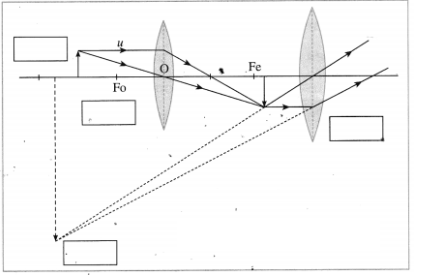
(i) Which type of microscope has the arrangement of lenses shown in the following figure?
Image
(ii) Label the figure correctly.
(iii) Write the working of this microscope.
(iv) Where is this microscope used?
(v) Suggest a way to increase the efficiency of this microscope.
Which projects will you run in relation to environmental conservation? How?
State and explain the various methods for preventing or retarding rancidity of food.
A four carbons atoms containing neutral organic compound $X$ reacts with sodium metal to evolve a gas which burns with 'pop' sound. Another four carbon atoms containing carbon compound reacts with sodium hydrogen carbonate to evolve a gas which turns lime water milky. When compounds $X$ and $Y$ are heated together in the presence of a little of concentrated sulphuric acid, then a new compound $Z$ is formed.
  1. What is compound $X?$ Also write its formula.
  2. What is compound $Y?$ Also write its formula.
  3. What is compound $Z?$ Also write its formula.
  4. What type of smell is given by compound $Z?$
  5. What is the general name of compounds like $Z?$
  6. What is the general name of the reaction which which takes place between $X$ and $Y$ to form $Z?$
Which products produced through biotechnology do you use in your daily life?
An object placed 4cm in front of a converging lens produces a real image 12cm from the lens.
  1. What is the magnification of the image?
  2. What is the focal length of the lens?
  3. Draw a ray diagram to show the formation of image. Mark clearly F and 2F in the diagram.
Observe the disaster cycle given below and explain each aspect of the disaster of earthquake.
The p.d. across a lamp is 12V. How many joules of electrical energy are changed into heat and light when:
  1. A charge of 1C passes through it?
  2. A charge of 5C passes through it?
  3. A current of 2A flows through it for 10s?