Question
Complete the reaction 
(a) 
|
(b) 
|
(c) 
|
(d) 
|
Complete the reaction
|
(a)
|
(b)
|
(c)
|
(d)
|
Generate a complete, print-ready paper with questions like this in minutes — across 16+ boards, with answer keys.
Susceptibility of ferromagnetic substance is
|
(a) > 1 |
(b) < 1 |
(c) 0 |
(d) 1 |
A star is going away from the earth. An observer on the earth will see the wavelength of light coming from the star
|
(a) Decreased |
|
(b) Increased |
|
(c) Neither decreased nor increased |
|
(d) Decreased or increased depending upon the velocity of the star |
The figure illustrate how B, the flux density inside a sample of unmagnetised ferromagnetic material varies with B0, the magnetic flux density in which the sample is kept. For the sample to be suitable for making a permanent magnet
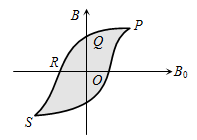
|
(a) OQ should be large, OR should be small |
|
(b) OQ and OR should both be large |
|
(c) OQ should be small and OR should be large |
|
(d) OQ and OR should both be small |
The magnetic field in a coil of 100 turns and 40 square cm area is increased from 1 Tesla to 6 Tesla in 2 second. The magnetic field is perpendicular to the coil. The e.m.f. generated in it is
|
(a) |
(b) 1.2 V |
(c) 1.0 V |
(d) |
When the electrical conductivity of a semi- conductor is due to the breaking of its covalent bonds, then the semiconductor is said to be
|
(a) Donar |
(b) Acceptor |
(c) Intrinsic |
(d) Extrinsic |

