MCQ
In a parallel plate capacitor, the capacity increases if:
  • A
    Area of the plate is decreased.
  • B
    Distance between the plates is increases.
  • C
    Area of the plate is increased.
  • D
    Dielectric constant decreases.

Answer

  1. Area of the plate is increased.

Explanation:

Hint:- Check the dependence of capacitance on certain quantities.

In a parallel plate capacitor, the capacitance is $\text{C}=\frac{\text{k}\in_0\text{A}}{\text{d}};$

Where, k is the dielectric constant, $\in_0$​ is the permittivity constant, A is the area of the conduction and d is the distance between plates.

From here we can see C is directly proportional to k, $\in_0$​,A and inversely proportional to d.

Need a full question paper?

Generate a complete, print-ready paper with questions like this in minutes — across 16+ boards, with answer keys.

Start Generating Free

Similar questions

Which one of the following is a safe place during lightning?
Consider the two idealised systems: (i) a parallel plate capacitor with large plates and small separation and (ii) a long solenoid of length L > > R, radius of cross-section. In (i), E is ideally treated as a constant between plates and zero outside. In (ii), magnetic field is constant inside the solenoid and zero outside. These idealised assumptions, however, contradict fundamental laws as below:

The focal length of the objective lens of a compound microscope is

(a) Equal to the focal length of its eye piece

(b) Less than the focal length of eye piece

(c) Greater than the focal length of eye piece 

(d) Any of the above three 

The magnetic field of Earth can be modelled by that of a point dipole placed at the centre of the Earth. The dipole axis makes an angle of 11.3º with the axis of Earth. At Mumbai, declination is nearly zero. Then:
Liquids and gases never exhibit:
Electric field is a _______?
If all matters were made of electrically neutral particles such as neutrons:
  1. There would be no force of friction.
  2. There would be no tension in the string.
  3. It would not be possible to sit on a chair.
  4. The earth could not move around the sun.
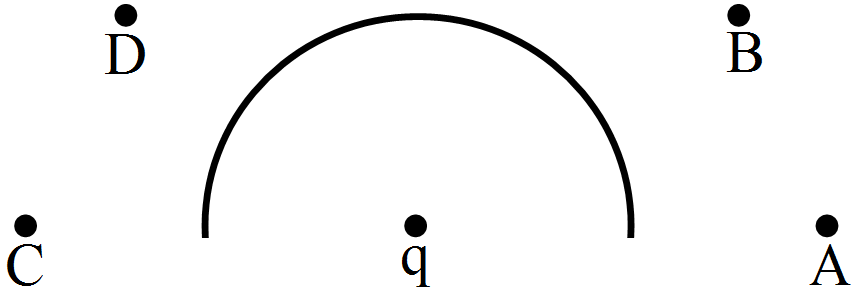
Figure shows a charge q placed at the centre of a hemisphere. A second charge Q is placed at one of the positions A, B, C and D. In which position(s) of this second charge, the flux of the electric field through the hemisphere remains unchanged?

  1. A
  2. B
  3. C
  4. D

There is a solid sphere of radius ‘R’ having uniformly distributed charge. What is the relation between electric field ‘E’ (inside the sphere) and radius of sphere ‘R’ is

(a) E  

(b) E

(c) E     

(d) E

On oscillating any metallic sphere in the magnetic field, its oscillatory motion is :