Question
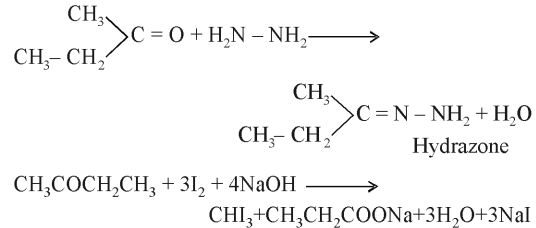
Compound with molecular formula $C _4 H _8 O$ reacts with hydrazine and gives hydrazone. It forms iodoform by the reaction with iodine and NaOH but does not react with Fehling solution. Give the structure of this compound and required equations.

Need a full question paper?

Generate a complete, print-ready paper with questions like this in minutes — across 16+ boards, with answer keys.

Start Generating Free

Similar questions

Discuss structure of the carbonyl group.
An organic compound ‘A’ having molecular formula C3H6 on treatment with aqueous H2SO4 gives ‘B’ which on treatment with HCl/ ZnCl2 gives ‘C’. The compound C on treatment with ethanolic KOH gives back the compound ‘A’. Identify the compounds A, B, C.
Write the structure of the alkene formed by dehydrohalogenation of 1-bromo-1-methylcyclohexane with alcoholic KOH.
Following reaction takes place in one step:
$\text{2NO(g)+O}_2\text{(g)}\rightarrow\text{2NO}_2\text{(g)}$
How will the rate of the above reaction change if the volume of the reaction vessel is reduced to one-third of its original volume? Will there be any change in the order of the reaction with reduced volume?
Explain mechanism of nucleophilic addition reaction of aldehydes and ketones with figure.
The electrical resistance of a column of 0.05 M KOH solution of diameter 1 cm and length 45·5 cm is 4.55 $\times$ 103 ohm. Calculate its molar conductivity.
In a reaction between A and B, the initial rate of reaction (r0) was measured for different initial concentrations of A and B as given below:
A/mol L-1 0.20 0.20 0.40
B/mol L-1 0.30 0.10 0.05
r0/mol L-1 s-1 5.07 × 10-5 5.07 × 10-5 1.43 × 10-4
What is the order of the reaction with respect to A and B?
A first order reaction has a rate constant of 0.0051 min–1. If we begin with 0.10 M concentration of the reactant, what concentration of the reactant will be left after 3 hours?
Write the structures of compounds A, B and C in the following reactions:
  1. $\text{CH}_3-\text{COOH}\xrightarrow{\text{ }\text{ }\text{ }\text{NH}_3/\triangle\text{ }\text{ }\text{ }}\text{A}\xrightarrow{\text{ }\text{ }\text{ }\text{Br}_2/\text{KOH(aq)}\text{ }\text{ }\text{ }}\text{B}\xrightarrow{\text{ }\text{ }\text{ }\text{CHCL}_3+\text{alc.KOH}\text{ }\text{ }\text{ }}\text{C}$
  1. $\text{C}_6\text{H}_5\text{N}_2^+\text{BF}_4^-\xrightarrow[\triangle]{\text{NaNO}_2/\text{Cu}\text{ }\text{ }}\text{A}\xrightarrow{\text{ }\text{ }\text{ }\text{Fe}/\text{HCL}\text{ }\text{ }\text{ }}\text{B}\xrightarrow{\text{ }\text{ }\text{ }\text{CH}_3\text{COCL}/pyridine\text{ }\text{ }\text{ }}\text{C}$