Question
Discuss structure of the carbonyl group.

Answer

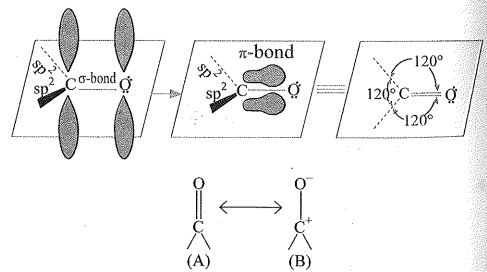
→ The carbonyl carbon atom is sp2-hybridised and forms three sigma (σ) bonds.
→ The fourth valence electron of carbon remains in its p-orbital and forms a π-bond with oxygen by overlap with p-orbital of an oxygen.
→ In addition, the oxygen atom also has two non bonding electron pairs. Thus, the carbonyl carbon and the three atoms attached to it lie in the same plane and the π-electron cloud is above and below this plane.
→ The bond angles are approximately 120° as expected of a trigonal coplanar structure (Fig.).
Image
→ The carbon-oxygen double bond is polarised due to higher electronegativity of oxygen relative to carbon. Hence, the carbonyl carbon is an electrophilic (Lewis acid), and carbonyl oxygen, a nucleophilic (Lewis base) centre. Carbonyl compounds have significant dipole moments and are polar than ethers. The high polarity of the carbonyl group is explained on the basis of resonance involving neutral (A) and a dipolar (B) structures as shown.
Need a full question paper?

Generate a complete, print-ready paper with questions like this in minutes — across 16+ boards, with answer keys.

Start Generating Free

Similar questions

Explain the preparation of ethers with mech- anism by dehydration of alcohols.
An organic compound ‘A’ (C3H4) on hydration in presence of H2SO4/ HgSO4 gives compound ‘B’ (C3H6O). Compound ‘B’ gives white crystalline product (D) with sodium hydrogensulphite. It gives negative Tollens’ test and positive iodoform’s test. On drastic oxidation ‘B’ gives compound ‘C’ (C2H4O2) along with formic acid. Identify compounds ‘A’, ‘B’ and ‘C’ and explain all the reactions.
Derive integrated rate equation for first order reaction containing gaseous components.
State Raoult’s law for a solution containing volatile components. How does Raoult’s law become a special case of Henry’s law?
What is lanthanoid contraction? What are the consequences of lanthanoid contraction?
Explain measurement and calculation of resistance and conductivity of electrolytic solution.
  1. For the complex [Fe(CO)5], write the hybridization, magnetic character and spin of the complex. (At. number : Fe = 26)
  2. Define crystal field splitting energy.
How would you account for the following?
  1. Transition metals exhibit variable oxidation states.
  2. Zr(z=40) and Hf (Z=72) have almost identical redii.
  3. Transition metals and their compounds act as catalyst.
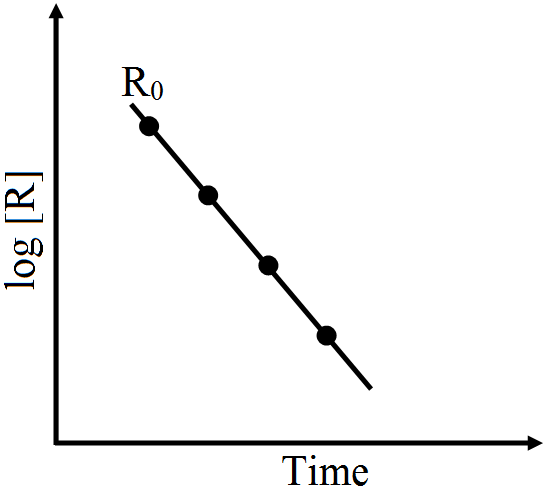
Observe the graph in diagram and answer the following questions.

  1. If slope is equal to -2.0 × 10⁻⁶ sec-1 , what will be the value of rate constant?
  2. How does the half-life of zero order reaction relate to its rate constant?
Explain the following items:
Biocatalysts.