MCQ
Compound$(s)$ that on hydrogenation produce$(s)$ optically inactive compound$(s)$ is (are)
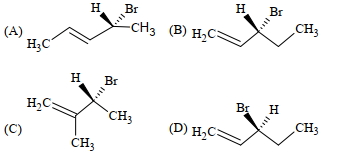
  • A
    $(A,D)$
  • B
    $(A,C)$
  • C
    $(B,C)$
  • $(B,D)$

Answer

Correct option: D.
$(B,D)$
d

Need a full question paper?

Generate a complete, print-ready paper with questions like this in minutes — across 16+ boards, with answer keys.

Start Generating Free

Similar questions

The enthalpy of solution of $BaC{l_2}(s)$ and $BaC{l_2}.2{H_2}O(s)$ are $ - 20.6$ and $8.8\,kJ\,mo{l^{ - 1}}$ respectively. The enthalpy change for the reaction $BaC{l_2}(s) + 2{H_2}O \to $ is......$kJ$
Consider the following four elements which are represented according to long form of periodic table- Here $W, Y$ and $Z$ are left, up and right elements with respect to the element $'X'\,'Y'$ belongs to $16^{th}$ group and $2^{nd}$ period. Then according to given information the incorrect statement regarding given element is
Which one of the following is expected to have largest size
$1\,L,0.02\,M$ solution of $\left[ Co \left( NH _3\right)_5 SO _4\right] Br$ is mixed with $1\,L,0.02\,M$ solution of $\left[ Co \left( NH _3\right)_5 Br _3\right] SO _4$. The resulting solution is divided into two equal parts $(X)$ and treated with excess $AgNO _3$ solution and $BaCl _2$ solution respectively as shown below:$1\,L$ Solution $( X )+ AgNO _3$ solution (excess) $\rightarrow Y$
$1\,L$ Solution $( X )+ BaCl _2$ solution (excess) $\rightarrow Z$
The number of moles of $Y$ and $Z$ respectively are
$\begin{array}{*{20}{c}}
{C{H_3} - CH = C - C = CH - C{H_3}}\\
{|\,\,\,\,\,\,\,\,\,|}\\
{\,Br\,\,\,\,Cl}
\end{array}$

How many geometrical isomers are possible for this compound?
The energy of electromagnetic radiation depends on :
$TNT$ has the structure
The ammonium ion is
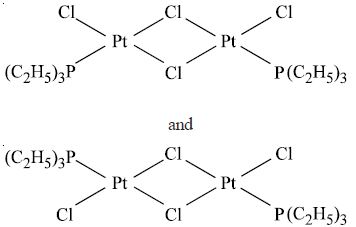
The complexes given below show :