Drift velocity ${v_d}$ varies with the intensity of electric field as per the relation
Easy


Download our appand get started for free
Experience the future of education. Simply download our apps or reach out to us for more information. Let's shape the future of learning together!No signup needed.*
Similar Questions
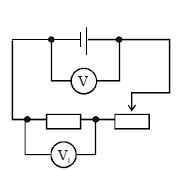
- 1If the rheostat slider were to move from the extreme right to the far left, How will the reading of voltmeter $V_1$ change?View Solution
- 2A wire of $1 \,\Omega$ has a length of $1\, m$. It is stetched till its length increases by $25\, \%$. The percentage change in resistance to the neartest integer is .....$\%$View Solution
- 3A wire of resistance $20 \Omega$ is divided into $10$ equal parts. A combination of two parts are connected in parallel and so on. Now resulting pairs of parallel combination are connected in series. The equivalent resistance of final combination is_______.0$\Omega$.View Solution
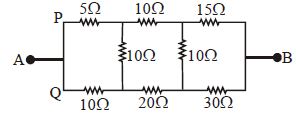
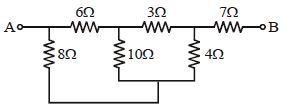
- 4In the arangement of resistances shown below, the effective resistance between points $A$ and $B$ is ............... $\Omega$View Solution
- 5A ($100\, W$, $200\, V$) bulb is connected to a $160\, V$ power supply. The power consumption would be ............. $W$View Solution
- 6Eight copper wire of length $l$ and diameter $d$ are joined in parallel to form a single composite conductor of resistance $R$. If a single copper wire of length $2\,l$ have the same resistance $(R)$ then its diameter will be $.....d$.View Solution
- 7What is the number density of donor atoms which must be added to a pure germanium semiconductor to make $n-$ type semiconductor of conductivity $6.4\ {\Omega ^{ - 1}}\,c{m^{ - 1}}$? The mobility of electr ons in $n-$ type germanium is $4 \times {10^3}\ cm^2\ V^{-1}\ s^{-1}$. Neglect the contribution of holes to conductivityView Solution
- 8The equivalent resistance across $AB$ would be ............ $\Omega$View Solution
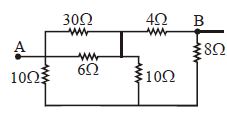
- 9The equivalent resistance between the points $A$ and $B$ is :-View Solution
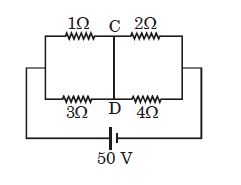
- 10In the given circuit diagram, find the current passing through wire $CD$ (in ampere)View Solution